Goodbye to a decade: Five things that changed the way we live in Beaufort County
At the dawn of this decade, Beaufort County was hurting.
It was hurting financially. The Great Recession inherited from the prior decade was still dominating the Lowcountry landscape as a Great Depression.
Many people lost jobs, careers and businesses. Even the venerable Malphrus Construction Co., which had helped build the Lowcountry for 70 years, didn’t make it.
Now, as we roar into the 2020s, jobs and opportunity are back. And here are five other facts of life in the 2010s that changed our world in Beaufort County.
Hurricane Matthew
It finally happened. Beaufort County was so used to dodging hurricanes in recent decades that people liked to claim we were immune due to the contour of the Atlantic shoreline.
Hurricane Matthew proved that wrong in a single day — Oct. 8, 2016.
It was a glancing blow, really, moving up the coast 5 to 10 miles offshore as a Category 2 hurricane with winds of up to 88 mph on Hilton Head Island. It dumped 14 inches of rain on the county, but it was not the direct hit that the Charleston area experienced with Hurricane Hugo in 1989.
Still, two years later, Hilton Head Island officials said recovery cost the town almost $60 million, with about $35 million coming from the Federal Emergency Management Agency and the South Carolina Emergency Management Division in reimbursements.
It cost about $44 million to collect, chip and haul away 3 million cubic yards of debris. The town used its disaster and other reserves along with a $20 million short-term loan.
Beaufort County Council chairman Stu Rodman wrote recently that the county recovered “$36 million of $38 million from FEMA” following Hurricane Matthew.
It cost $7 million to replenish sand on Hilton Head beaches.
And private property owners and their insurers bore the brunt of millions of dollars in damage to homes, most of it from falling trees. A rough estimate was that Hilton Head lost 120,000 trees.
Many lessons were learned: Officials need to communicate with the public through social media; re-entry after the storm is harder than evacuation; large tracts are needed to deposit debris and accommodate fleets of trucks that descend on the community to haul out the debris; citizens need quick access to thousands of dollars to get home repairs started; service-industry workers can be out of a job for weeks, so social services are needed to help keep food on the table.
The decade saw two more evacuations for storms that did not hit.
It also saw increases in premiums for flood insurance, as well as wind-and-hail insurance.
In short, we learned firsthand that hurricanes are expensive, as well as stressful and dangerous. And, in short, both the Town of Hilton Head Island and Beaufort County governments were well-prepared and did incredible work before, during, and after the storm.
Hurricane Matthew also brought out the best of humanity. Local churches found their mission in cleaning yards and serving food. Volunteers from the Midwest, and local citizens who raised money, cleaned the devastated Gullah Talbird Cemetery on Hilton Head, a task its sponsoring church could never have done alone.
This fading decade can shout clearly into the future: “Yes, Beaufort County, you are indeed vulnerable to great loss from powerful hurricanes. You better have an emergency fund, and be prepared to help those who don’t.”
Guns
Guns rocked Beaufort County like never before in this decade.
On Sept. 1, 2012, little 8-year-old Khalil Singleton was shot and killed while playing in a yard on the north end of Hilton Head.
He was an innocent victim of gunfire between adults.
And three years later, after the third and final defendant was sentenced to 30 years in prison, The Island Packet could report:
“Singleton’s death that Labor Day weekend Saturday sent shockwaves through a stunned community as his family grieved.
“Rallies decrying violence on Hilton Head were organized.
“An ad-hoc activism group was created.
“Town government and law enforcement promised new approaches.
“Changes seemed to be coming.
“But three years after Khalil Singleton’s death on Allen Road, those changes are hard to find.”
In 2015, reasons were also hard to find when a 15-year-old shot and killed a 17-year old at point-blank range with a .40-caliber handgun in one of Hilton Head’s busiest beach parks in the heat of July.

A jury deliberated for less than 10 minutes to find the suspect guilty this year after 14th Circuit Solicitor Duffie Stone presented evidence.
The defendant, later sentenced to 37 years in prison, killed the youth because he felt disrespected by a marijuana theft and a fistfight the day before.
And again, family and friends marched and formed groups to try to keep others from feeling the hurt of gun violence.
Earlier this month, data compiled by the Island Packet and The Beaufort Gazette showed 19 unsolved homicides out of 62 in the county since 2015.
As the decade came to a close, the the Beaufort County Violent Crimes Task Force was created so that the Beaufort County Sheriff’s Office, City of Beaufort, Town of Bluffton and the Town of Port Royal police departments could work together to investigate crimes, including gun violence. The task force also focuses on gang activity and sale of illegal drugs.
It was credited with helping get an arrest in another shocking death two days before Christmas. An 18-year-old died of multiple gunshot wounds. A 16-year-old was charged with murder.
Paving paradise
Despite the decade starting during a recession, the march of concrete that began on the southern end of Hilton Head 60 years ago is at full throttle as the decade ends.
The poster child of the paving of paradise is the Bluffton Parkway flyover on U.S. 278 at the gateway to Hilton Head.
The $45 million project near Buckingham Landing was touted as a key piece to a transportation jigsaw puzzle that seems to have no end. Voters approved a sales tax that is to fund widening the bridges to Hilton Head, and a new, more urban entryway to the island.
This decade saw the widening of U.S. 278 from four to six lanes through Bluffton. It saw the widening of U.S. 17 completed between Beaufort and Charleston.
And it saw commercial and residential construction going full tilt throughout Bluffton and Okatie, with more on the horizon.
In 2017, we learned that a 2,700-acre tract near Interstate 95 in Hardeeville would become Latitude Margaritaville Hilton Head, with about 3,000 homes and a 290,000-square-foot retail center.
Then came the big bombshell.
A 7,300-acre swath of land called East Argent would be developed, turning the area between U.S. 278 and S.C. 170 near Sun City Hilton Head into a metropolis.
The city of Hardeeville announced it could include 9,500 homes and apartments, as well as 1.5 million square feet of retail and office space. If all of the proposed homes are built, the population of the city would balloon from about 5,800 residents to more than 25,000.
Meanwhile, threats to environment — specifically the May and Okatie rivers — continued throughout the decade despite efforts by the town of Bluffton and Beaufort County to control it.
As the decade closes, a study shows that the bacteria levels near the headwaters of the May River were 15 to 16 times greater in 2017 than in 1999.
National park
Beaufort County’s history made a lot of news in this decade.
The highlight was creation in 2019 of the Reconstruction Era National Historical Park headquartered in Beaufort, an upgrade to the National Park Service’s Reconstruction Era National Monument created in 2017.
Beaufort County was deemed by National Park Service officials and historians to be the place most critical in understanding the period during and after the Civil War when newly freed African Americans transformed the social, political and economic landscape.
In 2015, that era filled a full book. It took two historians — Stephen R. Wise and Lawrence S. Rowland, both of Beaufort — 701 pages and 19 years of work to sketch the drama in “Rebellion, Reconstruction, and Redemption, 1861-1893.”
And this year, the history department at USCB, led by Brent Morris, has created what it calls “the first scholarly center devoted entirely to the study of the Reconstruction era.” The Institute for the Study of the Reconstruction Era is a part of America’s reexamination of a pivotal era of American history, which began here.
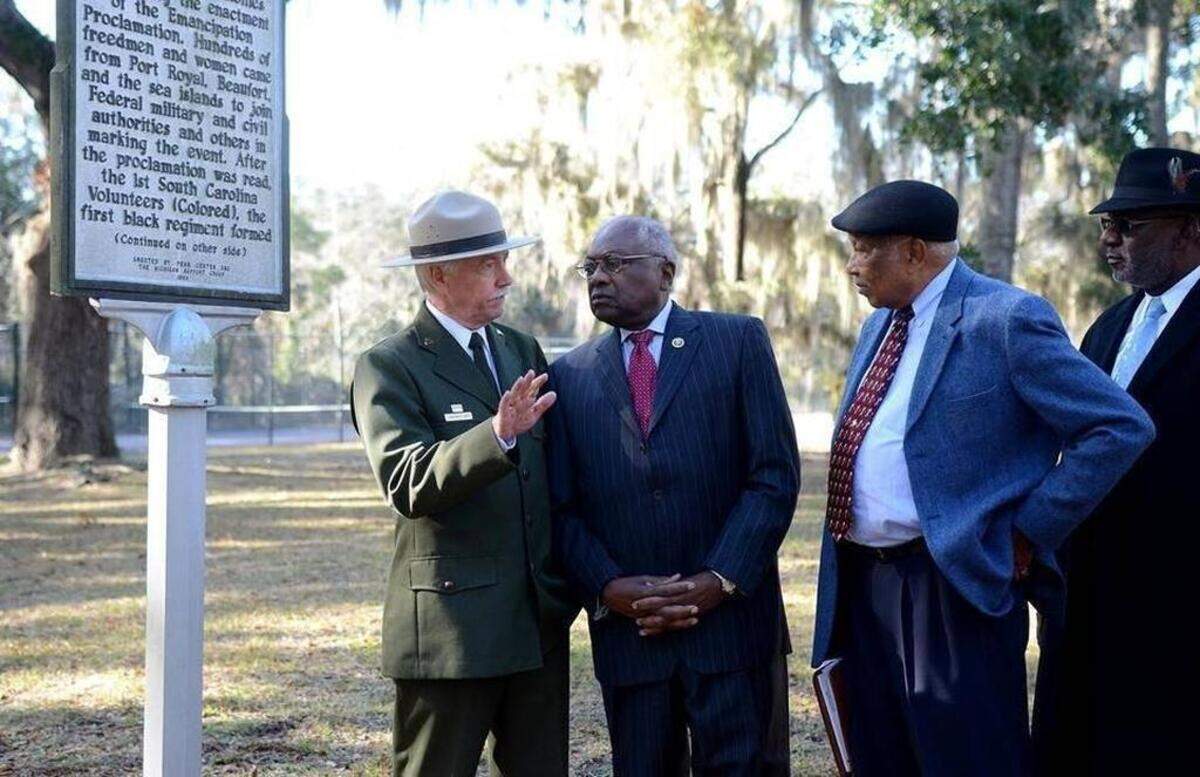
This decade saw local celebrations of the 300th anniversary of the city of Beaufort and the Parish Church of St. Helena. Hilton Head marked the 350/30 milestones in 2013: 350 years since the island was “discovered” by English Capt. William Hilton, and 30 years since the island’s incorporation.
The Santa Elena Foundation opened a museum in the old Beaufort County Courthouse on Bay Street in Beaufort to better tell the story of the Spanish Santa Elena town and fort founded on Parris Island in 1566.
On Hilton Head, the Mitchelville Preservation Project gained traction this decade to tell the story of an early, self-governed community of freedmen.
Among other “historic” achievements on Hilton Head were the inclusion of the Zion Chapel of Ease Cemetery and the Gullah Cherry Hill School on the National Register of Historic Places.
Bicycling
Call it the “decade of the bicycle” in Beaufort County.
The Town of Hilton Head Island was recognized nationally for its commitment to bicycling. The town website says it is “one of the top 25 bicycle-friendly communities in the United States and one of 21 to achieve the Gold Level Bicycle Friendly Community award from the League of American Bicyclists. The town is the only Gold Level community in the Southeast and only one of two on the East Coast to receive this designation.”
And since 2012, the Spanish Moss Trail has taken shape in northern Beaufort County.
Conversion of the old Port Royal Railroad line now offers “a 12-foot wide, paved path dedicated to those who want to walk, run, bike, fish, skate, scoot or stroll ‒ offering spectacular Lowcountry water and marsh views, coastal wildlife viewing, and historic points of interest as it meanders through Spanish moss-draped neighborhoods.”
When completed, it will be a 16 mile-long gift from this decade to the future.
This story was originally published December 31, 2019 at 4:30 AM.