
How Hurricane Matthew changed Hilton Head: 2 years and $51 million later
Two years after Hurricane Matthew battered the Hilton Head coast, residents can still see how the Category 2 storm changed the island— from the landscape to the increasing bills from recovery experts.
Hurricane Matthew brought winds of up to 88 mph and 14 inches of rain to the area on Oct. 8. 2016, according to previous Island Packet reporting. The storm — which officials initially estimated caused $51.6 million in damage in Beaufort County — was called the deadliest Atlantic hurricane since Hurricane Stan in 2005.
But the bill for recovery grew over the years.
This year, the Town of Hilton Head Island announced that it had paid off a $20 million loan used for Matthew recovery. Hilton Head “has spent more than $51 million on hurricane response efforts” and officials expect the total cost will “exceed $57 million.”
Of that spending, $35 million came from the Federal Emergency Management Agency (FEMA) and the South Carolina Emergency Management Division (SCEMD) in reimbursements, the press release said.
Here is a look at recovery efforts from Hurricane Matthew, two years after landfall:
Sand displacement on Hilton Head beaches
The town and FEMA estimate Hilton Head has spent about $7 million repairing island beaches after Matthew, said Scott Liggett, the town’s director of public projects and facilities. He said the storm moved 700,000 cubic yards of sand and destroyed around 33 acres of dunes.
“If we were building a project and moving 700,000 cubic yards of sand, it would take a month,” he said in 2016. “Hurricane Matthew did this in 12 hours.”
On the south end, a 6,000-foot stretch of beach dunes were completely leveled by the storm, Liggett said. The impacts of Hurricane Matthew have since been repaired, although he said Tropical Storm Irma in 2017 made new work for the town.
Homeowners on Piping Plover Road in Sea Pines responded to the storm by constructing a controversial $750,000 seawall, which they told the Island Packet was buried in the sand in September 2018 and will protect their properties from future washouts.
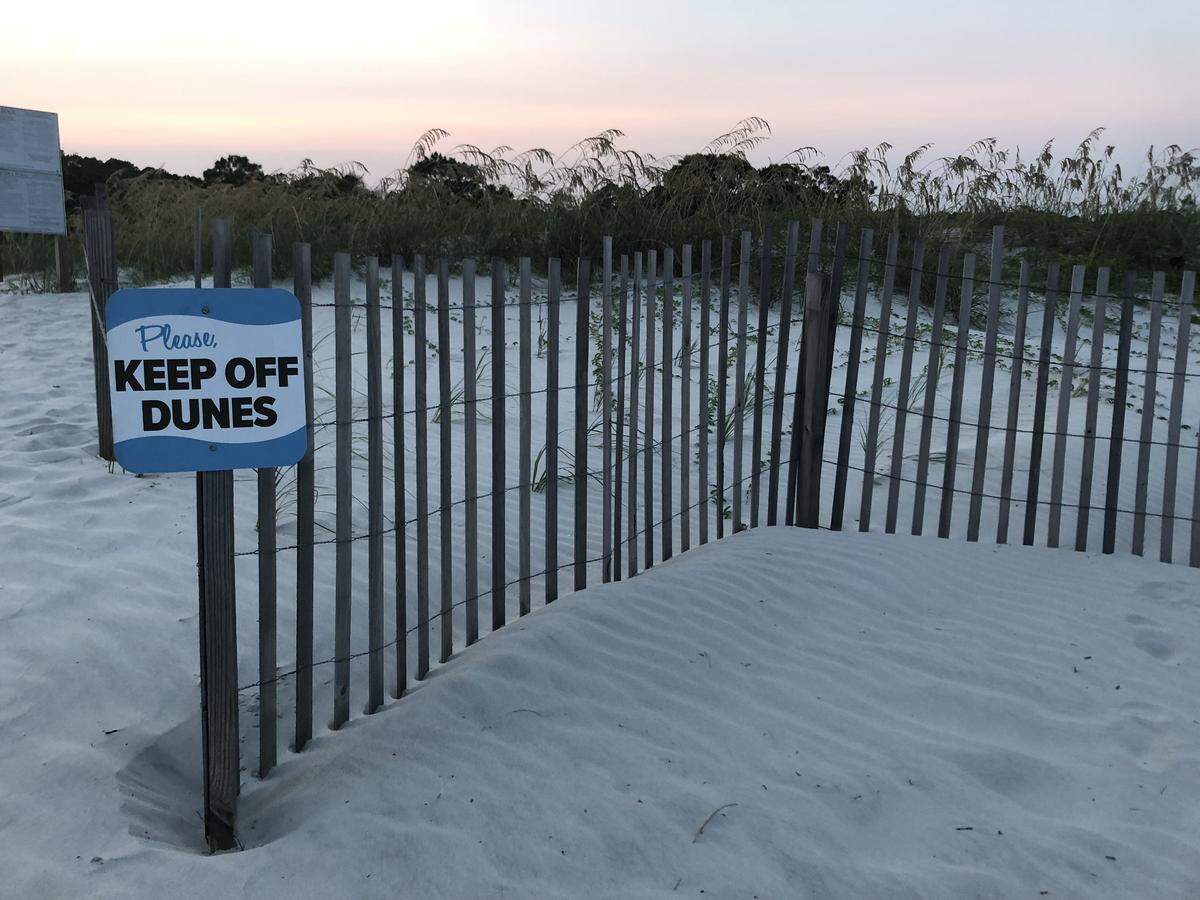
The town renourished the South Beach area around Piping Plover Road as part of an island-wide project, adding around 37,000 feet of fencing to sand dunes after Matthew. Liggett said fencing and vegetation on sand dunes capture the windblown sand and keeps it on the dunes — helping them grow.
The dune vegetation and fencing project after Hurricane Matthew cost the town $300,000, Liggett said.
Mounting debris-removal costs
After Matthew, many leaders said they expected debris removal to be the most expensive part of recovery. On an island that consistently protects trees from removal for developments, trees became a controversial threat for property owners.
Although no one could say the exact number of downed trees, Liggett told the Island Packet that a “reasonable estimate” of about five to 10 trees per acre would mean Hurricane Matthew caused the loss of “at least 120,000 trees” on Hilton Head.
Originally, the town expected debris removal to cost around $35 million, but Liggett said it ended up closer to $44 million. He said the town removed 3 million cubic yards of debris from Hilton Head after Hurricane Matthew.
Tree removal was one of the harder tasks for the town after the storm, and Town Manager Steve Riley said in 2016 that some living trees would have had to be removed in order to get equipment to downed trees. In the months after the storm, he called the debris removal situation “complicated.”
Liggett said he was not aware of any “direct tree replacement” efforts after the storm, and that some trees are still lying where they fell during Hurricane Matthew.
Those may not ever move, though. The town ran out of money in its hurricane recovery reserves which meant there was no further funding for debris removal six months after the storm.
Before the funding ran out, Liggett said the town used 87 trucks to remove downed trees that were a direct threat to safety and stormwater drainage.
Liggett said the debris-removal projects the town could take on were finally finished in August of 2017, almost a year after the storm.
The town sent hurricane debris to the Coastal Discovery Museum at Honey Horn, which it used as a staging area. The museum received $150,000 from the town to cover operating costs after having to cancel months of weddings due to the debris piles.
Communities moving forward
Hilton Head marinas were also devastated by Hurricane Matthew. The Harbour town Marina Pier was wiped off the Sea Pines map after the storm, and Matthew pushed several boats ashore at Palmetto Bay Marina.
Harbour Town opened the brand new pier in February 2018, which was rebuilt to include lighting and a roof after Sea Pines received an emergency permit from the state to replace the pier and repair docks shortly after the storm.
The owners of the Palmetto Bay Marina, the Utah- based Pelorus Group, initially announced plans to rebuild the marina after the hurricane. However, one of the owners died by suicide in 2017 amid several pending legal cases that included foreclosure on the marina, and no plans have been publicized since.
Another iconic Hilton Head location, the Harbour Town Golf Links, was littered with debris after Hurricane Matthew. Sea Pines Resort President Steve Birdwell told the Island Packet in 2016 that the famous course was the last Sea Pines golf course to reopen after the storm, just over one month after it made landfall.
Damaged structures and delayed
The island had to face immense damage to buildings. Preliminary estimates showed that town officials expected about 19 percent of buildings on the island to be damaged by the storm.
Shawn Colin, town deputy director of community development, told the Island Packet in 2016 that 39 homes had damage that equaled 75 percent or more of the value of the property.
In addition to helping residents recover, the town had to reprioritize projects after Hurricane Matthew that are still ongoing.
Notably, the Coligny-area park project and resurfacing of Pope Avenue were put off until August 2018 to account for hurricane cleanup. Liggett said the town rescheduled or interrupted around 10 large-scale projects because of the storm.
“It’s still something we’re dealing with regularly,” Liggett said of getting projects back on track after Hurricane Matthew.
This story was originally published October 8, 2018 at 5:19 PM.