Clock ticking on US 278 Corridor project: Has Beaufort County reached a decision?
READ MORE
Beaufort County Traffic
As Beaufort county’s population has grown in recent years, bringing more vehicles to the roads, the diverse mix of drivers are contributing to the increase in traffic volume at intersections.
Expand All
Beaufort County and the Town of Hilton Head may be one step closer to finalizing a funding plan for the U.S. 278 Corridor project. However, the clock is ticking.
At a joint workshop Wednesday evening, 16 council members from both jurisdictions supported a revised version of the South Carolina Department of Transportation’s option one alternative funding plan — a within-budget design that excludes a multiuse pathway. A decision to vote on the plan could come as early as the next council meetings.
If the county does not present a viable funding plan by March 31, the SCDOT has warned it will terminate its agreements with the county and focus solely on replacing the deteriorating Mackay Creek Bridge. If a plan is reached by the deadline but not approved by the State Infrastructure Bank, the $120 million in funding may be withdrawn, leaving the county and town to regroup. In this case, SCDOT would likely take over the bridge replacement project.
The corridor project has faced years of delays due to rising costs and a failed sales tax referendum, forcing local officials to find alternative funding solutions without raising property taxes. The county aims to stay within its $298.53 million budget, while addressing both current and future traffic flow needs.
What is the revised plan?
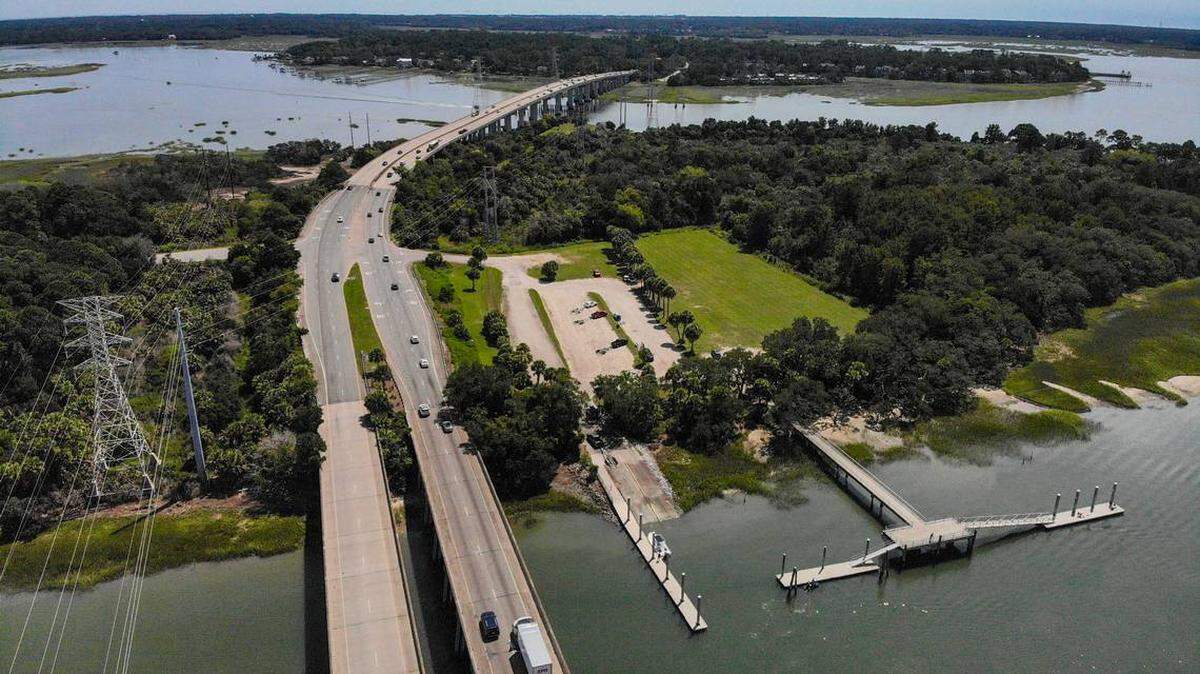
The revised plan involves replacing the eastbound Mackay Creek and Skull Creek bridges, while keeping the two-lane westbound bridges, according to an unfinalized joint resolution presented at the meeting. A new three-lane eastbound lifeline bridge will also be built without a multiuse pathway. The new bridge will then be stripped for two lanes with only the necessary road tie-ins and will be designed for future expansion if the westbound bridge replacements become necessary.
The new bridge will not provide direct access to Pinkney Island; instead, the existing eastbound Skull Creek Bridge will be repurposed for two-way access. The current Mackay Creek Bridge will be removed, and a connector road will be built to provide access to Mariner’s Cove, Blue Heron Point and Hog Island, linking back to U.S. 278 at Windmill Harbor. The Windmill Harbor traffic signal will also be retained and upgraded with mast arms.
Funding breakdown
The total current funding available for the U.S. 278 Corridor project is $298.53 million, sourced from a combination of local and state contributions.
The county has committed $101 million, which includes $80 million from the 2018 sales tax and $21 million from impact fees. The Town of Hilton Head has provided just over $3 million through right-of-way donations, while the State Infrastructure Bank has contributed $120 million. SCDOT has pledged $74.5 million and may add an additional $16 million specifically for the MacKay Bridge.
To date, $13.07 million has been spent on the project for engineering design, environmental impact studies and community meetings.
The revised project costs would use the available funds and would be broken down as follows:
- Revised Project Costs: $257.7 million
- Remaining Engineering Costs: $15 million
- Reserve Funds: $15.83 million
- Local Public Service District Relocation Funds: $6.5 million
- Stoney Community Safety Project: $3.5 million
- Total Costs: $298.53 million
Reserve funds are set aside to cover any potential project overruns, according to the resolution. If these funds remain unused, they will be redirected for local road improvements along the corridor between Moss Creek Road and Spanish Wells Road, as requested by Councilman Alex Brown.
The project will also fund the replacement of a 24-inch waterline within the limits defined by State Act 36. The $6.5 million allocation will help cover the difference between actual relocation costs and the costs covered by the project. Any additional relocation expenses beyond this funding will be the responsibility of the Public Service District.
To address urgent safety concerns in the Stoney community, $3.5 million in local county funds will also be dedicated to a road project, with the Town of Hilton Head overseeing both the design and construction.
Feedback
Council members expressed general support for the revised plan, provided it stays within budget. However, some raised concerns about how the project would impact infrastructure improvements in the Stoney community, the bridge’s width and its alignment with safety needs and the lack of bike and pedestrian paths.
Some residents also expressed concerns about the lack of a bike path and the impact on Windmill Harbor. Charles Perry, chairman of the Windmill Harbor traffic committee, advocated for keeping the traffic light for safety amid discussions of its removal. Stoney community members also urged the council not to overlook their neighborhood, citing ongoing safety struggles.