
Jack Bass, journalist, historian, whose work embodied SC and the South, dies at 91
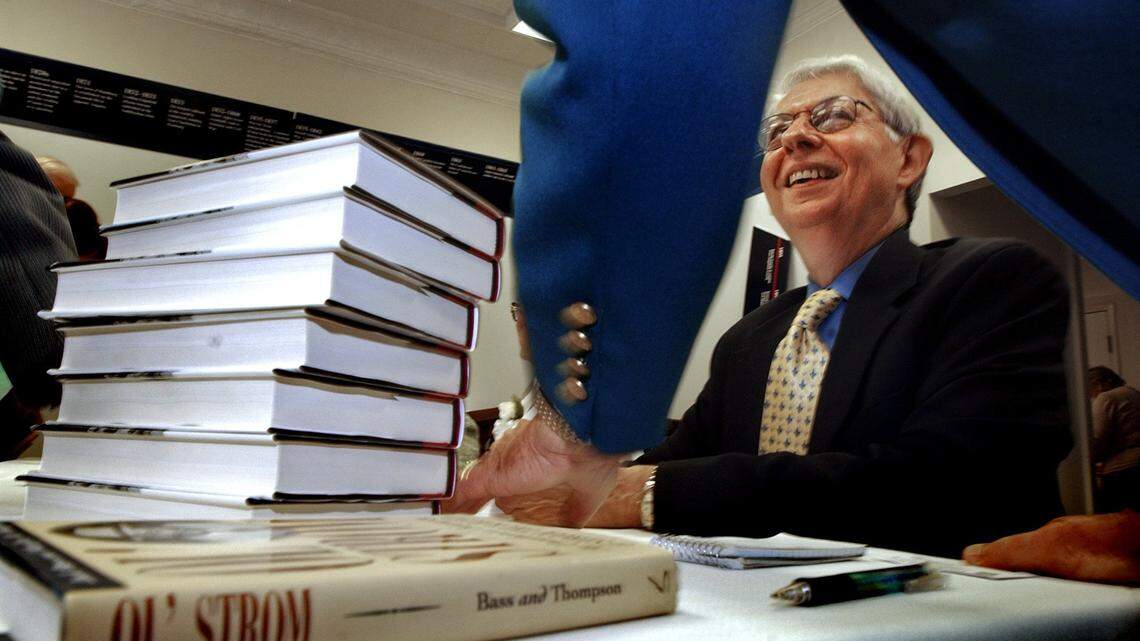
Jack Bass, journalist, historian and professor, whose work chronicled South Carolina’s civil rights era and the state’s transformation from a Democratic Party segregationist enclave to a hard-right Republican bastion, has died. He was 91.
Over six decades, first as a student reporter at the University of South Carolina, then as a journalist for newspapers in Charleston, Columbia and Charlotte, and then as a writer of books and as a professor, Bass covered the state’s politics in the volatile civil rights era of the 1960s and 1970s, when in-depth reporting on racial issues was not encouraged by South Carolina white power elites.
“Jack Bass was a great reporter, great researcher, great interviewer with great insight — few could match his talents, and he made an important contribution to the understanding of our life in South Carolina,” said U.S. Judge Richard Gergel, 71, a South Carolina civil rights historian in his own right who knew Bass all his life.
Bobby Donaldson, who leads the University of South Carolina’s Center for Civil Rights History and Research, said, “Jack Bass’s early journalism and his publications later made my work as a teacher and historian much easier. He was meticulous in his coverage of major news stories, and the articles and stories he produced provide extraordinary first-hand accounts of some of the largely overlooked civil rights moments in our state.
“He was a major eyewitness for the things we now write about,” Donaldson said.
Bass’s son, Ken Bass, wrote on Facebook that his father, whom he called “a social justice warrior,” died peacefully in Raleigh.
“Dad grew up the youngest of seven children in the only Jewish family in the small cotton farming town of North, South Carolina. The family ran a mercantile store in town,” Ken Bass wrote.
Major civil rights events that Bass wrote about include sit-ins around the state, the integration by a Black student of Clemson University (1963) and of the University of South Carolina (1964) and what is known as the Orangeburg Massacre, a violent event in 1968 at S.C. State University, when armed state troopers fired on unarmed Black students protesting a whites-only bowling alley, killing three students and wounding 28 others, Donaldson said.
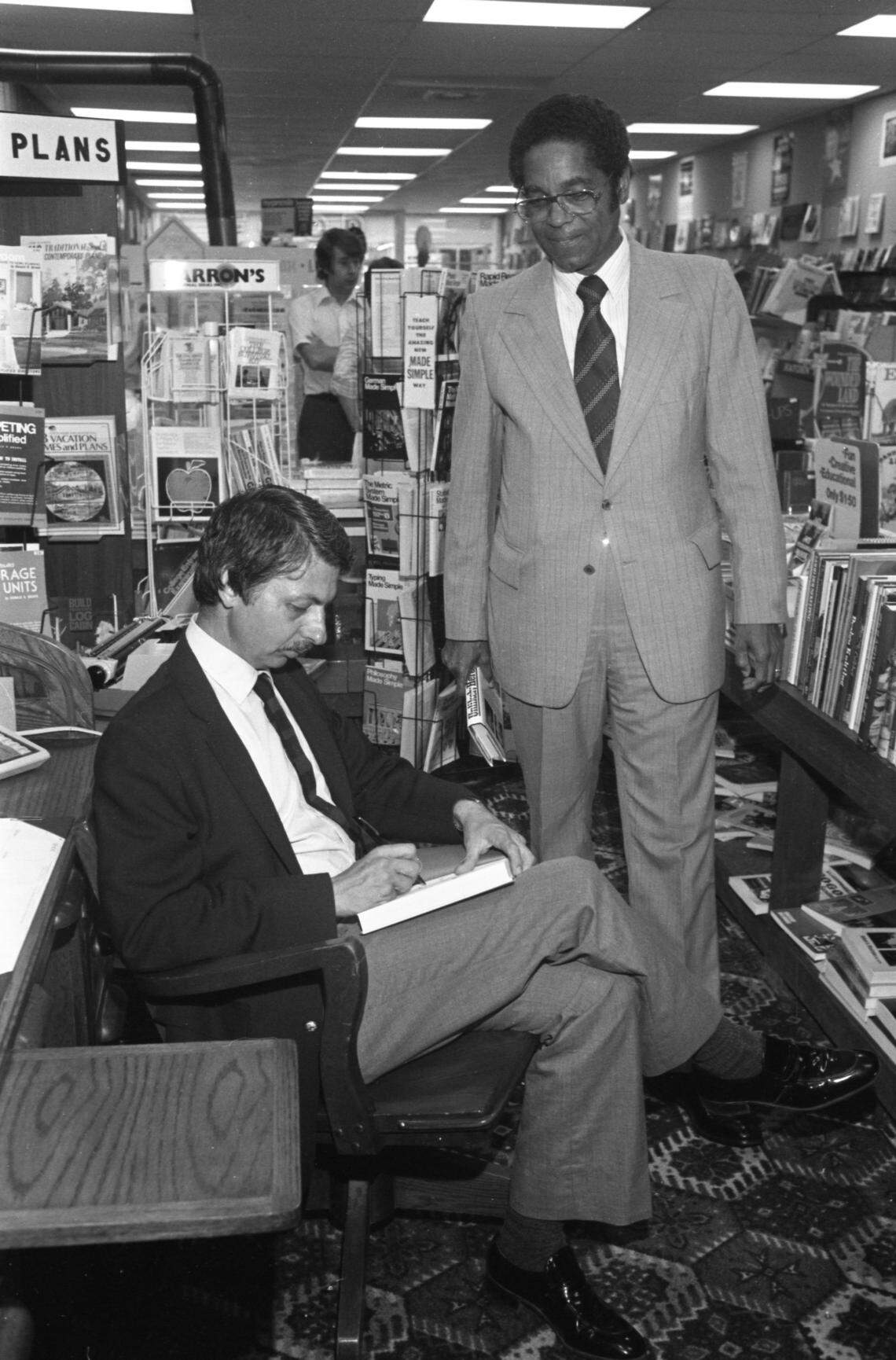
In a book of essays about the great African American South Carolina civil rights lawyer and later federal judge Matthew Perry, Bass wrote about what he liked about being a reporter in the civil rights era.
“The great thing about a reporter’s job is the capacity to call almost anyone, ask questions and print the answers. To me there were many questions,” Bass wrote.
In the 1960s, Bass wrote, he found he could call powerful white elected officials resisting school integration and also civil rights fighters like Perry and get “honest measured responses to the same questions. Few other reporters in the state at that time seemed interested in asking those questions, but the answers informed the public of the changes taking place,” Bass wrote in his book of essays about Perry: “Matthew Perry: the Man, his Times and his Legacy. “
The student protest shooting in Orangeburg led to Bass’s first book, “The Orangeburg Massacre, “which he co-wrote with the late Los Angeles Times investigative reporter Jack Nelson. It was published in 1970 and became the definitive account of one of South Carolina’s most brutal racial tragedies. Bass and Nelson called the event “an American bloodbath.”
Bass’s life
Bass was editor of the Gamecock newspaper at the University of South Carolina, where he graduated with a degree in journalism in the late 1950s. After college, he spent three and a half years in the U.S. Navy, where he was a naval flight officer who flew on Navy anti-submarine planes, according to Ken Bass and the South Carolina Encyclopedia.
After the Navy, he began a series of jobs in journalism, first with the Charleston News & Courier (now the Post & Courier), where he switched from writing about sports to writing about politics. In 1961, he moved to Columbia, covering politics for first the Columbia Record and then The State, where he joined the paper’s governmental affairs staff.
“While in that position, Bass became interested in the changing politics of the South in connection with the civil rights movement,” according to the South Carolina Encyclopedia.
In 1965, Bass won a prestigious one-year Nieman Fellowship at Harvard, where he studied constitutional issues at the college’s School of Government.
On returning to South Carolina in 1966, Bass worked until 1973 with The Charlotte Observer as Columbia bureau chief, a position he held for seven years at the height of the civil rights era. It was also a period of immense unrest across America, a time marked by the assassinations of Martin Luther King Jr. and Bobby Kennedy, Black protests and riots and student upheaval over the war in Vietnam.
Bass had left The State to go to the Charlotte Observer because the conservative State newspaper downplayed racial and civil rights stories, while The Observer treated them as the major news events that they were and gave him freedom to report on them, Bass told others.
In those pre-internet days, The Observer had a large circulation in South Carolina. And as that paper’s Palmetto State bureau chief, based in the state capital in the center of the state, Bass’s job was a perfect match for his interests.
More books, professor’s posts
Over the next 50 years, Bass was to leave daily journalism and wrote books and articles in major news publications such as The New York Times and The Washington Post. He also worked as a professor, passing on his knowledge to hundreds of students over the years and winding up at the College of Charleston. He was someone who national journalists called when they wanted to learn about South Carolina politics.
More than just an observer, Bass managed to insert himself as a player in South Carolina political life, working first in 1974 with U.S. Rep. Brian Dorn, D-S.C., during Dorn’s failed bid to become governor. In 1978, Bass ran unsuccessfully for Congress as a Democrat against the late popular Floyd Spence of Lexington County, according to a biography in the digital edition of the South Carolina Encyclopedia.
Books that Bass wrote included “Porgy Comes Home” in 1972 (a history of South Carolina from its settlement to the civil rights era), “The Transformation of Southern Politics” in 1976 (with Walter DeVries, a state-by-state analysis of 11 southern states and their political and social changes), and in 1981, “Unlikely Heroes” (a look at judges on the Fifth U.S. Circuit Court of Appeals and their impact on the upholding of federal civil rights laws). In all, Bass wrote 10 books.
Bass’s ventures in academia began while he was still a journalist, starting with a stint as a part-time lecturer in journalism at the University of South Carolina from 1967 to 1971, followed by a position at Duke University as a visiting research scholar. From 1975 to 1978, Bass served as writer-in-residence at S.C. State University.
In 1987, Bass accepted a position as a journalism professor at the University of Mississippi, where he worked for 12 years.
In 2000, he began teaching at the College of Charleston where he became professor of humanities and social science, working until he retired and then moved to Raleigh.
Bass’s most popular work was yet to come.
Strom Thurmond’s Black child
In 1998, Bass and Marilyn Thompson, a reporter who had started her career in South Carolina, teamed up to write “Ol’ Strom: An Unauthorized Biography of Strom Thurmond,” the state’s longest serving U.S. senator, a staunch segregationist who had moderated to some extent his racist views over the years.
Bass had based a doctorate he received from Emory University on Thurmond’s life. Thompson, a Pulitzer Prize winning journalist, had been working on her own book about Thurmond.
After Thurmond’s death in 2003, Thompson — who was working for The Washington Post at the time — finally was able to prove that Thurmond as a young man had fathered a mixed-race daughter with a Black teenager who worked in his family’s Edgefield County house. Thompson’s exclusive news story, written after Essie Mae Washington-Williams contacted the reporter, revealed how Thurmond had secretly supported her over the years and paid for her college education. It was a sensation.
With the new information about Thurmond’s daughter, Bass and Thompson were able to publish a second book on Thurmond. It was titled “Strom: the Complicated Personal and Political Lfe of Strom Thurmond” and published in 2005. Thompson is now a reporter for the Charleston Post and Courier.
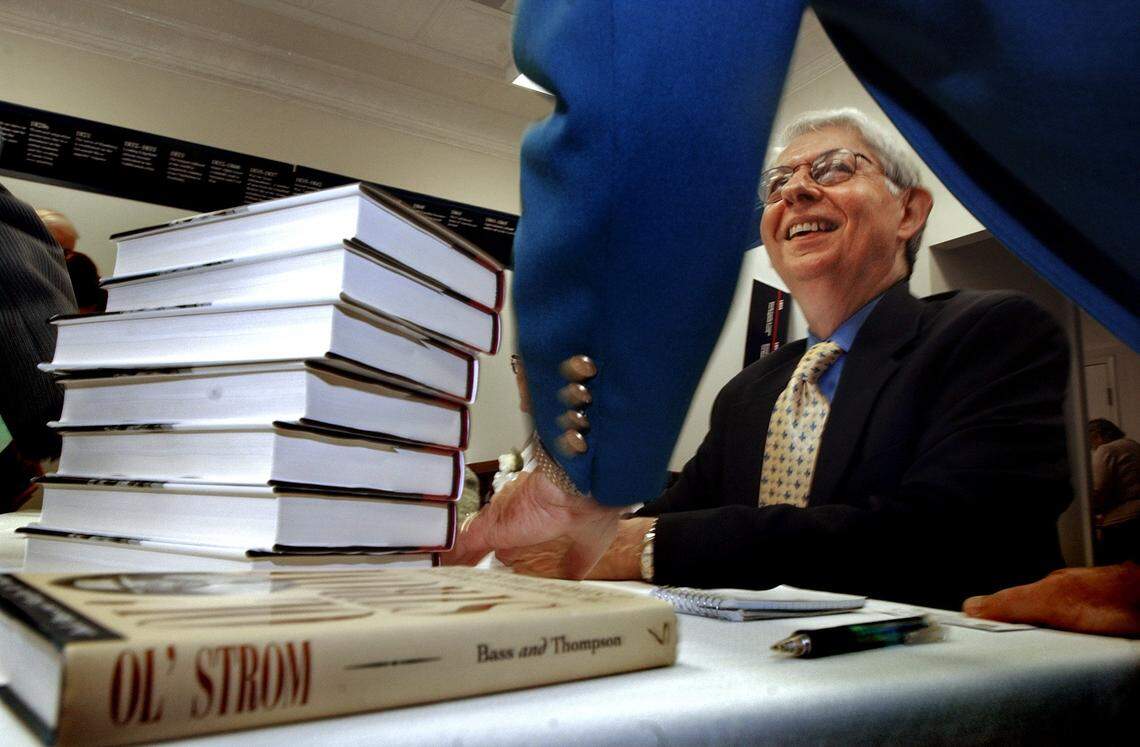
Thompson, who now is a reporter for the Post & Courier, wrote in an email Friday: “Jack was a serious student of and player in South Carolina politics. He had run for Congress himself, so he knew from first-hand experience how the system worked. Governors and members of the delegation respected him and sought his input.
“As a journalist, for many years he was the authoritative voice on Southern politics. His work was regularly published in The Washington Post, and I know many of my colleagues there held him in the highest esteem.
“We collaborated on two versions of a Thurmond biography. The first book, Ol’ Strom, was published by a regional publisher before Essie Mae Williams came forward with her story in 2003.
“After that, Ms. Williams offered enough details of her life to allow us to go back into the Thurmond archives at Clemson and flesh out the story... We were really flattered to learn from friends at the New York Times that Bill Clinton kept it in his library in New York and told visitors it was his favorite political biography.
“Jack and I did not see eye to eye on Thurmond’s conduct. I viewed this secret relationship as the ultimate hypocrisy, given his segregationist stance. Jack was more forgiving. He thought such relationships were more common in the South than we might imagine.”
Bass’s legacy
Over the years, Bass — who had spent much of his life writing about institutions — become something of an institution himself.
He wrote four articles in historian Walter Edgar’s massive print edition of South Carolina Encyclopedia, the longest one being on the Orangeburg Massacre. Another article Bass wrote was on Harry Dent, a major influence in longtime Democrat Thurmond’s switch to the Republican Party in 1964 and how Dent helped shape the Republican “Southern Strategy,” a racist appeal to segregationist leanings of Southern whites, Bass wrote.
Two other articles for the Encyclopedia Bass wrote were on influential Jewish South Carolinians: the late state Rep. Harriet Keyserling, D-Beaufort, and Francis Salvador, the first person of Jewish faith elected to the state Legislature, in 1774. He died in 1776 after being ambushed and scalped by a party of Loyalists and Indians, Bass wrote.
In 1973, a young journalist at The Sun News in Myrtle Beach who had no formal training in newsgathering telephoned Bass, whom he didn’t know, and asked Bass how to write profiles, which are news stories about individual people.
Bass patiently explained that he used the GOSS method, each letter standing for what questions to ask. G stands for “goals,” O is for what “obstacles” did you overcome, S is for “how did you get your start” and the second S is for “solutions” the subject came up with.
I was that young journalist, and I remain amazed that the busy Bass had the kindness and patience to take a call from a stranger seeking help and explain such basics.
Bass was known for pausing in conversations, thinking about what he was going to say, before expressing himself.
Longtime Columbia television journalist now-retired Jack Kuenzie published on Bluesky a succinct but apt tribute Friday: “They don’t make them like Jack Bass anymore.”
This story was originally published April 25, 2026 at 5:30 AM with the headline "Jack Bass, journalist, historian, whose work embodied SC and the South, dies at 91."