SC board halts book bans, questions fairness as Beaufort County resident leads push
READ MORE
South Carolina Book Bans
The state now has 22 books banned from all public school classrooms and libraries, becoming the nation’s leader in book bans.
Expand All
In what almost became another addition to the state of South Carolina’s growing list of banned books, a last-minute motion on Tuesday afternoon halted a decision that could have removed ten more titles from school shelves.
Instead, members of the state department of education board meeting tabled the discussion, opting to clarify the process before moving forward. It remains unclear when the full 15-member board will vote again on the books.
Had the bans been approved, the total number of books removed from public schools statewide would have risen to 21 — or 22, counting “Crank,” which has been restricted to high school libraries. That would make South Carolina the national leader in book bans, according to PEN America, a nonprofit organization advocating for freedom of expression.
At least 14 of the books challenged originated from Beaufort County resident Elizabeth “Ivie” Szalai, who previously sought to remove 97 books at the district level. In past meetings, she has argued that while these books explore important themes, they contain explicit sexual descriptions inappropriate for K-12 students.
Under Regulation 43-170, books can be banned in South Carolina public schools if they contain descriptions or visual depictions of sexual conduct. With local school officials declining to act on Szalai’s challenges within the required 90-day period, the decision now rests with the state.
But unlike previous meetings where book removals were approved without much debate, concerns arose Tuesday over the fairness of the process itself.
“I’ve heard from several of our board members, and they have noted how this is not quite playing out like they thought it would,” said Reverend Tony Vincent, a newcomer to the board. “Some are concerned, as am I and some of you that have spoken today, how relatively few voices seem to be making an awfully huge impact on our state.”
A Charged Debate
The timing of the debate was not lost on those in attendance. As several speakers pointed out, April is both School Library Month and Sexual Assault Awareness Month — making the fight over banned books particularly charged.
One speaker noted the irony of removing books that discuss sexual violence, arguing that these stories are not explicit for the sake of being graphic but serve as cautionary tales for young readers.
Mary Foster, a member of Families Against Book Bans — a local group formed in response to the 97-book challenge — said it was refreshing to see board members actively discussing and examining the proposed regulation rather than passively accepting it.
“It was pretty amazing to be there,” she said. “I kept thinking, ‘Wait, are they saying what I think they’re saying?’”
Szalai, who was not present at the meeting, did not respond to requests for comment. When the ten books first advanced past the Instructional Materials Review Committee, she wrote in a text message that she encourages “anyone who opposes what I am doing to watch Megan’s Story: Lost in the Pages to see how this kind of material can be dangerous for teens.”
A link to the video can be found here.
Books being reviewed
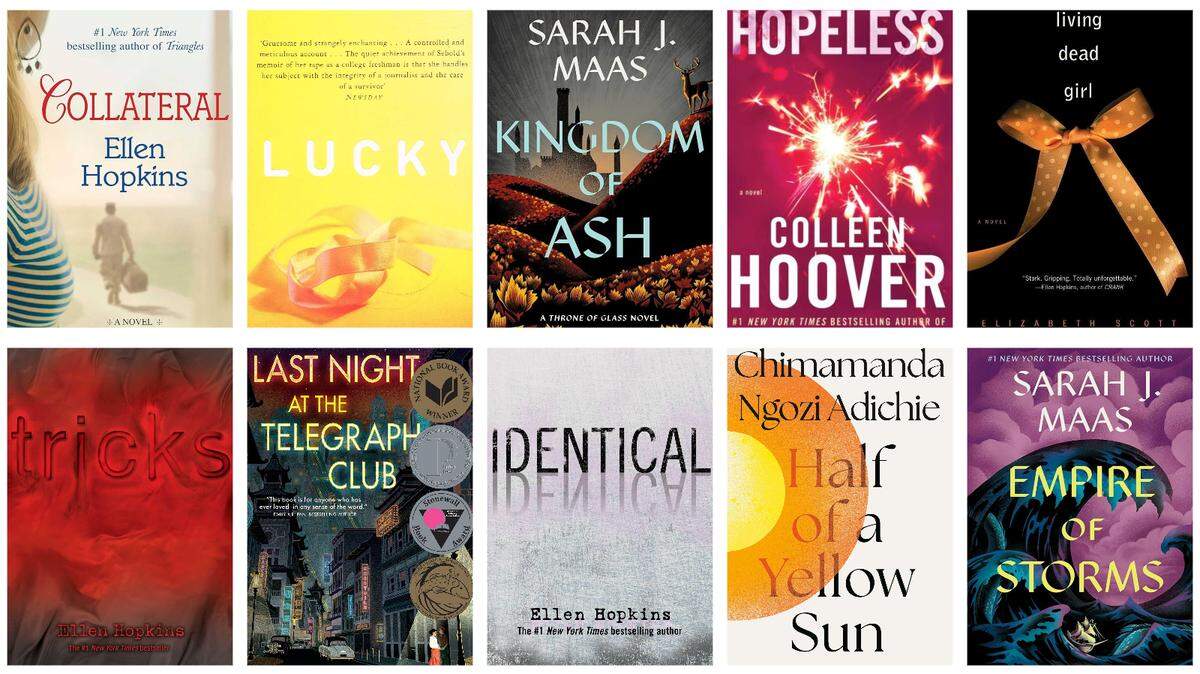
The ten books being reviewed are listed below:
“Collateral,” a novel by Ellen Hopkins, tells the story of a woman conflicted by her love for a Marine and her resentment toward the war he must fight
“Empire of Storms,” a fantasy novel by Sarah J. Mass and the third book in the series “Throne of Glass,” depicts a young adult’s journey to reclaim her kingdom
“Half of a Yellow Sun,” a novel by Chimamanda Ngozi Adichie, explores themes of moral responsibility, colonialism, ethnic allegiances, class and race during the Biafran War in Nigeria
“Hopeless,” a novel by Colleen Hoover and the first book in the “Hopeless” series, shows the challenges of navigating new relationships
“Identical,” a novel by Ellen Hopkins, dives into tough topics such as incest, drugs and attempted suicide
“Kingdom of Ash,” a fantasy novel by Sarah J. Mass and the seventh book in the series “Throne of Glass,” depicts a young adult’s journey to reclaim her kingdom
“Last Night at the Telegraph Club,” a young adult historical novel by Malinda Lo, explores a Chinese American teenager’ life as she explores her sexuality, societal pressures and the Red Scare
“Living Dead Girl,” a young adult novel by Elizabeth Scott, depicts the sexual abuse of a young teenage girl as she attempts to escape from her predator
“Lucky,” a memoir by Alice Sebold, recounts the author’s sexual assault and its impact on her life
“Tricks,” a young adult novel by Ellen Hopkins, conveys the narratives of five troubled teenagers as they navigate through challenges like sex and drugs
Total books banned
The total books not allowed on any South Carolina public school shelves has risen to 12. They are as follows:
“Perks of Being a Wallflower” by Stephen Chbosky*
“All Boys Aren’t Blue” by George M. Johnson*
“Flamer” by Mike Curato*
- “Push” by Sapphire*
- “Crank” by Ellen Hopkins (Restricted)
“Normal People” by Sally Rooney
“Damsel” by Elana Arnold
“Ugly Love” by Colleen Hoover
“A Court of Thorns and Roses” by Sarah J. Maas
“A Court of Mist and Fury” by Sarah J. Maas
“A Court of Wings and Ruin” by Sarah J. Maas
“A Court of Frost and Starlight” by Sarah J. Maas
The asterisk indicates the titles Beaufort County resident Szalai brought to the attention of the state review board in an effort to get them banned throughout South Carolina public schools.
This story was originally published April 2, 2025 at 12:33 PM.