Beaufort County school superintendent discusses ICE, vouchers, safety & teacher shortage
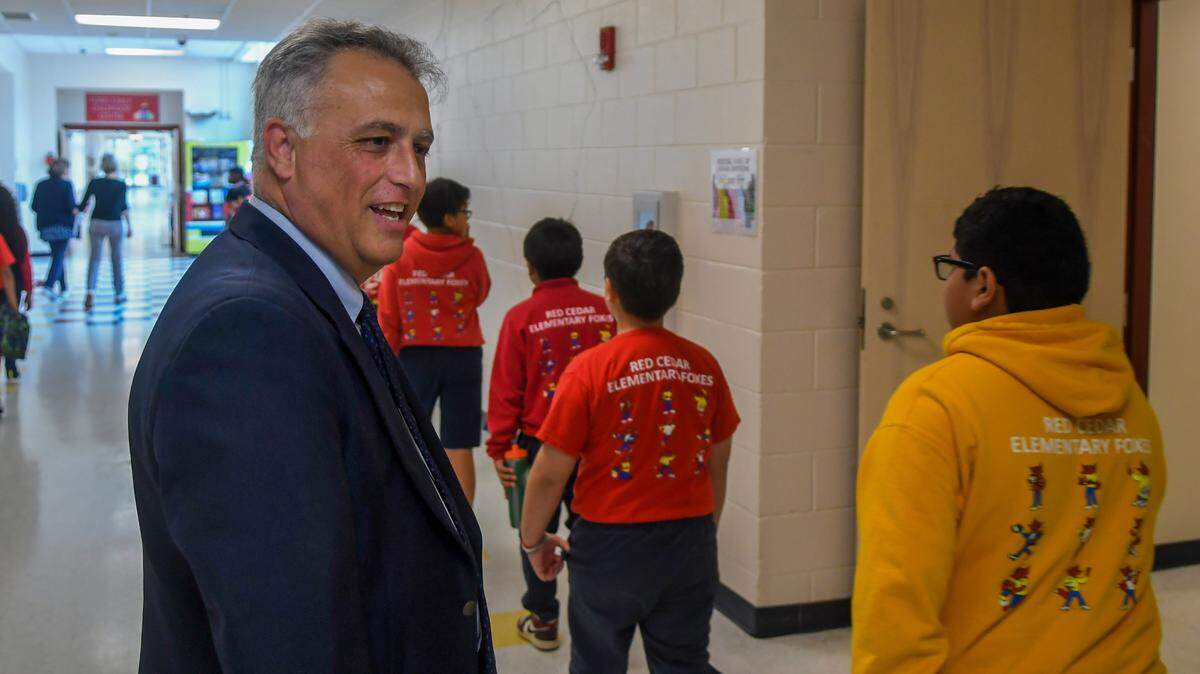
In the midst of political pressures making their way into Beaufort County schools, parents are wondering how the district is handling the overcapacity in classrooms, if free lunch will still be free and if the U.S. Immigration and Customs Enforcement needs a warrant to enter schools.
During a wide-ranging interview with Superintendent Frank Rodriguez, the Island Packet & Beaufort Gazette discussed the current state of Beaufort County Schools and his thoughts on important issues such as book bans, religious instruction, private school vouchers and whether and how pressure from President Trump’s policies and conservative agenda might affect local students.
This interview coincides with Rodriguez’s upcoming six-year anniversary as superintendent — with three years remaining — Rodriguez’s current contract ends in 2029. The paper’s editors have made minor edits to the transcript for clarity and brevity but retained the substance of his sentiments throughout the hour-long discussion.
Student performance, graduation rates & teacher vacancies
What has been your biggest accomplishment(s) since becoming superintendent?
First and foremost, our literacy scores are the highest that the school district has ever had on the current state assessment. In spite of the challenges with the pandemic, we were able to move forward and achieve that level. The other thing is, our college or career readiness score from the state for our students is the highest the district has ever had, and our current graduation rate is the highest recorded graduation rate that the district has had. So those are three important academic milestones.
A couple of other factors that have been important are, one, we passed two bond referendums, with I think the first one having 69% community support and the second one having 72% community support. That’s important because it helps us make sure we’re maintaining our high standard in our facilities as well as teaching and learning standards for our environment. The other thing that was important was a couple of years ago, we moved our teacher compensation from 53rd in the state to number one in one year. We’re not currently number one, but we moved in one year from 53rd to number one — and that was an important piece, too, for our educators and school system.
What strategies or programs have been implemented to spark this improvement?
In terms of the literacy pieces, we have professional learning communities that are in place that support teachers’ work in delivering standards-based instruction, and I think that’s helpful. We put several systems in place, like instructional reviews, that help support good, strong instruction. In terms of graduation rate, it’s close monitoring of students when they’re coming in and what their current status is from year to year, so that we can work at continuing to improve our graduation rate. So, it’s putting good systems in place that help support the work of teachers.
Since coming to Beaufort County in 2019, what has changed the most for students here?
One of the things that has changed for students quite a bit is the opportunities that are available to them, like our career and technical education programming. That provides a vast array of options and opportunities for students through the school system.
One of the things that we’ve vastly improved is exposure to career and technical education programming. Opportunities that students have to engage in, whether it’s extracurricular activities, clubs, or even their own academic programming — we want to make sure that we’re offering them a high-quality experience.
Is there anything about public education in the county — or your job — that you think parents might not know?
The school system offers so much for students that there may be programs within their schools that they don’t know about and could take advantage of. We offer so much in academics, programming and opportunities for engagement — opportunities for their children to get involved in, that I think are really, really important to them.
The other thing I think is important has to do with what we call PowerSchool. PowerSchool is a student information system. Through PowerSchool, parents can keep up with and track how their students are doing in their classes. They can look at that and see on a daily basis how their students are performing. How are their homework assignments? What are their grades? All of that is available to parents in PowerSchool, and that’s something that I think parents can take advantage of that also sparks conversations with their children. And in doing that, it also helps to build that partnership between school and parent.
What do you see as the biggest challenge for public education in Beaufort County right now?
I think the biggest challenge — and this isn’t just a Beaufort County challenge, this is a nationwide challenge — is finding teachers.
You have your normal retirements that take place, but you also have significantly fewer and fewer people going into the profession of education. And so, as all districts across the country are competing for personnel, that’s one of those things that is an increasing challenge for school districts because there are fewer and fewer people going into the profession.
Is there a certain school that you know of here in the county that needs more teachers specifically?
There’s always, from time to time, different vacancies in schools, and so I wouldn’t necessarily call out a particular school, but I would say in general there are several schools that may have vacancies they deal with. So, we have to adjust in order to be able to provide instruction for students, but that is an increasing challenge for school districts across the nation.
Is there something that keeps you up at night when you think about the future of this district?
A lot of things keep me up at night, but I think in terms of our school district: How do we continue to make sure that our students get a great education here? How do we push to the next level?
Math is a huge challenge. Math is not just a challenge for Beaufort County School District but nationwide. That is a subject area that got impacted the most by the pandemic. The Secretary of Education said the impact was decades long, and while we didn’t necessarily see an impact that was decades long, we saw a significant impact, and it is proving to be a challenge as we grow.
We’re growing in small amounts — I would like to see us grow more. And so, I’m trying to find innovative ways to help increase that. That growth is an important challenge that lies ahead, and that’s one that keeps me up.
Culture wars, Department of Education & President Trump
Many feel like public schools are under greater attack than ever before. Do you share that opinion?
I think it’s fair to say that public schools have challenges. In terms of being under attack, for example, there’s a constant push on public schools.
But today is different than it was 20 years ago. Twenty years ago, 30 years ago, you may have had a public school and a couple of private schools, but now you have a lot of public, private and charter schools. There’s a constant flow of schools and opportunities and choices for parents.
There’s often a national rhetoric that challenges public schools. But I think a lot of times, it’s just because people don’t know the full amount of what public schools offer.
There’s often a national rhetoric and sometimes a rhetoric that challenges public schools. But I think a lot of times, it’s just because people don’t know the full amount of what public schools offer. I mean, we try to publicize what we do on a regular basis, and there is some tremendous exciting work that happens in our schools every single day and those stories all aren’t always captured and shared.
[Coosa Elementary School] is a Blue Ribbon School. We’ve won significant awards for their academics and their programming, and we have several schools like that, but those are stories that are often told, but in small segments of communities so they tell their story to their constituents.
Pritchardville tells their story to their constituents, but on a global scale public education is really a fantastic avenue for everyone and with tremendous opportunities for children. If you look at at where our students graduate and go to school. We have students graduating go to Yale, they go to Harvard, they go to Ivy League schools, they go to University of South Carolina, they go to Clemson, they go to University of Florida, they go to Alabama.
They’re going to a lot of great universities and opportunities across the country, and many are going with industry certifications right into the work field, which automatically lifts them up. Our students through our BCSD Tides Program can graduate not only with a high school degree, but can graduate with with an AA degree, with a two year degree, and maybe two two year degrees. So there’s tremendous opportunities that are available to children that more people should know.
If you could say one thing to parents frustrated by these education-related culture wars, what would it be?
What I would say to parents is that we’re focused on providing their child with a great, standards-based education. We’re not really into the politics or political wars or any of that kind of stuff, but when it filters into classrooms, we try to deal with it.
The fact is, the reality is, that we try very hard to navigate everything from a perspective of the educational component, and I think that’s important for parents to know. We’re focused on making sure that their child gets a great education in a safe learning environment.
If the U.S. Department of Education was eliminated or severely reduced, as President Trump has proposed, how would that affect students in our district?
Well, the truth is we haven’t gotten a lot of information on how that’s going to play out.
A critical component to us is the school food services and the feeding of students in schools, and that comes from the U.S. Department of Agriculture. So that’s not really coming from the U.S. Department of Education, and we haven’t heard anything about whether that’s going to be impacted in any way.
The Department of Education allocates dollars to schools. Some cases, like Title I dollars, for example, are federal dollars, and they come to schools based on generally poverty level and poverty impact. To cut funding to Title I schools, you need somebody at the federal government to sign those dollars off to the state because they go from the federal government to the state, and then the state pushes it out to schools. So you need somebody over there to release it, to get it to the state, so the states can then administer it.
There are federal grants. We’ve got a couple of federal grants that we have applied for, and so we’re watching very closely to see what it means for any of those federal grants, which should provide some really great programs for our students. We haven’t gotten any word of anything being cut along those lines. We’re keeping an eye on it and navigating it. What I can tell you is we’re monitoring it closely so that we’ll learn more about any potential impact.
Capacity issues in schools & solutions
Several schools in the district are at or near capacity, with rapid population growth continuing. For example, Pritchardville Elementary has already exceeded capacity, and May River High is at 99%. What solutions or strategies are being considered?
One of the items in the 2023 bond referendum is a new elementary school in Bluffton on the May River Campus. When the community approved that bond referendum, that allowed us to begin work on a new school, and what a new elementary school will do is alleviate the capacity of other elementary students.
The way it’s been dealt with currently is with mobile units. We have some mobile classrooms that are full-size classrooms and are at Pritchardville Elementary.
Book bans & new review process
A parent initially challenged 97 books, and the district ruled that 92 should stay. The state later overruled the district and banned more books under a newer regulation after a second challenge. During this time, the district declined to rule under the new regulation. Why was that?
Essentially, what the district has done is say we have gone through a process to review these books. We followed the state’s model process for reviewing these books (Editor’s note: before state Regulation 43-170 was created to further oversee the review process).
This was their model process, and we followed their model process, and it yielded a certain outcome. And so, all we’ve said is books that we have already reviewed through that process we would send directly to the state if they are challenged again.
So we’re not going through that process again with the ones we’ve already reviewed, but any book that’s newly challenged that hasn’t been challenged before, we will follow the process here at the local level.
So we didn’t decline to follow the legislation. We just said the ones that we have already reviewed we’ll just send right up to the state so they can do their review because it’s already happened here.
Do you worry this could make it seem like the district is avoiding responsibility or hesitating to stand by its beliefs?
No, not at all. I mean, we went through a very thorough process — in fact, the state’s model process. I added an additional person to the book review committee to add additional community voice. At the end of the day, it’s not avoiding responsibility — it’s that we’ve exhausted the community through that process. We’ve exhausted our efforts in reviewing those books. I think that legislation provides the opportunity for that appeal to go to the state level. And since it’s already been reviewed here, let it go to the next level and let it be reviewed at the next level. New ones, we’ll do it.
Religious instruction & discontinued programs
A released-time religious program recently started at Hilton Head Elementary School. While the district stated that it’s legal, do you personally believe it’s good for the school, the educational environment or the students?
In my role as superintendent, it doesn’t matter what I believe. I have to be the superintendent for everybody in the school system, and we’ve got to follow the law.
Part of my job is to make sure that my team and I implement and execute on things. So whether I like something or I don’t like something — if the law makes it such, then that’s the parameter that we navigate.
Are there concerns about students losing recess or gym time because of this? Are there safety concerns for students walking to and from school?
It’s a parental choice. It’s not something that the district is imposing on anybody. If the parent has concerns about their child missing recess, then they wouldn’t put them in. It’s their choice; they’re in the driver’s seat.
A foot-washing event, hosted by Tidal Creek Fellowship Church and Samaritan’s Church, was previously held in local schools but was canceled this year. Why the change?
It took place in the past. It’s happened in some previous years, and they’ve been school-level events. This year, concerns were raised about it, and the system took a closer look at it, determining that it falls outside of what may be legislatively or traditionally allowed or permitted. And as such, as we move forward, that’s just a program that we would discontinue and make sure that our schools aren’t going to take part in.
In my short time here, I don’t recall any concerns or complaints that were raised at a previous time. I think that concerns were raised at this juncture, and we took a closer look at it and, as such, made a determination as we move forward.
Private school vouchers & school choice
South Carolina’s legislature is prioritizing private school vouchers this year. Do you support or oppose them?
My personal position is that if we’re going to compete, let’s compete on an even playing field. For example, if our students in the public school system have to take state assessments, then if you’re accepting vouchers, you should have to take state assessments too. And if vouchers don’t require state assessments, then my question is — if those assessments aren’t that important, then why do we have to take them as well?
For me, it’s about an even playing field to compete for students. We want to be the parents’ best choice, which we believe we are. But to be the parents’ best choice, let’s make sure the playing field is fair in how we do things.
ICE & warrants
Parents have expressed growing concerns about potential ICE enforcement in schools. The district has a policy requiring principals to immediately contact the Director of Protective Services if ICE initiates enforcement action. However, if ICE agents were to come into a school requesting access to a student or records, what is the district’s policy?
They [ICE] would have to have a judicial order.
You can go back to the Civil Rights Act of 1964 and the Equal Educational Opportunities Act of 1974, in which school district must provide all school-age children with public education and equal access to public schools, regardless of race or national origin. There’s also a Supreme Court case, Plyler v. Doe (1982), that prohibits schools and school districts from denying students access based on real or perceived immigration status. So, we cannot even inquire about a student’s legal status.
Do you believe ICE enforcement in schools conflicts with the district’s mission to provide a safe learning environment for all students?
I haven’t seen ICE in schools, and I’m not aware of ICE being in schools. Maybe they are, but I’m not aware of it anywhere. In our county, they haven’t been, but I’m not personally aware of them going into schools to do that. Our focus is on providing our students with a safe learning environment. We obviously have to comply with legal obligations while respecting the rights of students. If there’s a judicial order, they would have to have that in place as they engage.
Combating gun violence & ensuring student safety
Are there going to be any updated policies in response to a recent incident where a student was arrested for having a gun on campus?
At this juncture, I would say that we’re always reviewing our safety and security policies and we’re always looking for opportunities. Some schools have metal detectors and things like that, but even those schools will tell you that, one, it’s not 100% effective, and two, sometimes it gives a false sense of security. The third thing they tell you is that it can sometimes be detrimental to school climate and culture, because sometimes students will tell you they feel more insecure having to go through those kinds of things all the time.
So, we’re constantly reevaluating. We don’t talk a lot about the different measures that we have in place, obviously, for obvious reasons. That helps us identify and deal with situations. One thing that’s always very important is that students, parents and community members, if they have any information on anything, they talk with us, talk to law enforcement, or talk to school personnel, because it’s always very helpful in helping us identify things.
Is there anything that I haven’t asked yet, or that you think is important to discuss?
The main thing we want all of our parents to know is that while there are these different challenges that may exist within schools, we work very hard and strive to make sure that we’re providing our children with a safe learning environment. We do so in a way that provides their child with a great education. We work hard toward that every single day because, as I mentioned, we think we’re their best choice, and we want to be their best choice.
This story was originally published March 27, 2025 at 8:30 AM.