No occupancy caps for short-term rentals in Hilton Head. See what is changing
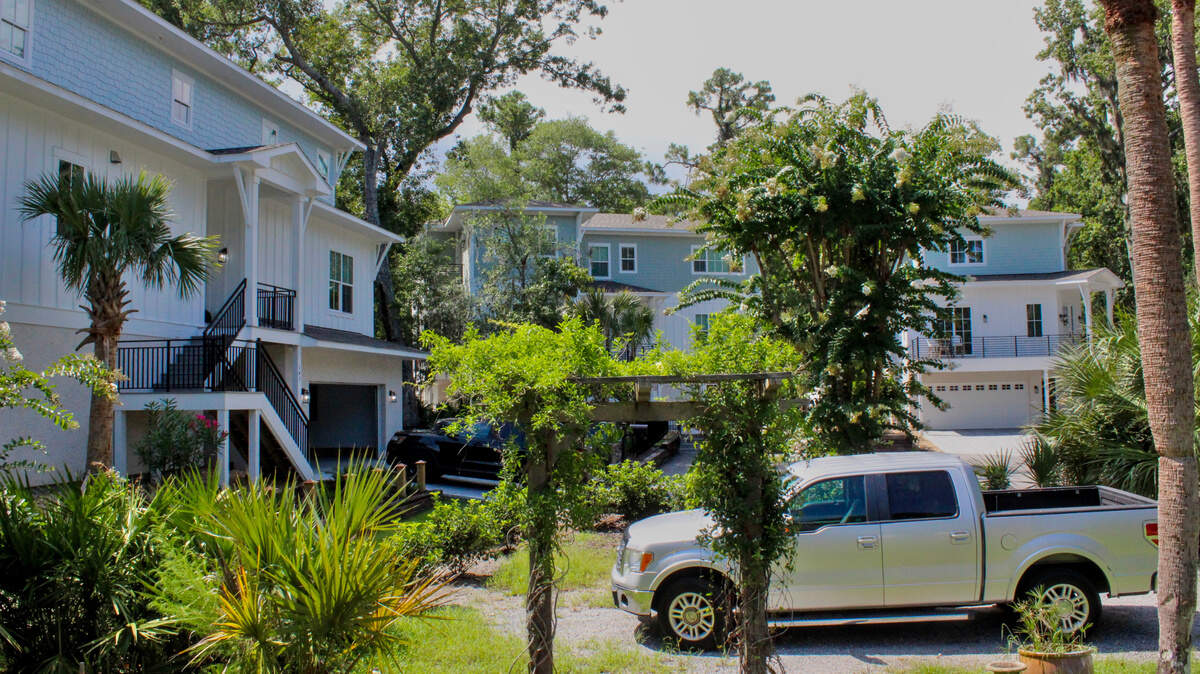
Hilton Head leaders have finally come to a consensus on new rules for short-term rentals.
At a special meeting Monday evening, the Hilton Head Town Council approved upon first reading new amendments to its short-term rental ordinance.
The vote comes eight months after the council failed to come to a consensus on new rules related to fire safety, occupancy and parking.
Short-term rentals are a hot-button issue for residents, real estate agents and business owners on Hilton Head, with many residents calling for tighter rules, while stakeholders in the industry worry too much regulation could push investors out of the market and weaken the island’s tourism economy.
A second reading of the new ordinance is scheduled for Oct. 21, according to assistant town manager Shawn Leininger.
The new rules will go into effect for new short-term rental permits on May 1, 2026, if approved upon second reading. Here’s what the rules are.
No occupancy limits
Council members debated whether to impose overnight occupancy limits on short-term rentals. The council first considered placing restrictions on occupancy in a September 2024 workshop.
“We’ve heard repeated cries from our community to do something about the size and the occupancy of short-term rentals on the island and how it’s impacting neighborhoods, including forcing long-term residents out of neighborhoods,” said Ward 2 council member Patsy Brison at the meeting.
It’s a complex issue. Vacationers looking to save money often prefer to squeeze as many people into a vacation rental as they can. Owners of short-term rentals are incentivized to use twin bunk beds and pull-out couches to stretch the maximum occupancy of their properties. However, many residents prefer not to live next to homes full of 20 vacationers that cycle out every week.
Ward 3 council member Steve DeSimone moved to remove any references to occupancy from the short-term rental ordinance, but instead suggested the council revisit occupancy restrictions in future discussions.
He explained that Hilton Head is “so different behind the gate and outside the gate,” and the council may not have “all the answers” as to how to enforce occupancy restrictions until they begin the process of rewriting the land management ordinance, the policy that sends land use requirements for development. Location-based rules on short-term rentals could also be discussed during the LMO rewrite.
“If we enact something right now, we’re going to find ourselves in a position where we’re going to be changing it shortly,” DeSimone said.
Ward 4 council member Tamara Becker supported removing the occupancy limits. “It doesn’t solve the problem that we need to solve in and of itself because there’s no way to enforce it, and without enforcement, I’m not interested in checking boxes,” she said.”
The council voted 5-2 to remove any references to occupancy limits from the ordinance.
Fire safety requirements
Under the new rules, short-term rental properties that are 3,600 square feet or more will be required to have a third-party monitored fire alarm system. Smoke detectors will be required in every bedroom, sleeping area, in every room on the path to exit a bedroom and on every floor, including basements.
Exterior gas grills will also be need to be equipped with automatic shut-off timers to reduce the risk of fires.
Fire and life safety is a huge concern in short-term rentals. A Palmetto Dunes short-term rental home burned down in 2022, killing one tourist and critically injuring another. The Hilton Head Fire Rescue responds to frequent fire calls to short-term rentals, and fire officials say that many fires stem from outdoor gas grills.
Other fire and life safety requirements have been floated in past discussions but have been turned down by council members. Here’s what didn’t make the final cut:
- Requiring floor plans with emergency exit routes to be posted on each floor, and also require floor plans to be submitted. This suggestion was dropped during an Oct. 7 committee discussion. Town leaders cited concerns it would place too much of a burden on both short-term rental owners and town staff.
- Requiring short-term rental owners to hold liability insurance against personal injury, including death.
Ward 4 Council Member Tamara Becker voiced disappointment that “simple things like providing an escape plan, an escape route, and a ladder, a foldable kiddie fire-safety-approved ladder for upper floors, have not been adopted.”
She urged short-term rental owners to buy a fire safety ladder and put them in the bedrooms of homes.
“If there’s a fire, if there’s smoke, the only way out is through that window,” Becker said. “If you don’t have something to climb down, you’re going to jump. If you have kids, you will throw them out. If you have dogs and cats, the same. And the surface below may not be forgiving.”
Parking
New parking regulations would limit the number of exterior parking spaces per property to six, not including garages.
When applying for a short-term rental permit, applicants need to assess the parking capacity of their property and show town staff where cars would park. Parking spaces must be off-street and within a driveway. There must be enough space for all the cars to be able to park without blocking sidewalks or buffers. A space of at least nine feet by 18 feet is required for each vehicle.
The new rules also prohibit expanding a driveway or constructing a new parking area “for the primary purpose of increasing the capacity of a short-term rental property.”
Fee changes still in works
Whether the fee to apply for a short-term rental permit will go up next year is still to be decided.
A previous proposal brought forth to committee on Oct. 7 would have raised the fee to $1000 for properties with 4 or fewer bedrooms, and $2500 for properties with more than 5 bedrooms.
However, the committee decided not to move that proposal forward, “to allow the town manager the opportunity to evaluate the operational impacts and cost to implement, administer, enforce, communicate, and maintain the resulting short-term rental program,” Mayor Alan Perry said at the Monday meeting.
A fee proposal will be brought forward to council as an amendment to the budget ordinance at a later date, Perry said.
Some council members have expressed support for changing the fees to $500 for small properties and $1000 for large properties.
Inspections
Any short-term rental property would be subject to inspections, under the proposal. The town would need to give a 48-hour notice prior to entering the property.
How did we get here?
As short-term rentals increase in numbers in Hilton Head neighborhoods, residents have voiced concerns about parking, noise, trash and a loss of a sense of community.
Ward 4 council member Tamara Becker has long been vocal about resident issues. A resident of Bradley Circle, she chose to run for town council after watching her once-quiet neighborhood become transformed into a tourism hotspot.

“The quality of life on Hilton Head for residents, and frankly the visitor experience, has been diminished over time,” Becker said at an Oct. 7 meeting of the Community Services and Public Safety Committee, where the proposed amendments were discussed.
In some neighborhoods, short-term rentals make up as much as half of all residences. They are found in high concentrations in neighborhoods zoned for single-family residential use rather than commercial or resort use.
Often, these are neighborhoods close to the beach that are not gated communities and do not have a Homeowner’s Association, such as Forest Beach and Folly Field. That leaves few options for Hilton Head residents who want to live in a quiet, peaceful neighborhood that’s walking distance to the beach without having to deal with the headaches of living under an HOA.
Hilton Head first introduced new short-term rental regulations in 2022, and they took effect Jan 1, 2023. That decision introduced the permitting system, and was a first step towards addressing parking, noise and trash issues.
“That was a beginning stage,” Becker said. “It has become apparent that there are additional rules and regulations that might be necessary.”
In February, the town council discussed new short-term rental regulations related to fire safety, occupancy and minimum parking requirements. However, the council did not come to a consensus.
The new amendments approved Monday will need to pass a second reading, scheduled for Oct. 21, before becoming officially adopted.
At the Monday meeting, dozens of community members spoke during public comment to voice their opinions on how the town should talk the short-term rental problem. Council member DeSimone expressed his appreciation that despite their differences, everyone in the community recognizes that “there’s a problem.”
“No one said there’s not a problem,” DeSimone said. “It’s just in specific areas and we need to work on that with our LMO rewrite.”
Correction: The original version of this story incorrectly stated that the new fees had been approved by council. The council has yet to approve new fees, pending more review from the town manager. Changes to the short-term rental permit fees will be brought forward as a future amendment to the budget ordinance.
This story was originally published October 14, 2025 at 2:15 PM.