As short-term rentals threaten Hilton Head character, residents put up a fight
For many Hilton Head residents, short-term rentals are like moth-eaten holes in their tight-knit community eating away at the fabric of their neighborhoods.
Their temporary nature leaves blank spaces in the community that would otherwise be occupied by a friendly neighbor. When few and far between, they’re less of a disruption. But when developers come in and eat away at big chunks of the neighborhood, longtime residents fear they’re watching their beloved hometown transform into a miniature Myrtle Beach.
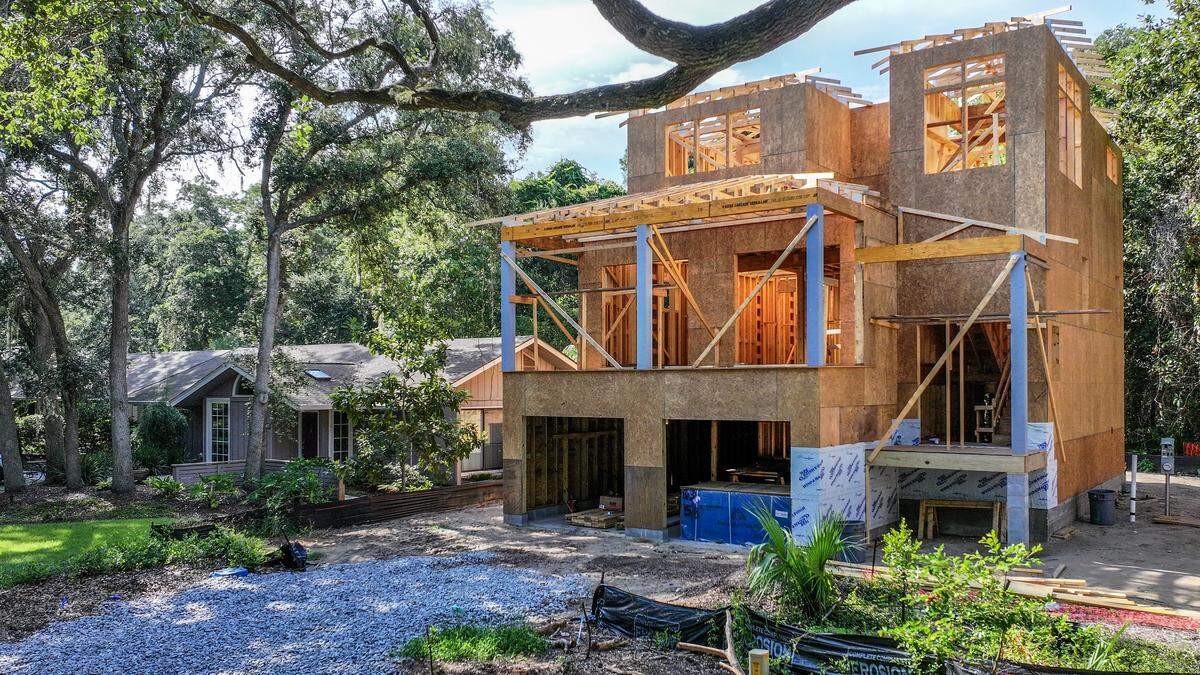
So when the residents of Holiday Homes, a long-established neighborhood on Folly Field Road that predates the town, found out that a West Virginia developer had plans to bring a trio of seven-bedroom, three-story houses into their neighborhood of mostly one-story homes, they banded together to fight it, fearing they would become short-term rental properties that would disrupt the quiet nature of their community.
“We don’t want these homes in the neighborhood,” said resident Matthew Lewis, who appealed the developments on behalf of his neighbors. “They don’t meet the character of our neighborhood.”
Many out-of-state developers, business owners, and individuals own short-term rentals across Hilton Head Island. Some live in the homes part-time as a secondary residence while renting it out for the months of the year they return to their parts of the country. Others own them as an investment property or side hustle.
As short-term rentals push into single-family neighborhoods across Hilton Head, many residents feel that the peaceful qualities that drew them to the area in the first place — access to the beach, lush scenery, and friendly neighbors – are eroding away.
A ‘quaint’ neighborhood
Holiday Homes was started by O.T. McIntosh Jr., one of Hilton Head’s first developers who, along with Charles Fraser and Fred Hack, laid the groundwork for modern-day Hilton Head.
McIntosh bought the deed for Holiday Homes in 1956 and built small ranch-style structures for working class families. There was no sewer, no bridge, and no town government. Future-minded McIntosh filed a restrictive covenant with the Beaufort County Clerk of the Court in 1957 that prohibited certain kinds of development — no three-story homes, and nothing that would be a “nuisance.”
Many of those original houses are still standing. Residents often receive offers from developers looking to buy their property. Some properties have been redeveloped into larger homes.
Barred owls hoot from the loblolly pines and live oak trees at night. Deer feed off of the foliage. Neighbors have formed a close-knit community that helps each other out in times of need.
Resident Gay Propst, who lives in the house her parents built in 1968, recalled the kindness of her neighbors when her mother was sick with dementia.
“They came and helped me pick my mother up off the floor, because she didn’t know how to get up, and I could not lift her,” Propst said.
No Sandcastles
One day, Propst’s father looked across the street and saw developer Jeremy Adams checking out three undeveloped lots in the corner of Holiday Homes.
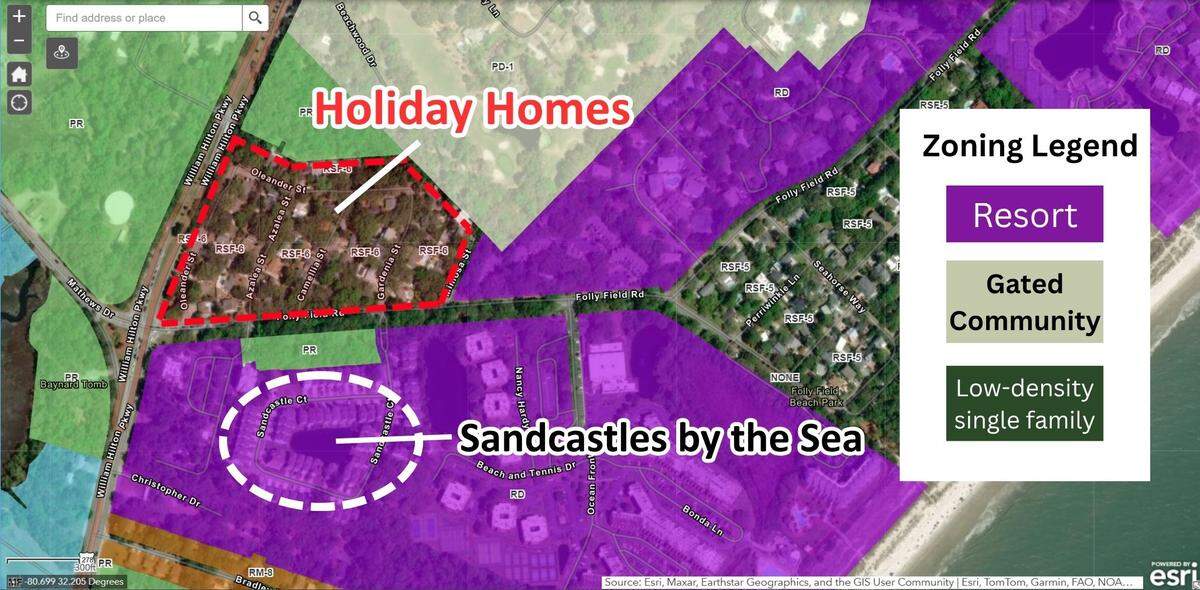
At the time, Propst said, Adams was staying in the neighborhood resort community Sandcastles by the Sea, which has become somewhat of a bane for residents.
The tall, narrow vacation homes in Sandcastles are packed together in a circular fashion with not enough parking for the amount of visitors, residents said. As a result, parking and traffic bleeds into Holiday Homes.
Adam said he’d bought the property in the neighborhood and was planning on building some homes, Propst recalled.
“Dad said, ‘Well, I hope you’re not gonna build homes like you’ve been living in across the street of Sandcastles, because we don’t want that over here,’” Propst recounted.
Adams assured him that he wasn’t going to build homes like the ones in Sandcastles. Propst recalled. Still, when residents found out what kind of houses Adams did plan to build, they began to worry.
Resident gear up for a fight
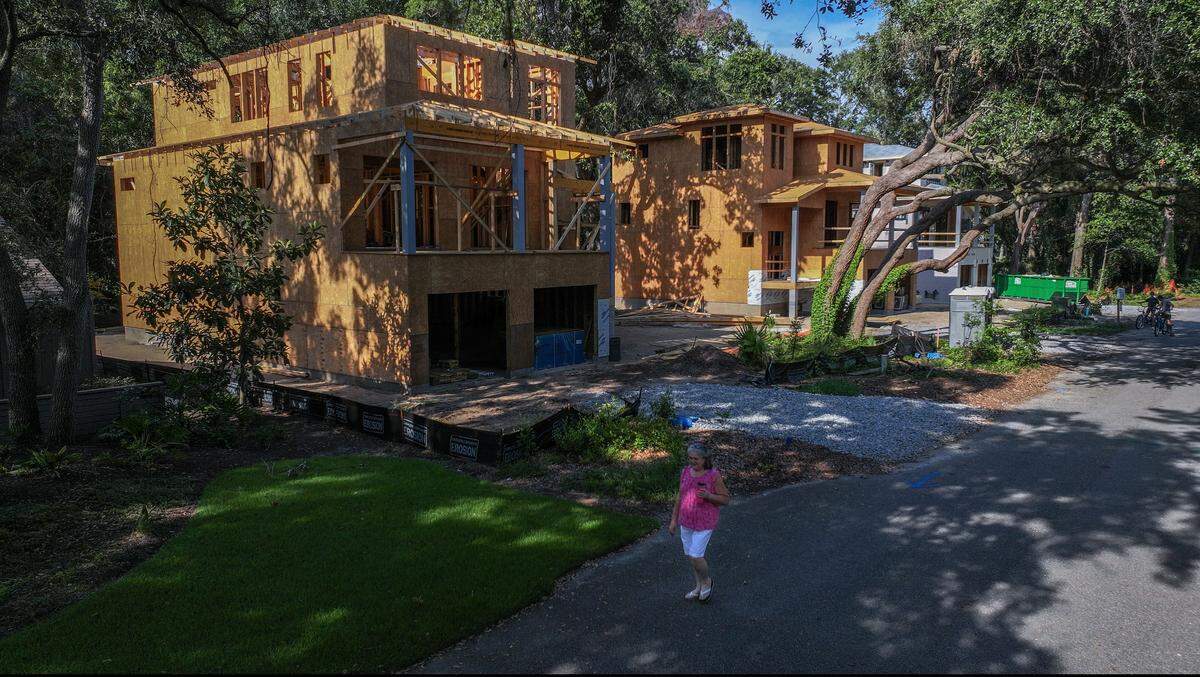
In January and February, Adams submitted applications to build three seven-bedroom, three story homes on the last three undeveloped lots in Holiday Homes.
Residents feared they would become short-term rental properties that would bring noise, parking, and traffic problems into their quaint neighborhood. Other short-term rental properties on the island with seven bedrooms advertise being able to accommodate up to 20 guests. Even when the homes provide enough onsite parking for guests, rentals also bring in traffic from cleaners, plumbers, and delivery drivers all trying to park on the street.
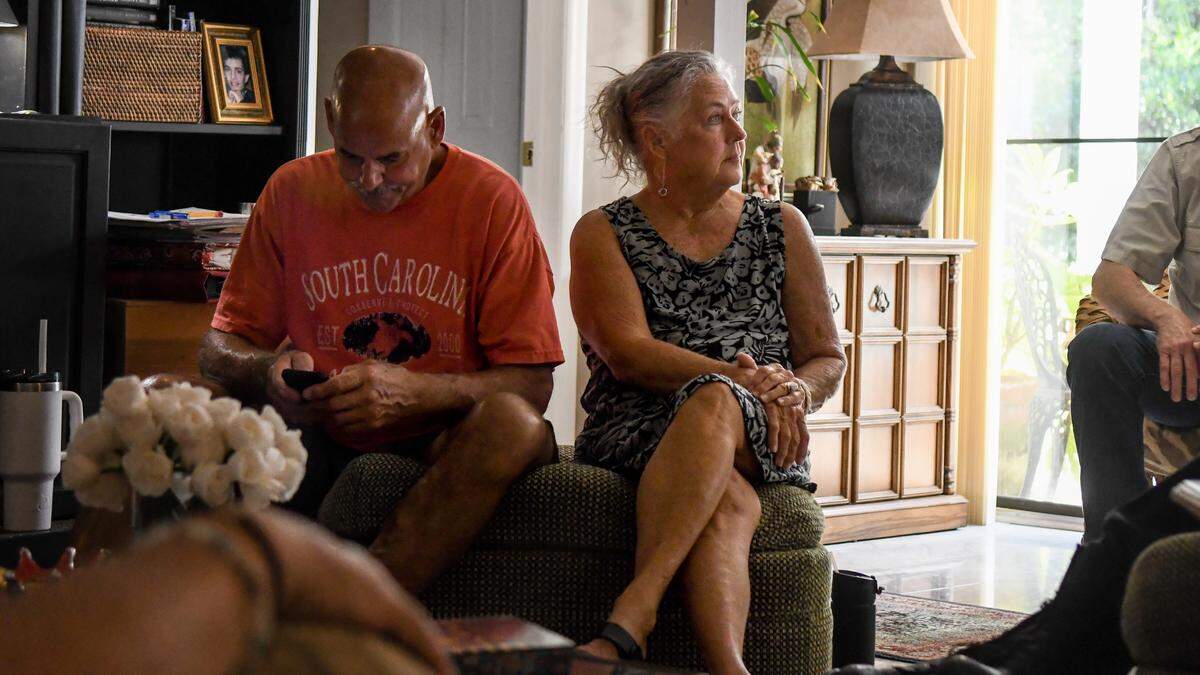
Beyond just the three houses, they feared it would open the doors for Holiday Homes to erode into a resort neighborhood like Sandcastles by the Sea.
Adams disputes the comparison between the houses he’s building and the homes in Sandcastles. He said he’s “definitely going to keep one” for his family, but declined to confirm if he plans on renting or selling the other two properties. “I don’t know yet, what the future will hold,” Adams said. “I mean, obviously I’m not gonna build three houses for my family.”
In April, builders installed silt fencing around the lots and started trimming trees. Residents realized the permits had been approved, and contacted the town.
Town staff met with residents and told them they didn’t believe they had made a mistake. The developments met the technical standards outlined in the zoning requirements, residents were told.
Residents didn’t agree that the new houses were in compliance. They argued that their homes would be detrimental to their neighborhood’s character and “quiet residential nature,” which is what the zoning rules sought to protect.
“The intent is to protect that environment from the possibility of extra noise later, excessive traffic, whatever it is,” said resident Matthew Lewis.
Neither side seemed willing to budge, so Lewis and his neighbors filed an appeal contesting the permits on April 29.
As construction speeds ahead, residents wait for hearing
It would be another three months before residents had their case heard by the Town of Hilton Head’s Board of Zoning Appeals.
The board meets once a month on the last Monday of every month, and was not able to squeeze the residents into their May agenda. In June, the board cancelled their meeting, citing that too many board members were on vacation. They tried to call a special meeting, but not enough members agreed to participate. Finally, the board heard the Holiday Homes case on July 28.
Residents watched and waited as builders cleared away the thick forest and began to erect the new homes. By the time of the hearing, the wooden frames were nearly complete.
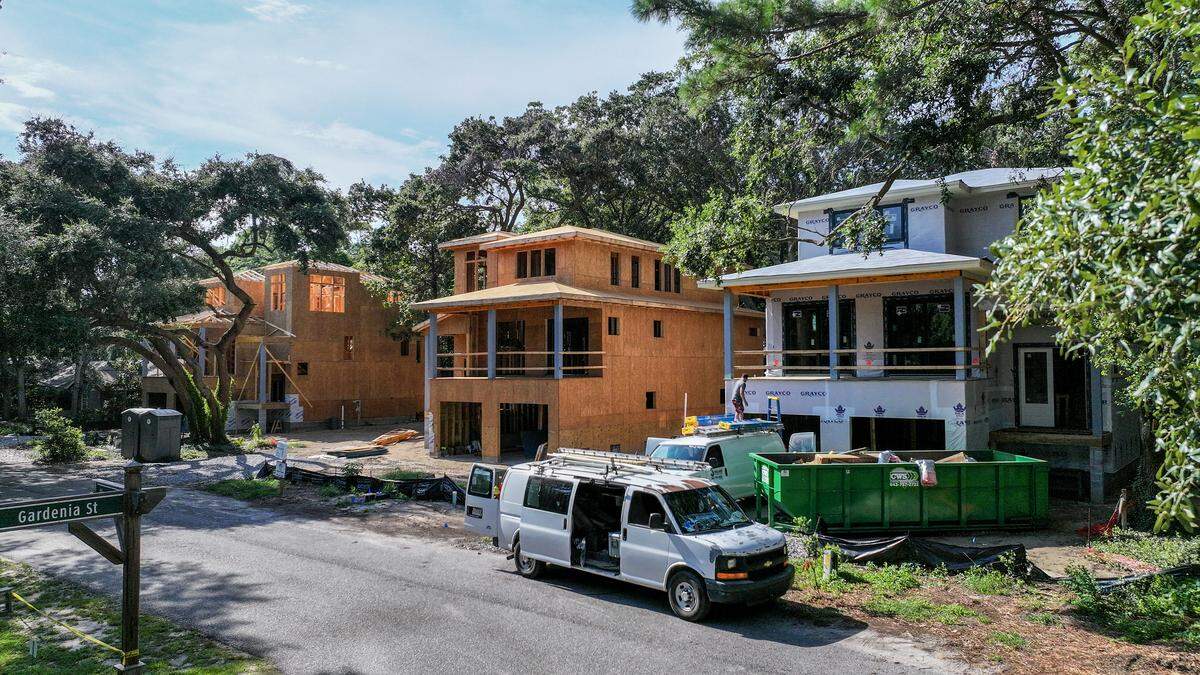
Ward 4 Council Member Tamara Becker said delays to the appeals process put communities “in a precarious situation” where the town has to weigh the concerns of residents against the potential of a costly lawsuit if development is halted.
“Because now you’ve got so much building having already taken place, and that lawsuit … becomes more and more valid,” Becker said.
‘Character’ protections allow for large homes
At the July 28 hearing, residents heard much of the same arguments from town staff.
When Holiday Homes finally transitioned from septic tanks to sewer lines in 2005, residents were concerned it would open the doors for large homes that didn’t meet the character of their neighborhood. They asked the town for a special zoning ordinance called a “character overlay” to place restrictions on the size, scale, and type of developments. The founding of AirBnb and the subsequent explosive rise of short-term rentals all over the globe.
Despite residents’ attempts to appeal to the intent of the overlay, Assistant Town Manager of Operations Shawn Leininger argued at the hearing that the homes’ measurements fell within the guidelines outlined in the character overlay and the town’s zoning ordinance.
Residents came to the meeting armed with what they thought was a third layer of protection uncovered after they’d filed the appeal.
The aforementioned restrictive covenant, written by O.T. McIntosh Jr., was found buried in a file cabinet in Propst’s family home in mid-June. Residents argued Adams’ homes conflicted with the 68-year-old covenant.
The Lost Covenant
Gay Propst lives with her father in the house her parents built in Holiday Homes in 1968. Her family has a long history on the island, dating back to 1880s. Her mother was born at Honey Horn Plantation in 1941.
When word of the new short-term rentals got out, her father Phillip Propst recalled the old restrictive covenant written by former Holiday Homes President and early Hilton Head figure O.T. McIntosh Jr.
Propst recalls the search as follows:
"My dad had rummaged through every file cabinet in our house, looking for anything to help the situation. And my mother, of course, just passed away so she wouldn’t have remembered where she put it.
We found this piece of paper. It was onion paper. It was 8 ½ by 14 onion paper folded into a piece that was about this big in an envelope filled with stuff that said “Holiday Homes.” And dad opens it up, and you can’t hardly see it, because you can see through onion paper. So I’m like, what is this?
So I copied it. I can hardly copy it, like I had to put paper behind it to get it to copy, and I gave it to [my neighbor] Ed."
Some of the restrictions in the document which residents say conflict with the new developments include the following:
- All lots in the subdivision shall be used for residential purposes exclusively.
- Single family dwellings are not to exceed two and a half stories in height.
- No noxious or offensive activity shall be carried on upon any lot, nor shall anything be done therein which may be or may become an annoyance or nuisance to the neighborhood.
Restrictive covenants like these are kept by the Beaufort County Clerk of the Court. However, the county is “infamous” for spotty recordkeeping, and old documents can be difficult to locate.
Ideally, documents like these should turn up when property buyers hire an attorney to do what’s called a “title search” – a search through public records to find every document related to a property.
Town rules place the onus on the applicant to find and notify town staff of any restrictive covenants, Assistant Town Manager Shawn Leininger said at the July 28 hearing.
After speaking with residents, Leininger said town staff attempted to look for the document, but were unsuccessful.
When filling out the application for the Holiday Homes building permits, builder Cameron Hackett of Hackett Homes & Construction indicated that there were no restrictive covenants that would prohibit the request.
Neither Hackett, Leininger, or the town attorney could speak to the actions the property owner or his attorney had taken towards searching for restrictive covenants.
Asked about whether he had had an attorney look for covenants on the property, Adams said he had "nothing to say about it."
Yet Leininger contended that the permits could not be revoked on the basis of a covenant that town staff were not aware of at the time of pre-permit review. The board dismissed the case.
Outside the gates, residents more vulnerable
Board members sympathized with the residents and encouraged them to establish a Homeowners Association, which could give the community more power over development, and allow them to be less reliant on Beaufort County’s inconsistent recordkeeping.
Residents aren’t too keen about the idea. Many chose Holiday Homes because they wanted to avoid dealing with an HOA or POA.
In Holiday Homes, there’s no gate for visitors to show their driver’s license before they enter. Neighbors don’t report each other for offenses as miniscule as a missing paint chip on their mailbox.
However, the lack of constrictions leaves neighborhoods like Holiday Homes more vulnerable to developers looking for a place to build with less oversight.
Becker, who was inspired to run for town council after seeing similar things happen to her own neighborhood, believes that the town has failed to protect residents outside the gates.
When Hilton Head residents voted to incorporate as a town in 1983, one of the driving forces for incorporations was a desire for growth control to protect the character of the island that attracted them in the first place.
Town leaders created a land management ordinance — a massive set of regulations intended to prevent unchecked development from destroying the island’s character.
“And here it was that we needed it, and it failed,” Becker said.
What’s next?
Although the appeal has been denied, the residents’ fight to protect their neighborhood could still continue.
They can appeal to a higher court, according to Becker. They could also use the newfound covenant they found to challenge the builder in court. Both steps would require finding an attorney.
Residents worry they don’t have the financial resources to continue the fight.
The town is in negotiations with residents to update their zoning overlay. But future regulations won’t put back the trees that have already been cut down. Residents like Julie Lawson mourn the loss of the sounds of wildlife.
“At night, you don’t hear the owls,” Lawson said.
This story was originally published August 5, 2025 at 1:44 PM.