One-dimensional economy has Myrtle Beach young people asking: Do we have a future here?
READ MORE
The Future of South Carolina Cities
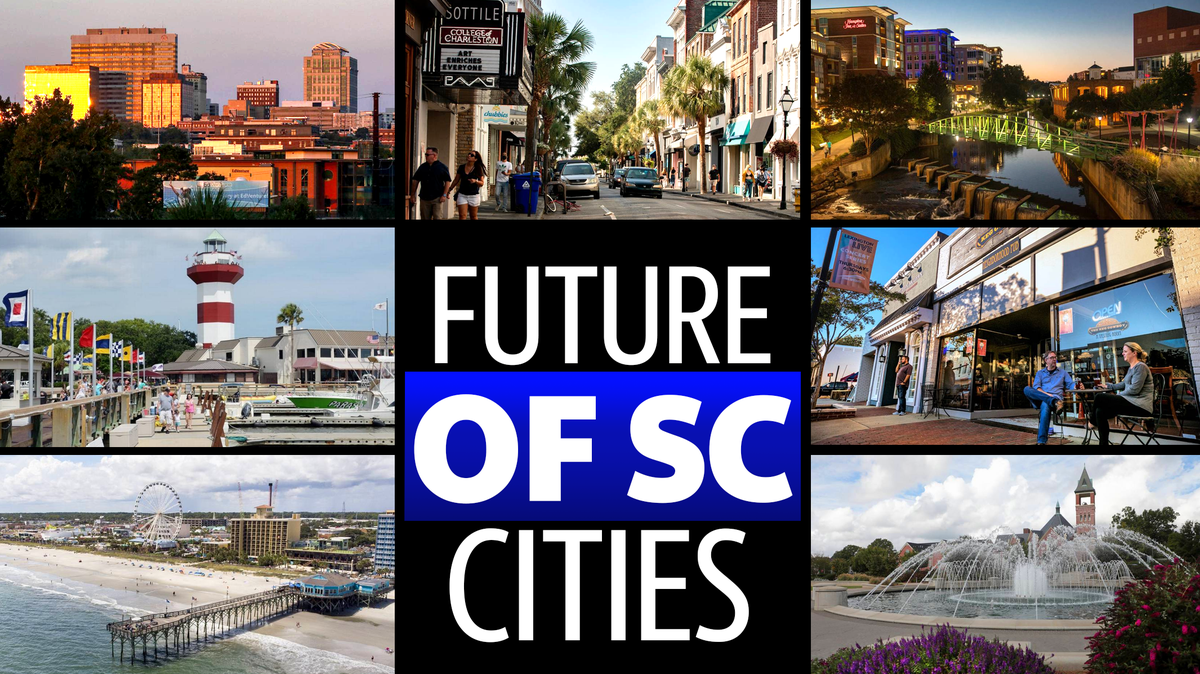
These seven cities hold the power to shape the future identity of South Carolina. Can they overcome their own unique challenges in order to become more sustainable for the Palmetto State in the long term? This is The Future of South Carolina Cities.
Expand All
Growing up in the early 2000s, Finley MacIver was raised on the idyllic notion of what it meant to live in Horry County.
Her Irish ancestors came to this corner of the state five generations ago and began farming the land outside of Conway. Though the family eventually moved away from farming, they kept the old farm house, off Highway 90, which didn’t have running water or electricity until the 1950s. That’s where MacIver grew up.
On days she’d spend with her grandfather, the last generation to farm full-time, they’d stop by the Tilly Swamp Handy Mart, hear the bell ring as they opened the front door, say hello to Aileen Thomas — Ms. Aileen as she was known — and buy gas and sandwiches for the day, maybe even breakfast.
But as she grew up, MacIver, now 21, said those idyllic notions began to fade. Looking around her once-rural and rapidly-growing community, she saw that roads and other infrastructure weren’t keeping up with needs. She wanted to teach history at one of Horry County’s high schools but changed plans after seeing how difficult that would be to do here.
“Teachers are overworked, underpaid (and) under-appreciated, especially in Horry County,” MacIver said. “All that money we make off of tourism, you’d think some of it goes into the schools, but it rarely does.”
The fact of the matter is this: Low property taxes and a conservative-but-beach-adjacent atmosphere in Horry County and along the Grand Strand have lured people, largely older workers or retirees, to the region for decades now, but not new industries. Jobs in health care, tourism or real estate are the few available to young people growing up here. Politicians across the Grand Strand promise that building a new interstate — I-73 — will bring new businesses and industries to boost the economy, but such an effect could be a decade or more away.
Meanwhile, young people are moving away, and wages have stayed low for the most readily-available jobs in hotels and restaurants, all while housing prices soar.
Those conditions, taken together, raise key questions about the Grand Strand’s future: Is the region’s economy sustainable? Can Myrtle Beach survive for another generation? Or will the house of cards propping up local economic engines fall before the region’s economy and housing market can support more than just retired transplants?
MacIver eventually decided she needed to leave. She now works for a pest control company in a small city in western North Carolina and splits her time between Horry County and her new home. She said she grieved when she came to understand that she wouldn’t be able to have the life she wanted closer to home, but her family gave their blessings. They just wanted her to be happy.
“To simply put it, I like the area better, and I eventually want to have a family up here (in North Carolina),” MacIver said. “I don’t see myself staying in Horry County, especially with the way things are set up for people my age down there.”
Myrtle Beach’s biggest problem
Myrtle Beach is at an inflection point. If it acts now and takes several important steps to fix its labor problem, it could continue its supercharged growth for decades. If it doesn’t, the economy could slow down, limping along as workers continue to flee for higher-paying jobs anywhere else.
Patty Rose Farley is one of the workers who makes the Myrtle Beach tourism machine run. A bartender and manager at Comedy Cabana, she worked nearly every day the business was open this summer. The business has seen unprecedented demand but hasn’t been able to find workers, much like the rest of the hospitality industry.
“It would be nice to work five days like a normal job as opposed to every day,” Farley said.
Comedy Cabana is primarily missing cooks, but on many days Farley has had to help with serving, the front door, even social media. Farley, who has lived in the Grand Strand and worked for Comedy Cabana for the last eight years, doesn’t believe it’s because people are “lazy” or trying to ride on unemployment.
“Everybody I know is working,” she said.
Ask almost any business owner or employee about Myrtle Beach’s most pressing economic issue, and they’ll almost certainly talk about the labor shortage. The lack of workers to fill jobs is an ever-present, practically all-consuming problem.
The shortage was exacerbated by the pandemic but wasn’t created by it. The problem has been around for decades, and it gets worse by the month.
The data doesn’t look good for an economy that relies heavily on a sizable workforce. Tourism isn’t an office job. Businesses can’t hire remote workers hundreds or thousands of miles away to clean a hotel room or cook. They can’t automate those jobs either. Housekeeping robots don’t exist yet.
Since 2000, Horry County has added more than 150,000 new residents, with more than 80,000 of those people moving here in the past decade, much of which Farley has lived and worked through.
Along with all of those people have come thousands of new homes, causing growing pains to ripple from homeowner-association-run subdivisions in Socastee and Myrtle Beach to still-under-construction neighborhoods closer to the Waccamaw River and beyond. People who have lived in the region their whole lives complain of congestion and suburban sprawl. Newer residents point out that the roads, stormwater system and police forces aren’t as well-maintained or robust as they should be.
Many residents have said they wonder why the cities and the county haven’t done more to keep up with the growth.
The workforce has not kept up either. According to a report from Habitat for Humanity of Horry County, one of the prime working age groups in Myrtle Beach proper, ages 20-29, has fallen by 30% in the last decade. The city’s older population, however, has grown astronomically, with the population of people in their 50s growing by more than 65% and people 65-69, those just entering retirement, grew by more than 100%.
Myrtle Beach must ‘diversify, diversify, diversify’
So how does the region fix its worker shortage? How does it convince people, particularly young people who make up a majority of the hospitality industry, to move here?
“The economy needs to diversify. It’s like your investment broker would tell you: diversify, diversify, diversify. So when one investment goes kaput, there are more eggs in the basket,” said Shirley Long-Johnson, who was an educator at Horry-Georgetown Technical College for decades before retiring.
Right now, most of the Myrtle Beach economy’s eggs are in the hospitality basket. Residents will even graduate from Horry-Georgetown Technical College or Coastal Carolina University but go into hospitality because white collar jobs either don’t exist or don’t pay as much as tipped jobs.
Another longtime local and economic development official, Buddy Steyers, said the region has long been a place full of the “most educated bartenders.”
Even Long-Johnson’s own son got a master’s degree then became a bartender because it paid more.
“You cannot expect somebody (young) to locate in Horry or Georgetown County if there is not an adequate paying profession with room for advancement. That’s just the lay of the land. You go where the money is,” Long-Johnson said.
Myrtle Beach needs more variety in its workforce, more people working in industries outside of tourism, like it used to have with the Myrtle Beach Air Force Base.
Before its closure in 1993, the Myrtle Beach Air Force Base was a major provider of workers to the region, said Long-Johnson and Styers, who is the head of the Myrtle Beach Air Force Base Redevelopment Authority. The spouses and children of the service members worked in those low-wage hospitality jobs, unconcerned about the main living expense — housing costs — if they lived on base. They also had health insurance through the military, a benefit often lacking in many hospitality jobs.
Now, some hope to recreate the effect of the base without the base. Economists and business leaders want to draw a diverse range of medical, manufacturing and other jobs to the region, which could bring in those young families that can, in turn, provide workers to the hospitality industry as well.
But a lot needs to change to get those businesses to come here.
I-73
There is one major solution that politicians promise could, eventually, bring more industry to Myrtle Beach and pave a path to a more sustainable future economy: Interstate 73.
For nearly 40 years, local business leaders and politicians have pitched I-73 as a major infrastructure project that will boost the region’s economy and workforce. Originally the brainchild of the Myrtle Beach Area Chamber of Commerce, the region’s leaders have argued that I-73 will not only provide a streamlined evacuation route during major storms and make it easier for tourists to come and go, but the highway will lure major industries — from shipping to manufacturing to technology — to the Grand Strand, boosting wages and quality of life in the process.
“The experience getting here will hopefully be a little nicer…but the primary aspect is the economic development and job creation,” said Karen Riordan, the chamber’s CEO, who has continued the organization’s legacy of lobbying for I-73.
I-73, though, could be a decade or more away.
Gov. Henry McMaster announced earlier this month that he’d pledge $300 million in state funds to the project, though that plan would need approval from the Legislature when it comes back for its regular sessions in January. McMaster and South Carolina Department of Transportation Secretary Christy Hall said they hope local governments from Horry County and beyond will eventually commit $350 million and that the federal government would pay for the remainder of the project.
The total price tag for I-73 ranges from $1.2 billion to $1.6 billion.
But rounding up that amount of money won’t be easy, and some county leaders are already pledging to oppose local funding efforts until state or federal lawmakers pitch in first. Similar conundrums have stalled the project for years before.
Until economy shifts, housing problems will linger
With I-73 still a distant dream, in the meantime, workers and advocates say the region needs to address problems with skyrocketing housing costs and low wages that haven’t kept up.
Today, it’s well known that much of the Grand Strand’s workforce can’t afford to live in the city limits of Myrtle Beach, North Myrtle Beach or Surfside. Rather, they’re often forced to cross the Intracoastal Waterway, living in Socastee, Conway, Aynor, Loris or one of the other communities farther west. That’s been the case for decades here: Wealthier people have been able to live near water or town centers, while non-wealthy people lived farther away.
What emerges from that history is a key question: If the tourism economy relies on lower-paid workers to keep the visitors coming and happy, how are they supposed to maintain their own lives?
“Too many of our residents are making minimum wage,” Conway Mayor Barbara Blain-Bellamy said. “Too many families are relying on their compensation from manual labor and getting the lowest wages there are and oftentimes getting no benefits and trying to raise a family. They can survive, but I’m not sure if there’s much more than surviving.”
Part of the issue has to do with how expensive land and homes have become. It’s common for new single-family homes to sell for $200,000 or more, and $10,000 for an acre of land has become normal in parts of the county.
“If we’d have kept that land, we’d be the rich people, too. But we didn’t keep it, because the governors back in the day gave land grants,” said Buster Hatcher, the chief of the Waccamaw Indian tribe in Horry County. “He thought he had the authority to give land away…and really, he did not.”
Local politicians have said they know more affordable housing is needed, but such housing is sparse. North Myrtle Beach even goes as far to bar the use of federal housing vouchers from city limits. Horry County leaders are currently discussing if funds from the COVID-19-related American Rescue Plan could be used for a grant program to spur affordable housing development. Blain-Bellamy, too, said she knows Conway needs more affordable housing.
One solution could be the creation of “ski resort-style” housing for seasonal workers, said former Horry County Council member Mark Lazarus, who owns several amusement parks in the region.
Most people who work at ski resorts don’t actually live on a mountain and instead stay on or near the resort in housing built by the local government or their employer. That’s one of the possibilities under consideration in Myrtle Beach, and it could make it easier to bring in international workers who might otherwise turn away from the Grand Strand because of the high costs of short-term housing.
“A lot of people can’t afford, you know, first and last month’s rent, utility deposits and all that kind of stuff to find a place to rent, and most places won’t rent for just the summer,” Lazarus said. “That’s a big need we have and will help attract more people here. If we had something like a hospitality village available that’s secure and safe for these people.”
Restaurant and hotel workers interviewed for this story also said businesses need to pay a living wage. Several criticized the way wages have not kept up with the cost of living in the region.
“If your place can’t pay a living wage for someone who’s coming to work for you, then you don’t deserve that employee,” said Ashley Schaef, a bartender at Sugrue’s in North Myrtle Beach. “Can you even wrap your head around how sad it must be for you to realize that you’re making more on unemployment than you’re making when you bust your ass 40 hours or more a week? I wouldn’t go back to work either.”
Many businesses still pay below the $15 minimum wage sought by advocates across the country. Though, some workers said even that isn’t enough to afford to live here.
Savannah-Jean Kirchman, a hotel assistant manager, said one of her friends who works in the service industry saw her rent go up from $750 to $1,100 this year when the lease ended. Kirchman also criticized the practice of requiring that people make three times their monthly rent, saying it prevents people from securing housing even if they can realistically afford it.
“Tell me what 25-year-old makes $4,000 a month, because that’s what they want,” Kirchman said.
When she was 19, Kirchman said she paid for an apartment with security because she was single and living alone, but that’s an expense not many people can afford.
“There are people who are willing to work, move here, in every and demographic, but you’re not going to make enough money to survive here if you want to live in a decent place,” she said.
Disparities
Added to those struggles for workers are the racial disparities that continue to exist in South Carolina and across the country.
Black residents, who disproportionately propped up the tourism economy by working those low-wage jobs for decades, can still struggle today to get a loan for a home or to start a business. And the practice of white developers and land-buyers breaking up Black homesteads via unfair heirs’ property laws has caused Black families to lose out on the region’s wealth as it’s grown.
“We’re still doing ourselves a disservice here in Horry County,” said Cedric Blain-Spain, a local minister and the state executive committeeman for the Horry County Democratic Party. “We’re doing ourselves a disservice because we could do so much more for working people. We’re all a part of Horry County, but Horry County hasn’t been quite a friend to Black people. We haven’t seen no fairness when it comes to the economic boosts.”
Marilyn Hemingway, the head of the Gullah Geechee Chamber of Commerce, believes part of the solution is helping Black residents start their own businesses, a process she helps facilitate in her role.
Horry County and the Grand Strand, she said, have always been sustainable for those who own land. But those who don’t, or can’t, have been left out.
“It has never been sustainable for labor, because labor has never been paid. It’s always been minimum wage and your whole day is taken up with two hours of travel to work and back,” she said. “That’s historically how Horry has worked. It’s a small percentage of people who made money, and everyone else is left to survive.”
Labor unions might have helped solve some of the wage issues in Horry County’s economy, but state and local leaders have worked to keep them out. South Carolina adopted its “right to work” law in 1954, meaning if a union successfully organized a workplace, the workers weren’t compelled to pay dues, and unions and employers could be subject to penalties if they violated that rule.
Unions representing hotel and motel workers at one point attempted to organize in the Grand Strand, but those efforts failed. Small pockets of unions have existed here, but there’s never been a strong labor movement in Horry County.
“From my experience from dealing with labor in South Carolina, South Carolina is very anti-union and anti-worker, and they want to keep people ignorant of the fact of organized labor,” said James Sanderson, the local president of the United Steelworkers union in Georgetown.
Those efforts, Sanderson said, have happened because business leaders rely on low-paid workers to keep the service economy afloat.
“This is wanting to be a retirement state, that’s who they’re gearing up for,” Sanderson said. “The working people, the affordable housing, they don’t care about that. (It’s) greed. They want to make as much money off the back of the workers as they can.”
Can Myrtle Beach overcome its ‘biggest downfall’? The future depends on it
If Myrtle Beach doesn’t solve the problems hurting its workforce, then the surging popularity it has seen for decades could wane, simply because the Grand Strand won’t be the enjoyable place many tourists remember.
“The biggest downfall in Myrtle Beach’s economy will be if we don’t attack the workforce issue,” said Lazarus, the amusement park owner. “When you’re inviting guests to come, we need to be able to take care of those guests. We need to be hospitable, which we are. And we need to be able to provide the services that our customers are demanding.”
As MacIver sees it, young people growing up in Horry County today, including those attempting to stay close to home and enter the workforce, are “trapped.” The county and its cities just don’t offer the type of economic stability needed to hold a steady, well-paying job, buy a home and raise a family, she said.
She believes the area’s businesses and politicians are more willing to cater to retirees who demand new roads, retail stores and enjoy golf, rather than young people who want steady jobs they can hold for a decade or more. Plus, she added, the school system needs to improve to better educate young people and attract young families.
She said she sees little opportunity for upward mobility.
“If you came from nothing, you stayed nothing. …There’s no room for upward growth,” MacIver said. “I think improving the school system is a very large and important part of it. We need different industries; it can’t just be tourism and restaurants and health care. People my age don’t want to go golf and go drink with their friends Marge and Bob.”
MacIver said it’s been emotionally difficult to grapple with the fact that the place that raised her wouldn’t provide the type of life she wanted to live. In a way, she said, the area has “abandoned” its young people.
“You almost feel abandoned because there’s nothing for people your age,” she said. “There’s no room to establish a family and put them through school and feel safe.”
Lazarus does feel some hope, though. If the industry and the region truly invest in building more housing, and figure out how to attract more workers, then the next 20 years could be the best Myrtle Beach has seen yet.
“We don’t have another economy. This is our economy,” Lazarus said. “Businesses have got to pull their bootstraps up and adapt. … (But) I think we’re on the cusp of significant growth in our current economy.”
This story was originally published October 27, 2021 at 5:00 AM with the headline "One-dimensional economy has Myrtle Beach young people asking: Do we have a future here?."