
Bluffton school let an asthmatic employee work remotely during COVID. Until it didn’t
Qaadir Phillips’ moderately severe asthma diagnosis hasn’t changed in the past six months.
It’s a serious enough condition that in August, Beaufort County School District granted him a medical exemption from returning in-person to Bluffton’s M.C. Riley Elementary School, where he’s worked as a data specialist since 2015.
The district granted similar accommodations, which were outlined by the CARES Act in March 2020, to 165 of its roughly 3,000 employees ahead of the 2020-21 school year — 82% of those who applied, according to district spokesperson Candace Bruder — when many expressed concerns about their outsized risks from COVID-19.
Some were older than 65. Some were immunocompromised due to cancer treatments, organ transplants or medication. And some had underlying conditions like asthma, diabetes or heart conditions.
As staff returned in September to buildings for the first time since the start of the pandemic, Phillips, 40, did most of his work from home, registering students via phone and updating student data, including attendance, grades, demographics and discipline, from his computer.
On the weekends, he would go to M.C. Riley to build student records and send them to new schools if kids had changed their enrollment.
“It wasn’t the same quality or production that it was before, but there’s only so much you can do,” he said Tuesday. “Enrollment’s not built in a day.”
Phillips’ asthma hasn’t changed. But on Dec. 18, he received an email from Alice Walton, the district’s chief administrative and human resources officer, that the CARES Act accommodations would expire Dec. 31, and he would have to reapply for his remote-work accommodations.
A follow-up email from Rosella Robinson, the district’s benefits specialist, clarified that the renewal would be a “two-step process.”
The human resources department needed employees with a waiver to submit a form with a medical professional confirming that their health condition had not changed. Human resources would also ask school principals “to confirm that your accommodation can still be continued/supported by your school for your position,” Robinson wrote.
Phillips submitted paperwork from his doctor on Dec. 21, verifying that his moderately severe asthma and other health conditions had not changed.
But on Jan. 11, he was told his in-person exemption wouldn’t be renewed “due to the hardship it places on the office administrative team,” and that he would have to begin taking unpaid days under the Family and Medical Leave Act to avoid the building.
Walton was not available for an interview Wednesday.

Bruder declined to comment on Phillips’ situation or how accommodations renewal decisions were made, stating that “accommodations are not generalizable, as each accommodation is individualized based on the need of the employee.”
Bruder said the district extended COVID-19 accommodations to June 30, 2021, but “since fall COVID-19 accommodations expired at the end of December, all individuals who desired a spring accommodation needed to apply, including those who previously had one in the fall.”
She added that not everyone who had a fall accommodation applied for one in the spring. According to Bruder, 84% of applications for spring accommodations were approved, totaling 127. That’s 38 fewer accommodations than in the fall, and 151 people applied for accommodations in the spring compared to 201 in the fall.
Bruder said the district did not “keep track” of how many of the 127 spring accommodations were renewals versus new accommodations, or how many people applied for renewals from the fall, since there were separate forms for each time period.
The school board’s operations committee will meet at 2 p.m. Thursday to discuss “COVID-19 related leave” for employees, along with teacher retention. The meeting will be held virtually and livestreamed on the County Channel.
Members of the public can call in to comment by sending an email with their name, phone number, and topic to robyn.cushingberry@beaufort.k12.sc.us between 1 and 1:30 p.m.
Phillips used 39 of his 60 medical leave days prior to the onset of the pandemic in 2020 following a flare-up of his anxiety and PTSD from his service in the Air Force. For the past 21 work days, he’s slowly worked through the rest of his leave, staying at home with his three children.
On Wednesday, his leave ran out.
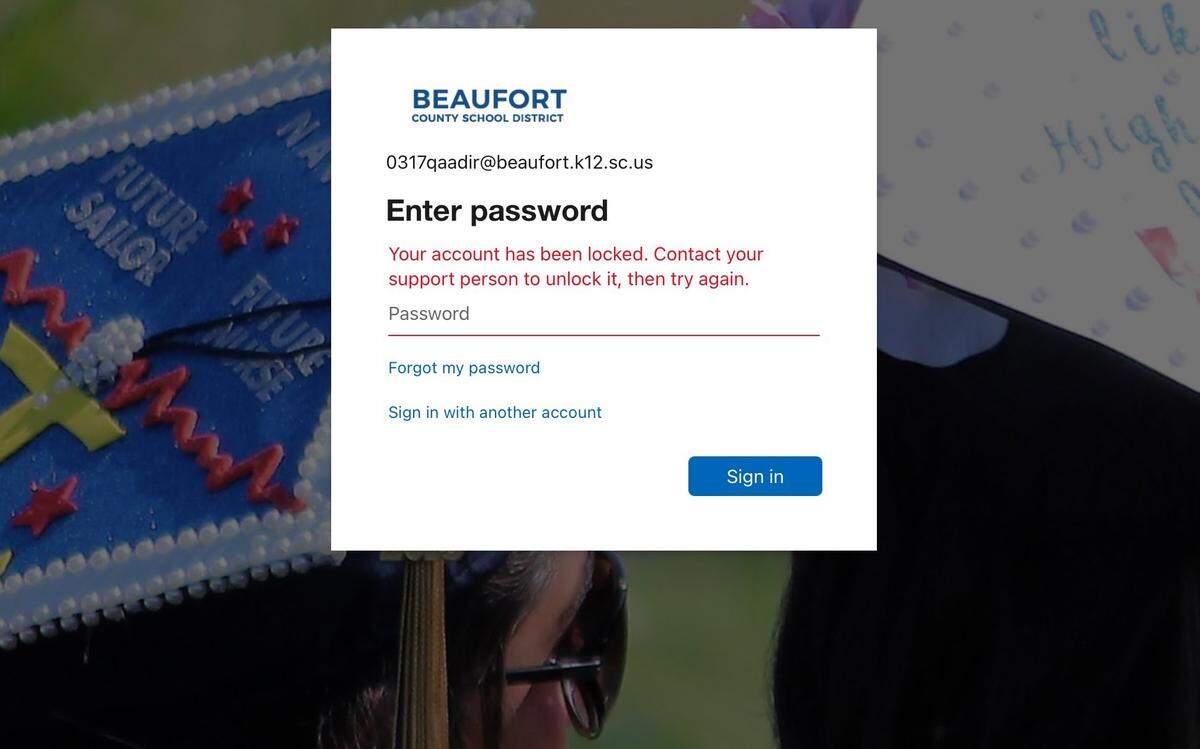
Phillips knows he no longer works for the school district — his email has been disabled, along with his login for Powerschool, which contained the database he maintained for M.C. Riley.
According to the district, Phillips resigned. In a Feb. 1 email to Robinson, he stated he would not “be returning to work, unless the denied reasonable accommodation is reversed.”
“Please know there has been no reversal of your accommodation request. To my knowledge, the decision still stands as not approved,” Robinson replied. “The district can use your email below as your notice of resignation effective February 11th.”
Phillips responded that he hadn’t resigned and had no intention of doing so. On Tuesday, he maintained that he was fired.
“I made it very clear I won’t resign,” he said. “They have to terminate me. But they don’t want to fire me, because they don’t want me to get unemployment.”
On Jan. 15, he filed a complaint with the U.S. Equal Employment Opportunity Commission regarding the district’s decision.
He claimed that his school’s leadership had not told him what his priorities and lapses were during remote work and added that his employment had been terminated “due to a lack of communication, gender, race, poor leadership, bias, slander, and gossip amongst other staff members who were not working remotely.”
His hearing is set for late March. Until then, he’ll be at home, watching his kids and wondering what happened.
“I loved being there for kids and parents,” Phillips said Tuesday. “Every kid I came across loved me. I was meant to be there, but my mission was not good enough for the principal.”
This story was originally published February 11, 2021 at 4:37 AM.