
School daze? Seen and heard on first day of school in Beaufort Co. in age of COVID-19
On the first day of school, the normal niceties — hugging classmates, wearing new back-to-school clothes, discovering friends in new classes — didn’t happen. Like students across the globe, Beaufort County’s students began the school year Tuesday in far different circumstances from last year’s start.
The coronavirus pandemic has changed the way all of us live and learn.
The vignettes below offer glimpses of that first day and how we’re doing as we educate and learn amid COVID-19.
‘I am not a robot’
Alex Smith let his grilled sandwich get cold as he scrambled to find headphones for his third grader.
The teacher’s voice could already be heard across the house’s lower level.
Sarah, Smith’s wife, was trying to find the headphone jack on her son’s school-provided laptop when a shrill call came from upstairs.
The Hilton Head couple’s youngest child needed help connecting to her Zoom class.
Both kids, students at Hilton Head Elementary, needed their working parents’ help to connect to Zoom classes, troubleshoot audio and visual problems and type in answers just as their classmates — some with the remnants of lunch still around their mouths — logged on for class.
Somewhere at the Smiths’ house, food in a toaster popped up.
No one rushed to grab it.
The pop up could wait.
School couldn’t.
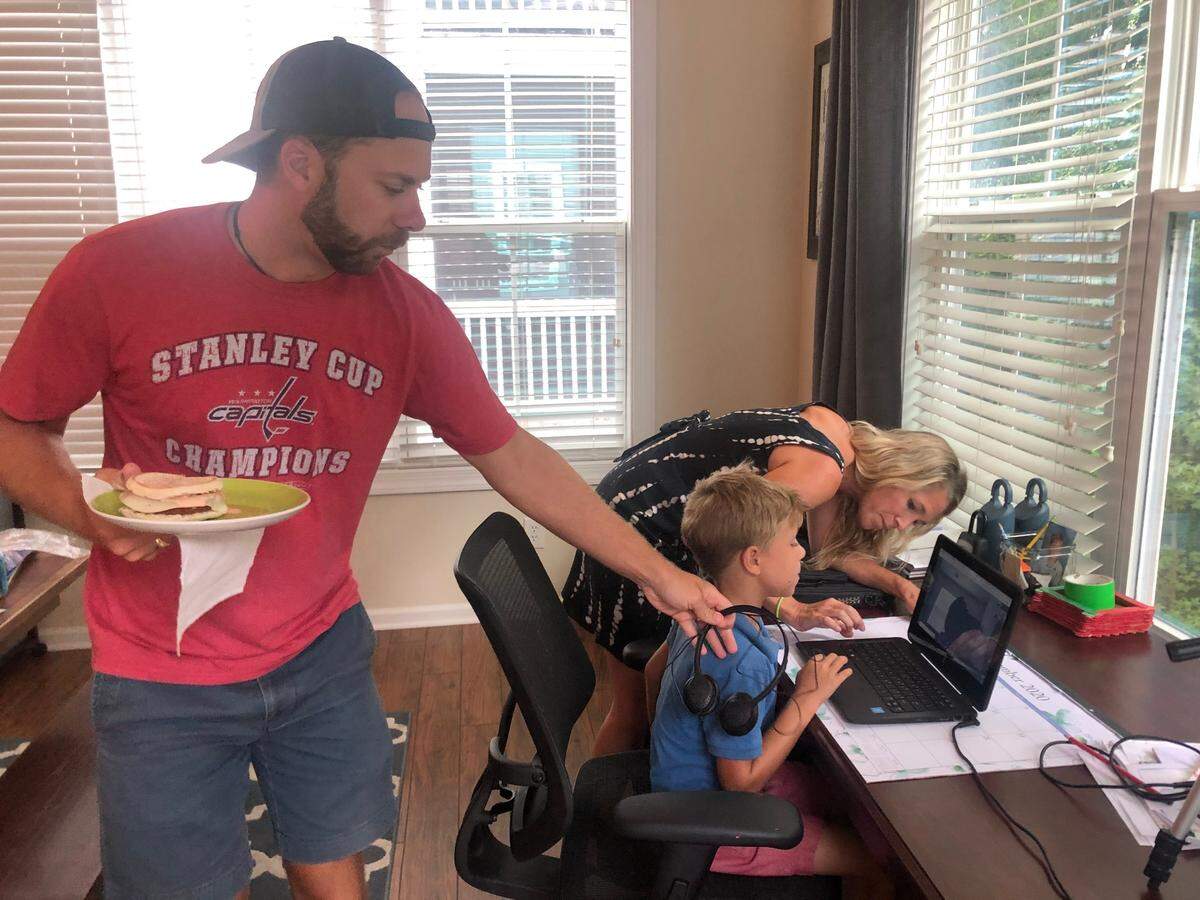
In the family’s house near Jarvis Creek, the first day of class was less about “facilitating learning” than putting out any number of small fires. The Smiths said the day showed them how flexible their teachers can be and gave them a new appreciation for what it takes to keep a class on track.
By lunchtime Tuesday, Sarah Smith estimated she and her husband had gone up and down the stairs over 20 times each. They went up to help Harper, their first grader, connect to her classes at a small wooden table adorned with stickers in the upstairs guest bedroom.
They went downstairs to keep third-grader Landon on task in a makeshift office next to the kitchen table.
The couple, who both work from home, divided and conquered on the first day and helped troubleshoot problems for other parents.
In between, they made calls and sent emails related to their work in real estate and insurance.
“Landon has a lot of instruction. He has to take a quiz, click this link, write a response, click another link and have that ready for the 10 a.m. Zoom class,” Sarah Smith said. “We can’t even leave to go to the bathroom or he misses something. For him to find the link on his own and do this? There’s no way.”
Things at home were chaotic, and the kids’ classes had a similar feel.
In the morning meeting of Harper’s first-grade class, none of the parents muted their computers.
That led to two dozen parents’ troubleshooting advice and instructions to students being broadcast to the whole class.
But Sarah Smith said Harper’s teacher took it in stride, switching roles from educator, to IT professional to parent coach in a matter of minutes.
“We’re just so appreciative for these teachers who are making it work,” she said.
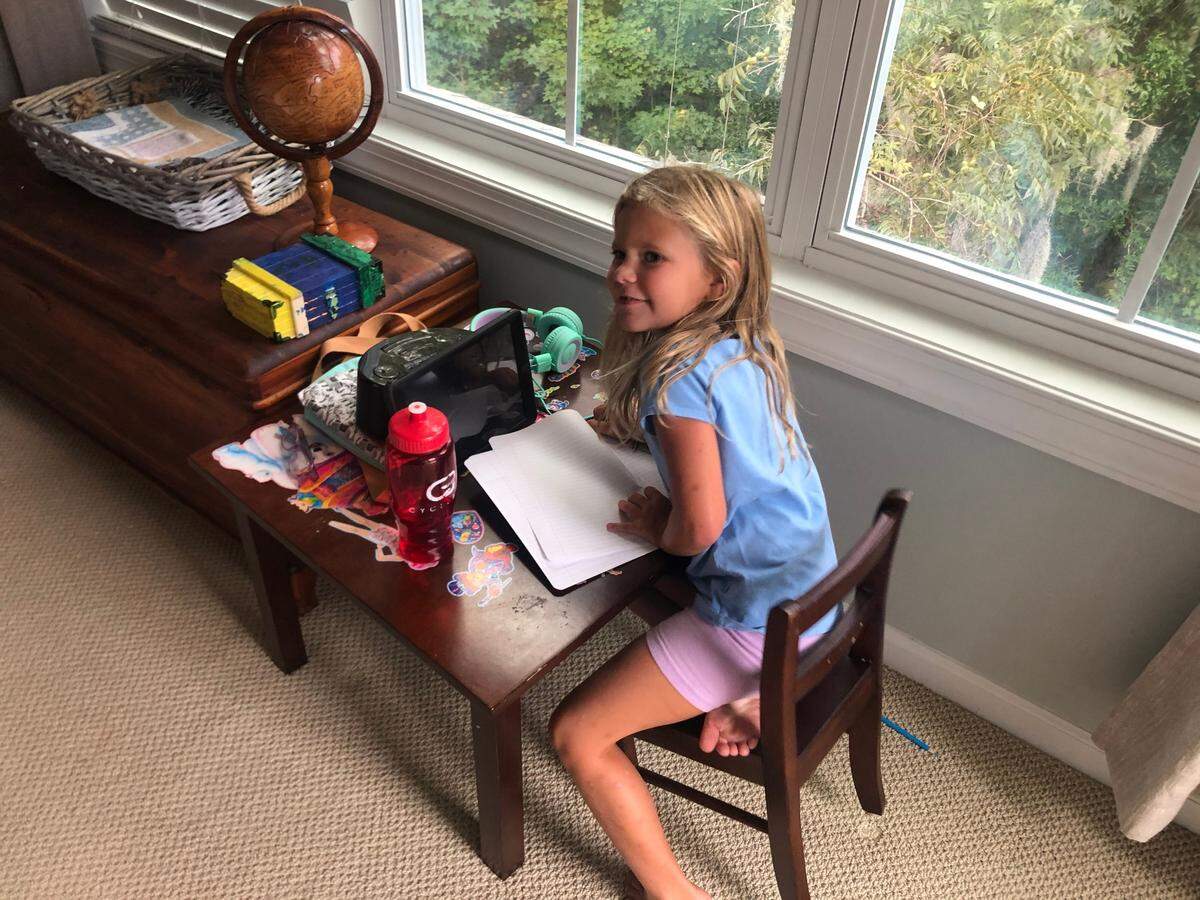
Throughout the day, Smith shared tips with other neighborhood moms.
One parent reported hearing only ear-shattering static feedback.
Another reported hearing absolutely nothing.
“The tech part is the hardest,” Smith said as she guided Landon through his sixth or seventh “I am not a robot” check so he could attend his 12:30 p.m. class.
Tuesday was only the beginning.
“It’s Day 1,” Smith said with a resigned shrug.
Traditions — new and old
At Pritchardville Elementary, principal Brenda Blue carried on a yearly tradition: She sprinted down the halls on a mission to visit every class on the first day.
She swung into Mary Powell’s classroom and waved hello to 30 first graders on the teacher’s laptop screen.
“Happy first day! Oh, hi Gabriel!” she said through Zoom.
Powell was one of three teachers on the call who combined forces for their first lesson of the school year: Zoom etiquette.
Powell had already fielded plenty of questions on online classes. Blue had asked teachers to send out a Google form for parents to submit tech questions or complaints. Powell got 35 responses before the first day, she said.
Students and teachers received their virtual classroom logins that morning, and many had questions about logging in.
There were more mundane questions, as well.
“We saw folks who didn’t understand how to turn on an iPad,” Blue said.
Students generally were less confused.
They knew all about Zoom, a platform they had used this spring.
“Once they settle in, we’ll move to our standards, our routine,” Powell said.
Part of that routine would be state-mandated MAP and iReady assessments for the start of the school year to see how well students retained information from a hectic stint in kindergarten, which ended without state or federal tests.
Small groups and breakout rooms via video allowed students to use “choice boards” to determine in-class activities, just as they would in a normal school year.
And there were “brain breaks” during their online classes — dance sessions and scavenger hunts to keep students from staring at a screen from 8:30 a.m. to 2:30 p.m.
A combined hour of lunch and recess was designed to be the same for every student to keep parents from juggling siblings’ free periods.
But first, teachers had the daunting task of helping the county’s youngest students get used to logging in for school.
Blue continued her welcome-back circuit, entering Kimberly Pennington’s kindergarten classroom.
Later, as students began to log off for a break, an adult face came into frame — Evan’s Seesaw account wasn’t working on his tablet, the face said, so he had missed all the instructions on how to find his reading assignments.
Pennington explained she’d recorded the whole lesson, and asked him to restart the app. He didn’t have to log back on until 9:20, when he could introduce himself to five of his new classmates.
For the five students who stayed on the call, Pennington clicked over to a slideshow with a cartoon classroom and a Bitmoji version of herself, then to a slide showing fun facts about her: her fourth grade daughter, her two dogs and her favorite food, pizza.
She called on Eli to fill in a slide of his favorite things, and after some confusion and help from his mom, he unmuted his mic to tell Pennington he liked the beach and vegetables — broccoli was his favorite.
“Eli is going to talk about that with his mom tonight,” Blue said. “It feels like a small thing, but it’s huge for them.”
In the time of COVID-19, traditions are important, a way to bring back at least a measure of normalcy.
Blue hopes to keep many of those traditions alive, among them the school’s “read to the principal” event. This year, parents who wanted their kids to read to Blue could fill out a Google form, and the school would send them a book for kids to read on video.
“You want kids to be excited about coming to school every day,” Blue said. “You want kids to think ‘my teacher is excited to see me.’”
‘It’s OK’
“So what’s the difference between an ‘A day’ and a ‘B day?’” a child asked.
Ann Ritchie, a sixth-grade teacher at Beaufort Middle School, smiled at the students on her screen and explained how the school’s alternating schedule worked.
She was sitting at a student desk near the window in her classroom.
Three other women, all sixth-grade teachers at the school, were spaced out in the room logged into the same Zoom meeting.
Virtual or not, Tuesday was in some ways like all first days of school: the eager sixth graders had a lot of questions. And some of them were a little nervous.
Some asked about technology, but most questions were about the transition from elementary to middle school.
“I need help finding the link, but my mom can’t help me because she’s a teacher so she’s in class, too,” another child said.
The teachers softly giggled. They understood the struggle.
“It’s OK,” Ritchie said with a small smile.
Principal Alvilda Graham poked her head in for a moment.
“This, and today really, is about easing the students’ nervousness,” Graham said.
‘It’s not chaos’
It’s just after 10 a.m. at Brooke Simons’ house in Hilton Head Plantation.
She’s set up in her family’s dining room with three screens.
One displays her Google Classroom.
The second shows her homework, where she has examined Einstein’s dreams.
The third has her Zoom account loaded and ready to go.
In front of her monitors, a diffuser emits a fine mist of stress-relieving essential oils.
It’s the 16-year-old’s first day of senior year at Hilton Head High School.
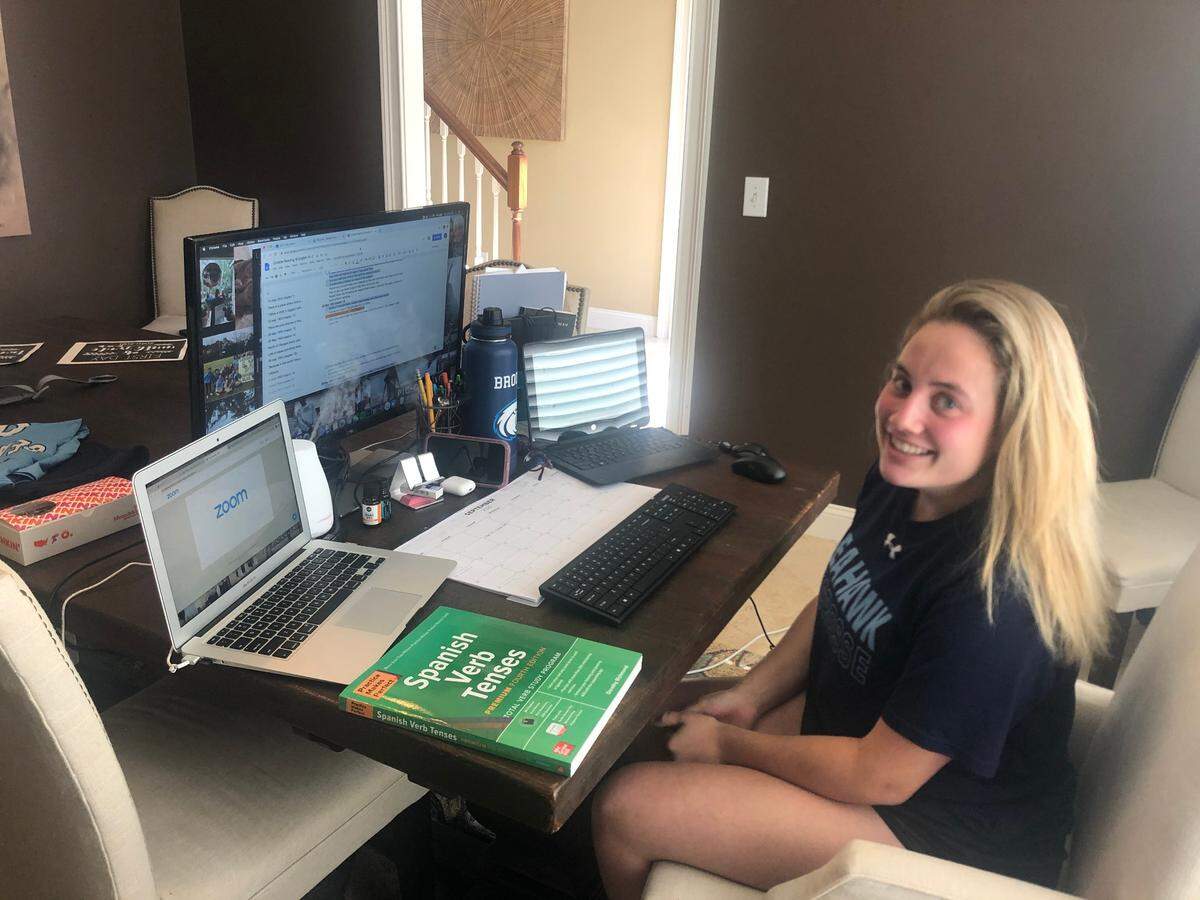
Brooke’s freshman brother, Garrett, is upstairs in his bedroom watching his class.
Mom Elise Simons is in the home office at work as event planner.
Dad Chip, a financial adviser who is usually working from a folding plastic table upstairs, is in Beaufort for a meeting.
The house is surprisingly quiet.
It feels more like a co-working space than it does a family home.
“We’re all pretty good about respecting each other’s space and knowing when people are on calls,” Brooke said.
“It’s not chaos,” her mother adds.
“Everyone knows what they need to do.”
‘This is so weird’
At the Boys & Girls Club of Hilton Head Island, Kassie Wiedower, the center’s director of education, darted around a room full of middle schoolers, answering dozens of questions.
It was just 9 a.m. Tuesday, on the first day of a new school in the age of COVID-19.
One girl didn’t know her class schedule.
A boy’s district-issued laptop refused to download Zoom.
“This is so weird,” added another, who was struggling to log into his virtual class.
“Weird” might have been the perfect word for Day 1.
“It’s all new,” said Wiedower, after telling a student to be careful while drinking his Capri Sun near a school laptop.
Wiedower was monitoring one of six “classrooms” at the child-care center, which is offering a program to watch kids as they attend virtual instruction.
On Tuesday, about 70 K-8 students attended.
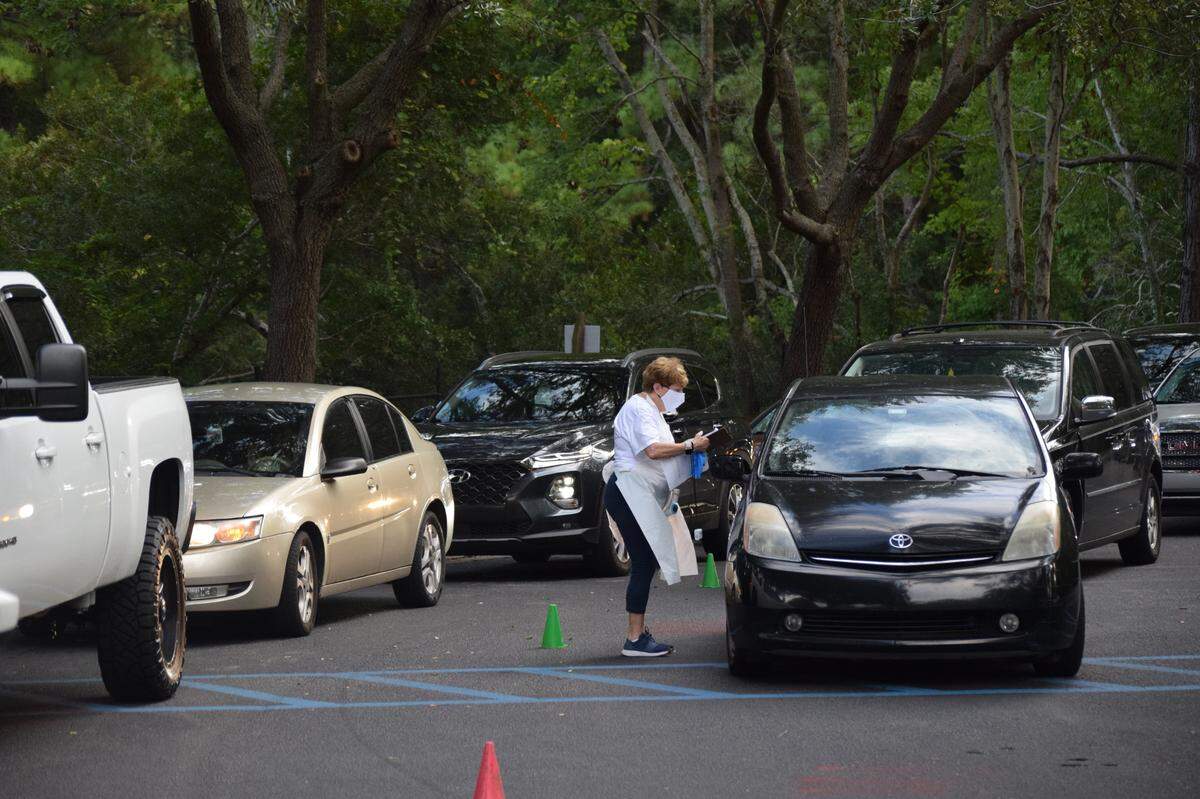
The kids walked into the building around 8:30 a.m. wearing a litany of face masks: Superman, one with tiny flamingos, one with cat’s whiskers.
Kim Likins, the club’s director, greeted them as their parents drove away.
She reminded them to use hand sanitizer.
Some students smiled.
Others shuffled their feet.
“We just have to work through that anxiety,” said Likins before she contacted Hargray about a WiFi issue. Elementary school students in a room next to the center’s gym were having trouble connecting to the Internet, she said.
Despite a few technology hiccups, things went reasonably well, Likins said..
“All in all, I think it’s been a pretty good day of school,” she said.
The center set aside six rooms for the program.
Only 12 kids are allowed in each room as a social distancing precaution. Seventy-two slots were offered in all.
But Likins said at least 70 kids were still trying to get in.
“We have a huge wait-list,” Likins said. “It just breaks my heart.”
First day struggles
It was mostly quiet Tuesday afternoon at the Hilton Head Island Recreation Association, where another child-care program was launched this week.
That silence, though, was interrupted by kids’ occasional tech questions and a group of middle schoolers laughing in a near-empty gym retrofitted to serve as two classrooms.
“My iPad just died,” said one boy around 1 p.m.
A few other children were frozen out of online classes about 2 p.m.
A group of sixth to eighth graders played “Mafia,” a murder mystery game, while waiting for their next Zoom call.
“It’s the first-day struggles,” said Bethany Brown, the center’s preschool and youth director.
Some children had issues logging into Zoom, but they worked through it.
A few tablets also had problems. Staff brought the devices to a help center at Hilton Head Elementary School.
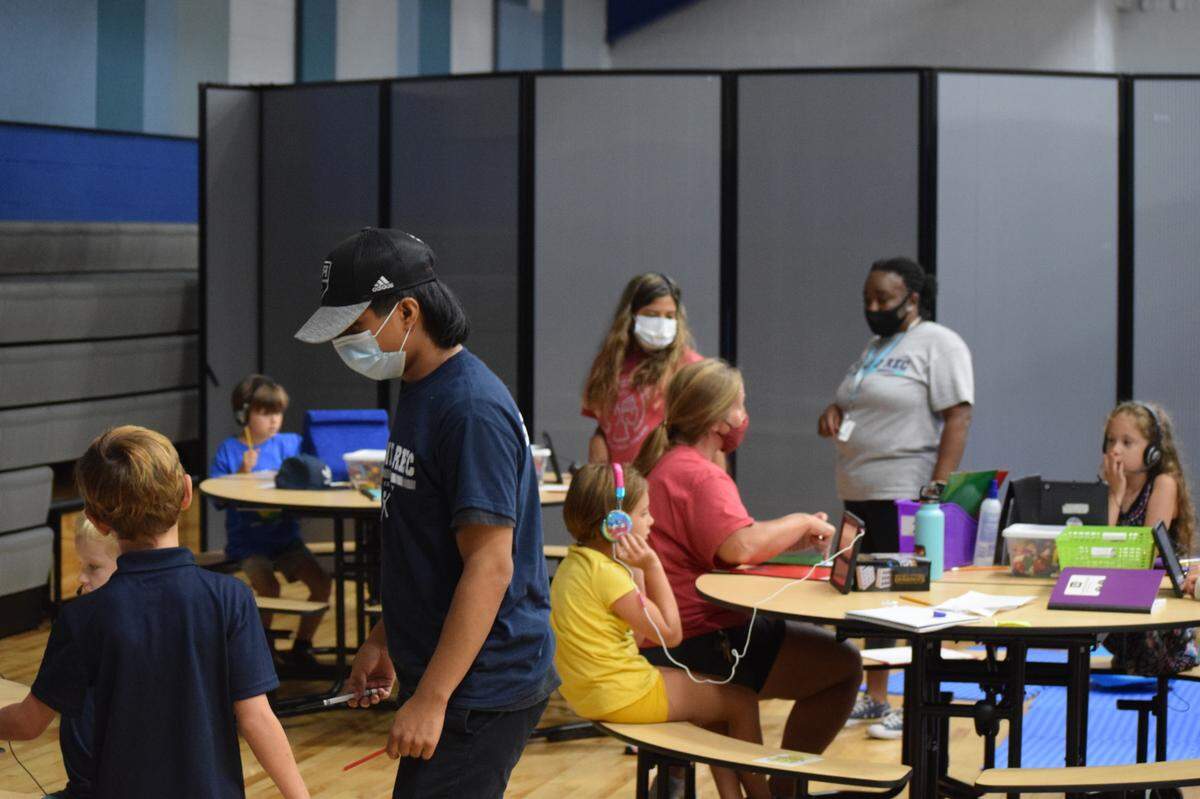
Like the Boys & Girls Club, the rec center took kids’ temperatures with a hand-held thermometer and didn’t allow parents indoors.
Staff members had to don face coverings.
Children, though, had an option to wear masks. (Most didn’t.)
Lauren Brown, a counselor watching teenagers on Tuesday, said the students were adjusting well.
It seemed like they were simply happy to be around one another, she said.
‘A little empty’
At Hilton Head Island Middle School, Principal Pat Freda stood with a group of students in the middle of the lobby, alternating between English and Spanish as she gave one of them instructions for his Google Classroom account.
Freda, a 30-year veteran of middle schools, said the school felt “a little empty” Tuesday despite the flurry of activity in the lobby.
“That little excitement of having kids in the building is missing, and I know that teachers and all of us kind of miss that while we’re walking around in empty halls,” Freda said. “Hopefully sooner than later we’ll get back here and we’ll have some kids in the building.”
Many of the students in the lobby were non-English speakers and sixth graders “who probably need a little tender love and care,” Freda said. Hilton Head Middle’s population is about 50% Hispanic, and about 20% of the school’s enrollment receives English as a second language instruction or interventions.
Charly Becker, an English-as-a-second language teacher who had just finished co-teaching a science class, said it was more difficult to do her job on the virtual platform, but she could still connect through question and response when students needed help.
She’s used to breaking down vocabulary and difficult concepts in science and math classes taught in English when non-native speakers need it. Normally, she could see student expressions and they could write questions to her during instruction; this year, they’d have to start sharing their screen with the whole class to ask those questions.
She prepared for Tuesday non-traditional opening in other ways.
Last year, all her lessons were pre-recorded, and this year, all Zoom meetings for classes would be recorded for students who needed to could catch up.
‘Hope and pray’
Jerry Hatcher stood alone in the middle of the practice field, with plenty of room for social distancing and a white mask covering his mouth.
But the Whale Branch Early College High School football coach was hardly muzzled.
His voice thundered instructions and gained a biting edge if players were slow to react.
Much of the scene would be familiar to anyone who has watched the Warriors in recent years.
But this year, so much is different.
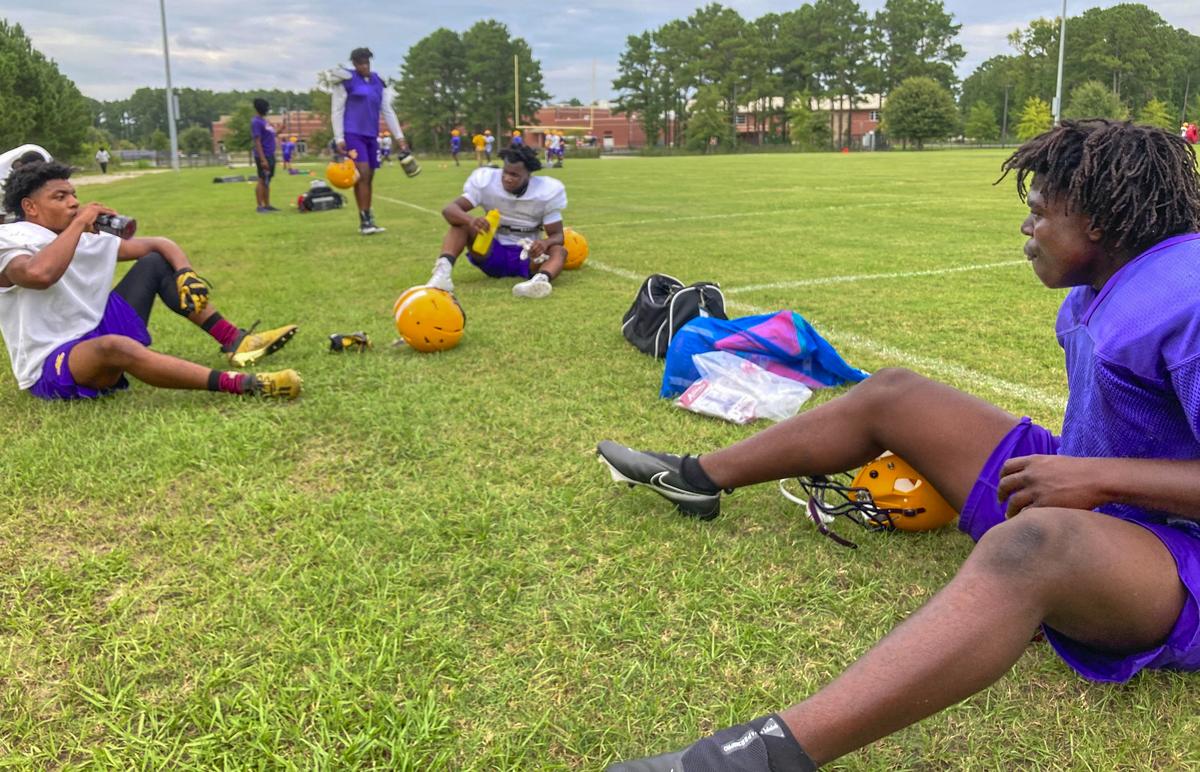
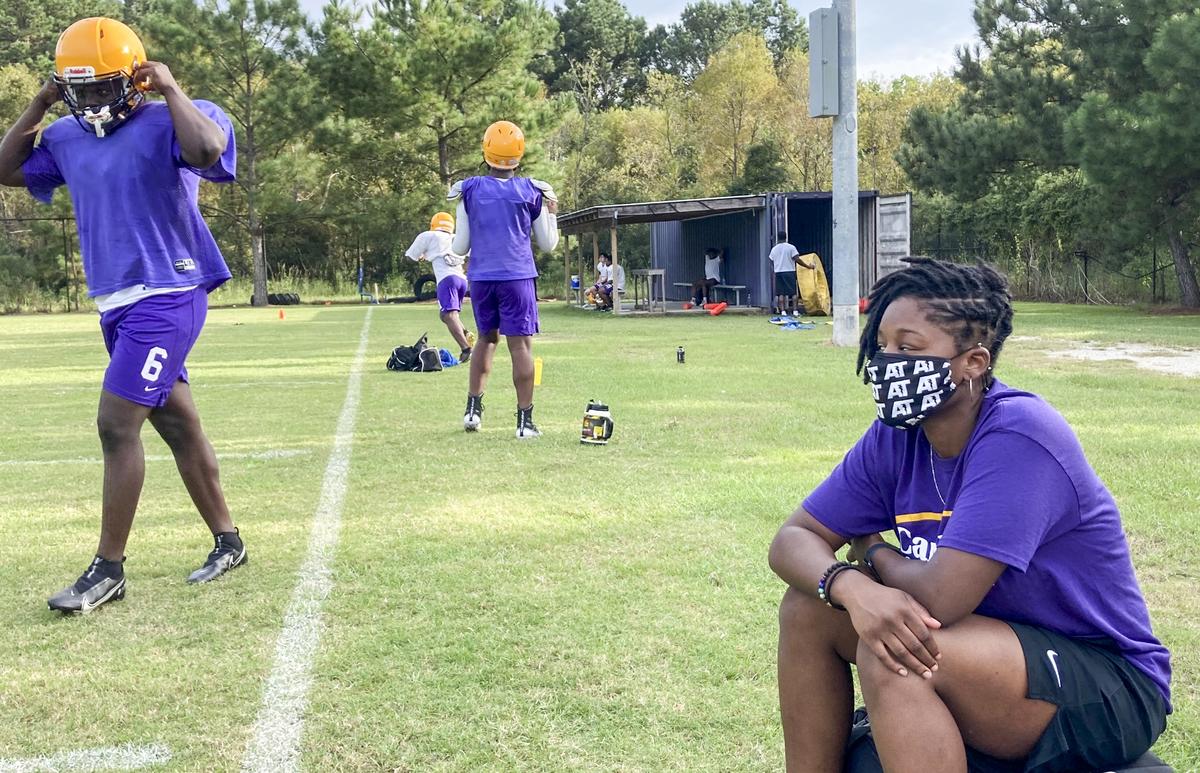
High schools throughout Beaufort County practiced for the first time since school started Tuesday. Because of the coronavirus pandemic, athletic trainer Tabria Cochran takes athletes’ temperatures and asks a now-familiar group of questions about any potential symptoms before players take the field.
The football team has been operating in small groups.
Players enter the locker room in staggered shifts so that there are never more than several of the teenagers in close contact at a time.
When players took breaks as a group, they spread out on the sideline and drink from their own water bottles.
But the action on the field became physical Tuesday, with the 27 players in shoulder pads for the first time.
And Hatcher admitted to some concern about the close contact.
Hatcher’s next-door neighbor and two members of his church have died due to COVID-19, he said.
“I think we’ve done a real good job of keeping them apart, social distance stuff,” Hatcher said. But starting today, we’re going to start putting hands on each other, we’re going to start hitting.”
Living in the age of conronavirus will affect fans, too.
School administrators are working on a method to purchase athletic tickets online to avoid cash changing hands at the gate.
The number of spectators allowed for the first football game Sept. 25 has yet to be determined as administrators decide how many people can be in the stands and in an ample standing-room-only area while maintaining safe distances.
Whale Branch will practice in full gear on Thursday and have a scrimmage that’s closed to the public Saturday.
On the sidelines Tuesday, athletics director Carlos Cave, in a Pittsburgh Steelers mask and purple Whale Branch visor, admitted some anxiety over the return from Labor Day weekend of players who might have been exposed to the virus. An outbreak could pretty quickly affect plans to compete.
“All we can do is hope and pray,” Cave said.
Forgetting the stress
Hilton Head restaurateur Fernando Lossada is excited about the school year.
His motto: “You have to keep it positive. If you go negative, you won’t make it.”
He and wife Heather knew they would have to come up with their own plan to give their kids a structured learning environment. Doing virtual school from their Sea Pines home last spring had been filled with so many distractions, not the least of which was finding a giant alligator ransacking their patio.
The couple decided they would set up their own learning pod, enroll their three children in the K12 South Carolina Virtual Charter School and hire a learning coach to direct the kids through their day while the parents worked.
“That was a tiny idea that started back in June, and it’s been a snowball,” Fernando said.
Price Beall and Sandy Beall, Lossada’s partners in the Truffles and Chow Daddy’s restaurants — Heather Lossada also works for the business as an administrator — agreed to let the family transform some vacant office space into the HHI Learning Club.
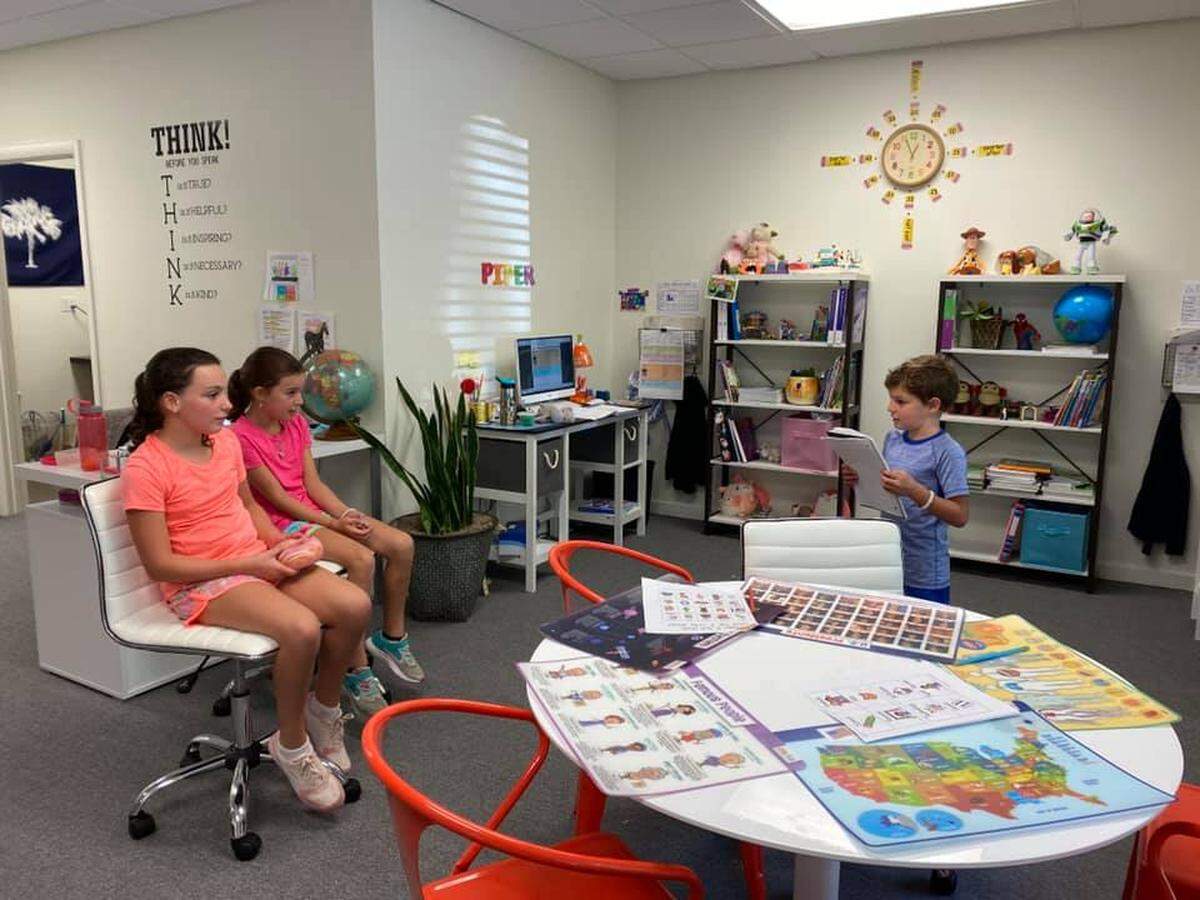
The result is a bright and colorful classroom with computers for fifth-grader Isabel, fourth-grader Piper and first-grader Renzo, a common area for reading or playing games, and a designated arts and crafts zone.
Lossada said he wished he had been recording video when the kids saw their classroom on the first day.
“Their faces ... it was like they were walking into Disney,” he said.
He has also created an after-school activity program for his children and some of their friends.
His goal is to have something different every day.
A recent afternoon saw 18 kids racing through an obstacle course on a grassy area near their classroom.
An art teacher plans activities each Wednesday, and Lossada wants to teach the kids about 3-D printing, maybe have a fall festival, all the things a typical school would do to keep things as normal as possible for the students.
“We are having fun,” he said. “Anything we can do to have fun and forget about the stress, I’m there.”
Technology tested
Mark Chauhan, the Beaufort County School District’s technology services officer, called Tuesday “very comparable to any other start of the school year” — getting 21,000 devices out to students is stressful no matter where they’re based, he said.
The biggest issue?
A national outage for Google, which interfered with some Google Drive and Google Classroom accounts. According to Chauhan, most district accounts had “limited connectivity.”
But one of the biggest tests for the district’s online approach won’t happen until later in the week.
The majority of teachers opted to use Google Classroom and Zoom for first-day introductions, meaning students haven’t used the district’s new virtual classroom platforms — Virtual SC for high schools and K12 Learning Solutions for elementary and middle schools.
Teachers and students received their classroom logins for K12 Learning Solutions on Tuesday.
“A lot of our software is based on user profiles, so that software doesn’t get deployed to the device until the kid logs in for the first time,” Chauhan said. “With our COVID procedures, we didn’t have as much time with the kids on site in the buildings, so every now and again not all the software comes down.”
Teachers are “the first line of defense” when students report problems, Chauhan said. If they can’t fix the problem, they’ll forward it to a school technology coach or a district technician.
The district is setting up call centers to handle issues, but for the first week, “every technician is at a school or a site,” Chauhan said.
If “10 or 15” students report the same tech problem, the solution gets added to the district’s e-Learning resource page.
Once the first few weeks of school pass, the district will go back to the “tech depot” model it used last year — but it’s expanding from two to five depots, with one in each school cluster.
‘Normal as normal can be’
At Bluffton High School, Col. Thomas Foster was preparing for a strong finish to the end of his first day of teaching.
Foster recently retired from the U.S. Army, and agreed to take over the JROTC instructor position for this school year before COVID hit.
He got his “first taste” of teaching at a summer drill camp a few weeks ago. “There are a couple of superstars in the class,” he said as he began admitting students to his fourth-period Zoom session.
He said his wife, Lynn, a teacher at H.E. McCracken High School, was his mentor for virtual instruction.
He was using her Bitmoji-laden Powerpoint slide to explain Zoom etiquette, and quickly launched into an introductory game of Cahoot that she favored for the first day of class.
Aside from “one young lady with a doctor’s appointment,” attendance was perfect.
Josh Fox, an English teacher at the school, said he’d deliver about 30 minutes of lecture, then allow students to complete independent work or activities.
“I just told them, if that means you lean back on your bed and start working on work, [or] if you go sit at the kitchen table and start working on work, that’s fine,” he said.
“We’re just all going to keep (Zoom) up and open, and if you have questions, I’ll be at my desk for you to shout them out. If it’s a question they want to ask discreetly, you can use the private chat function on Zoom or send me an email.”
For the first day, students could join a Zoom session with counselors, who would take them to a breakout session to guide them through class registration or technology issues.
Principal Denise Donica, a former math teacher, had assembled a flowchart for counselors to consult as students detailed their problems.
“We have a plan, and it’s working,” she said in her office. “It’s as normal as normal can be right now.”
Island Packet and Beaufort Gazette reporters Katherine Kokal, Lana Ferguson, Stephen Fastenau, Rachel Jones, Lisa Wilson and Sam Ogozalek contributed to this report.
This story was originally published September 10, 2020 at 4:45 AM.