
How Beaufort Co. schools will handle sanitation, buses and social distance in January
As schools head into Thanksgiving break, Beaufort County School District is gearing up for another change: The district will open its classrooms for in-person instruction five days a week starting Jan. 4, when students return from winter break.
Students who are already registered for the district’s current in-person hybrid classes will automatically be placed in the full-week classes when they begin, though the district will continue to offer virtual-only classes through the end of the school year.
Students are able to change their registration from virtual to in-person instruction or vice versa for the spring semester, which begins Feb. 2. The window to change that registration opened Nov. 16 and closes Nov. 24.
The district hasn’t seen “very many shifts whatsoever” in registration since then, deputy superintendent Duke Bradley said. Most of the changes have been from virtual to in-person.
Bradley said Thursday that “not really much will change” from the district’s current hybrid-instruction protocols once the switch to five days a week happens in January.
But with twice as many students in buildings at a time — and the end of all-virtual Wednesdays, which were used to sanitize buildings — here’s what you can expect to see for social distancing, cleaning, bus routes and burnout.
The effects of COVID-19 in schools so far
Public health experts earlier this year predicted massive COVID-19 outbreaks in the state’s K-12 schools.
But Beaufort County School District hasn’t recorded significant disease spread in its classrooms so far, based on the district’s data. Only 108 coronavirus infections have been confirmed among students or staff since Sept. 28.
District spokeswoman Candace Bruder said Nov. 13 that approximately .05% of the district’s students and staff were testing positive for the virus each week, far below the district’s threshold to reopen.
Dr. Scott Curry, an infectious disease specialist at MUSC, reviewed the S.C. Department of Health and Environmental Control’s coronavirus case data for Beaufort County schools.
“There’s nothing like an outbreak, as I would define one, at any of the local schools in your area,” Curry said. “But schools are running at substantially less capacity.”
He said K-12 cases this fall were measured when S.C. didn’t have much “hot zone” disease activity.
“The test will be if we can get to a bad part of COVID spread among adults and see if it stays out of schools,” he said.
“I would have expected to see more outbreaks,” said Kathleen Cartmell, a public health professor at Clemson University, in an interview Monday. “It could be that kids really are less likely to get severe symptoms and we’re not picking it up as much.”
In other words, without school-mandated COVID-19 testing, some asymptomatic carriers of SARS-CoV-2 or kids with mild symptoms may not be reflected in BCSD’s coronavirus numbers. The district doesn’t regularly test students.
A recent study published in The New England Journal of Medicine found that asymptomatic Parris Island recruits quarantining at The Citadel in Charleston earlier this year still spread the virus to others. Researchers discovered those infections only through scheduled PCR testing.
And colleges with high case counts, including the University of South Carolina, have identified hundreds of coronavirus infections by testing both asymptomatic and symptomatic students.
Clemson University, as another example, requires students living on campus to get tested once a week. The Upstate college has recorded 4,903 student cases since June 5.
“If you’re not testing, you’re not going to find it,” Cartmell said.
Gov. Henry McMaster on Thursday announced that he would issue an executive order directing DHEC to provide COVID-19 test kits to school districts around South Carolina.
Cartmell, though, stressed that she’s still surprised that COVID-19 outbreaks in the state’s K-12 system are not as bad as initially feared, considering schools’ reported case counts.
It’s not entirely clear why the schools are faring better than some expected.
Dr. Frank Esper, a pediatric infectious disease specialist at Cleveland Clinic Children’s in Ohio, previously said that children under the age of 10 are seemingly less affected by COVID-19.
“They can get infected, they can spread, and they can get sick, but thankfully not nearly as often as older people,” Esper said.
Young kids are apparently able to resist the infection better than others, he said.
Michael Schmidt, a microbiology and immunology professor at the Medical University of South Carolina, in an interview Tuesday also said kids in BCSD schools might be driving case numbers down through mask use.
Masking is key to preventing COVID-19 spread, experts say.
Schmidt stressed that K-12 conditions are different elsewhere in the U.S. amid the country’s third coronavirus wave. The U.S. has logged record-breaking case numbers in recent days, as infections mount in states from California to Iowa.
“We’re in a deep ditch,” Schmidt said. “And we have no way of getting out.”
COVID-19 prevention and social distancing
Beaufort County School District will continue to require masks on campus and conduct daily temperature checks in January, though Bradley said Thursday that those checks haven’t resulted in “any COVID detection” since they began Oct. 19.
One of the biggest changes for the district will be an increase in students per classroom. Under hybrid instruction, most classrooms had a maximum number of students that hovered around 12, and students were kept at least six feet apart. But that could change in January, especially at schools with high in-person participation and a history of overcrowding.
“We acknowledge fully that physical distancing is going to be more difficult in our more crowded schools, most of those are south of the Broad,” Bradley said. “I can think of three or four right off the top of my head that will make it more difficult to physically distance.”
The district will provide desk barriers to students to alleviate some concerns around social distancing.
Chief operations officer Robert Oetting said Wednesday that the district has purchased or received from the state four different types of desk barriers for different seating configurations, ranging in price from around $20 to $80 each.
The most common protection will be a “tri-fold” barrier with a see-through window and two plastic wings for support at individual desks.
Changes for teachers
“In the age of COVID, everything is more difficult for teachers,” Bradley said Thursday. “Every typical standard, professional expectation that we have for teachers has increased and has contributed to their stress.”
In the announcement to resume hybrid classes, Bradley and Rodriguez both cited principals and teachers saying that hybrid instruction had contributed to a spike in teacher absences and stress during the fall semester, which has led the district to hire substitute teachers from Savannah in addition to their normal Beaufort County pool.
“Hybrid is better than not having the ability to have kids in the building at all,” said Chad Cox, principal of Battery Creek High School. “But now that we’ve done this system, it does stretch the system of school to our capacity in some cases.”
One of the largest sources of that stress — delivering simultaneous online and face-to-face instruction for hybrid classes — will end for many of the district’s 1,000-plus teachers in January, Bradley said Thursday.
“We should be fairly well positioned to not even have to ask teachers to execute simultaneous instruction,” he said.
The notable exceptions will be some high school courses with high demand and classes with large numbers of students in quarantine.
Sanitation for schools and buses
The district will continue daily cleanings and weekly sanitation protocols during full-week instruction, Oetting said Wednesday — but sanitation will take place mostly in the evenings instead of Wednesdays, when school buildings are currently closed to allow for deep cleanings.
Over the summer, the district purchased HaloFogger machines for each school in the district. The upright, rolling machines spray a disinfecting mist of hydrogen peroxide and ionic silver across each room in the building on a weekly basis.
Each of the machines, which cost about $10,000 and were paid for with CARES Act money, can disinfect most of a school building in a day. In addition to their weekly schedule, the machines are used to quickly disinfect areas with a known COVID-19 case.
A small room takes about 25 minutes to spray and wait for the mist to clear, while a media center or gym could take 2 1/2 hours and a little under a gallon of the disinfecting solution, which costs around $60. HVAC is kept on while the machines run, so it is sanitized as well.
“You can go in and eat off the counter after the machine runs,” said William Wagner, the district’s contracted Bluffton manager for HES Facilities Management.
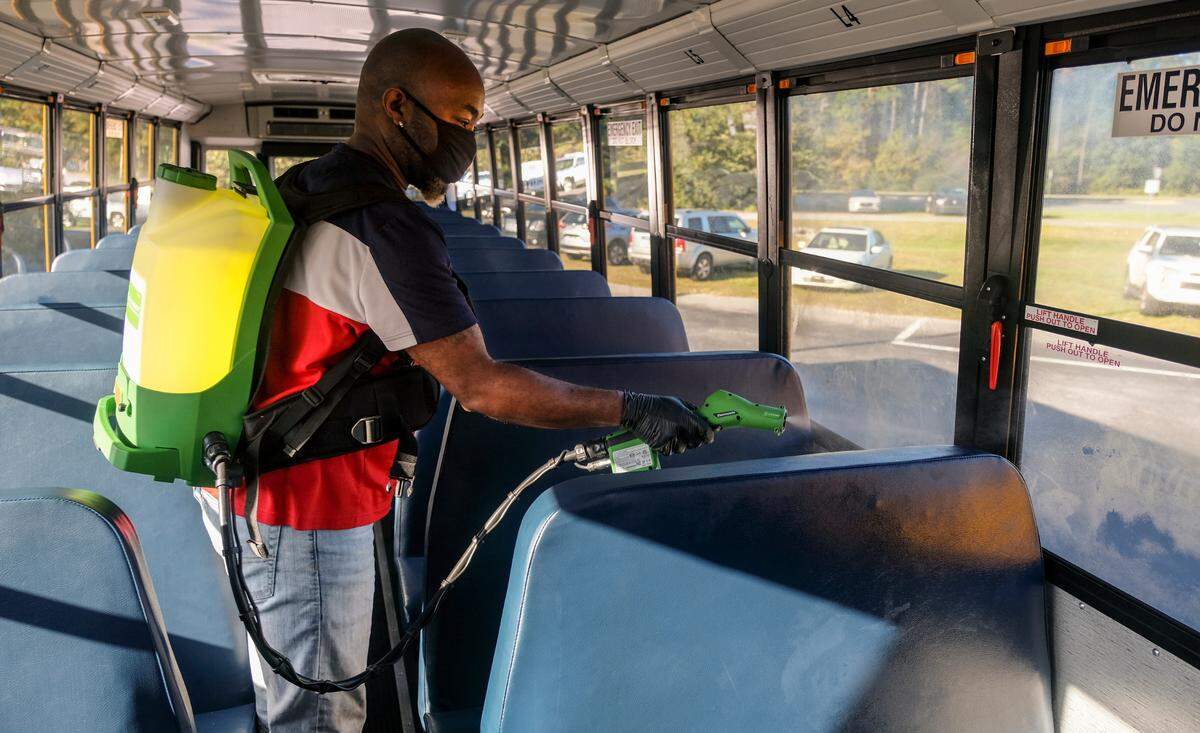
On buses, drivers are using a similar solution with handheld electrostatic sprayers after every bus route (at least twice a day).
Bus capacity will be kept at or below 67% as more students ride the bus every day, Oetting said. The district is creating seating charts for buses, running multiple bus routes and hiring more drivers to make up for the lack of a substitute driver pool.
“We can handle absences with the demand now,” Oetting said. “In January, it’ll be more difficult.”
This story originally published Nov. 20, 2020
This story was originally published November 20, 2020 at 10:06 AM.