‘Motivated suicide’ term stirs controversy in case of missing Hilton Head couple
READ MORE
From the Archive: The Island Packet’s coverage of the disappearance of John and Elizabeth Calvert
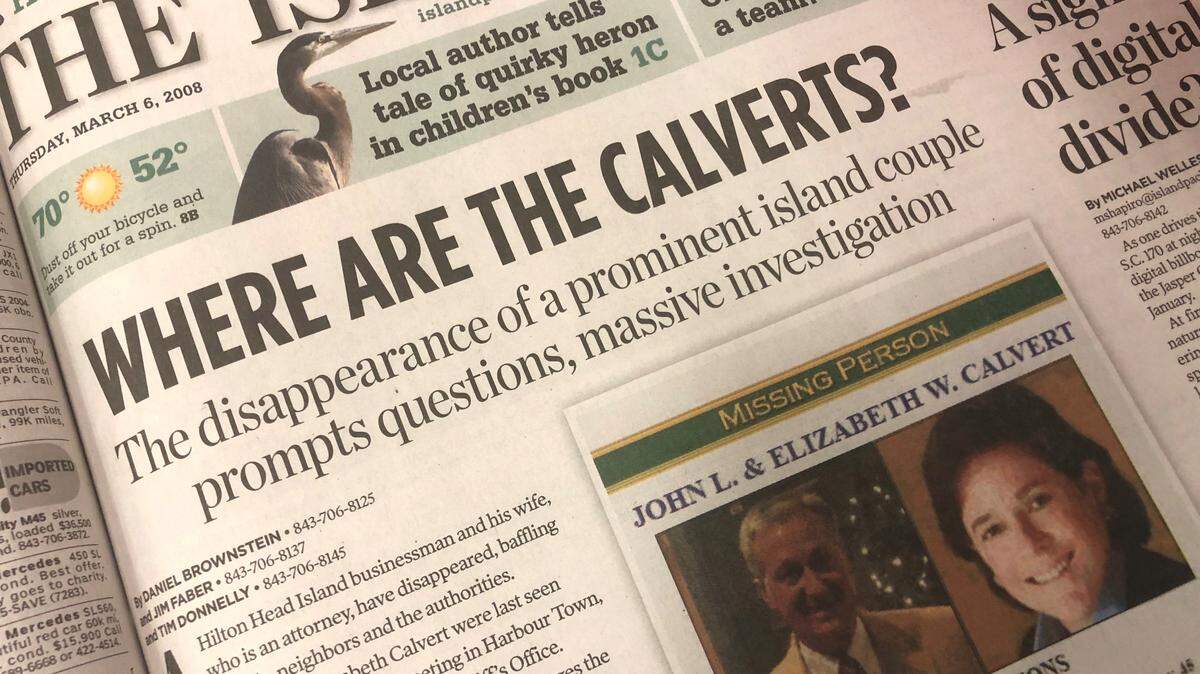
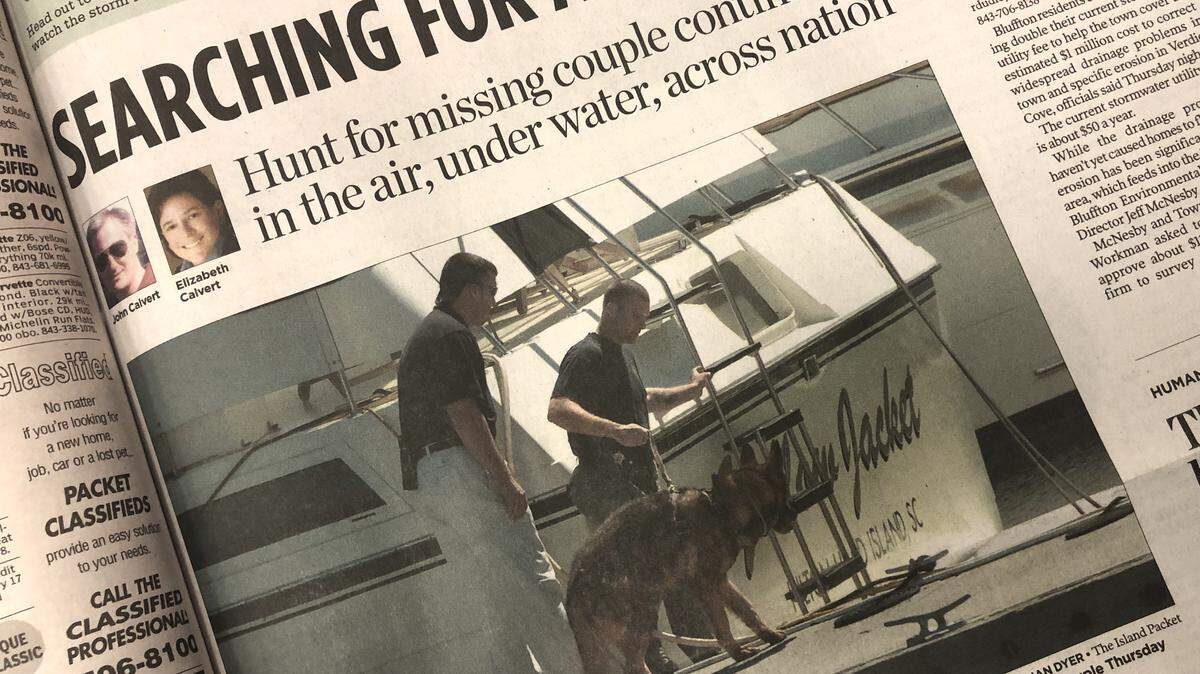
Hilton Head couple John and Elizabeth Calvert were last seen on March 3, 2008. Revisit the Packet’s coverage here.
Expand All
This story originally was published in The Island Packet on March 28, 2008.
Editor’s note: This report includes graphic details about suicide that may be disturbing to readers.
When a reporter asked Beaufort County Sheriff P.J. Tanner on Wednesday why Dennis Gerwing would have cut himself more than six times in what was probably a gruesome and painful death, Tanner’s responded that it was a “motivated suicide.”
That led to more questions.
What does that mean? Motivated by what?
Tanner said the term came from the pathologist who examined Gerwing’s body, and the sheriff said he didn’t have an explanation beyond that.
“That’s what I was told,” Tanner said. “I can’t give you a definition of their expression.”
Gerwing, the only person so far linked to the disappearance of John and Elizabeth Calvert, killed himself in a locked bathroom of a Sea Pines villa March 11. His death has already been the subject of intense speculation. Wednesday’s classification of the suicide again raised some eyebrows about what the term means.
No definition exists for “motivated suicide,” and it isn’t an official term or description in the medical or psychiatric fields, according to several local and national doctors, experts and coroners, who say they’ve never come across it before.
“I’ve never heard of that in reference to a medical term or a forensic term,” said Dr. Kim A. Collins, professor of pathology at the Medical University of South Carolina, where Gerwing’s autopsy was conducted. After all, Collins and others pointed out, any person who sets out to commit suicide is “motivated” by definition.
So does that mean the phrase has some deeper meaning?
Probably not, the doctors and experts said.
Pathologists often consider the external factors behind a suicide, things such as alcoholism, debt or anything beyond psychological problems, said Thomas Andrew, the chief medical examiner for New Hampshire.
“That is by no means a diagnostic or medical term,” Andrew said. “These other external circumstances may ‘motivate’ him to take his own life.”
Roger Sorg, the Hilton Head pathologist and deputy county coroner who examined the body at the scene, said the term “motivated suicide” did not come from him.
‘SOME VERY FATAL AREAS’
The preliminary autopsy report released Wednesday described several cuts on Gerwing’s body apparently made by a serrated steak knife with a black, plastic handle. Six of them were major, the deepest being a 7-inch gash into the lower neck and a 4-inch cut into the inner right thigh. Other cuts were found on Gerwing’s wrist, calf, hand, arm and thighs.
The body was found in the bathtub, where Gerwing had put a bed comforter and pillow, in the locked bathroom of the Swallowtail villa.
The circumstances and method of death may sound odd, Tanner said Wednesday, but the Sheriff’s Office is confident Gerwing died by his own hand. There is no evidence anyone else was in the villa or involved, Tanner said.
“I’m sure that you would draw some conclusions that it is unbelievable,” he said. “But the true facts reveal that this was a motivated suicide as we’ve been told.”
A pill container and an empty wine bottle were also found in Gerwing’s villa.
John Parkinson, a psychiatrist in Wilmington, N.C., who studied at the Medical University of South Carolina, said the kind of suicide Gerwing committed would have taken some forethought and a “reduction of impulse.”
“He went to some very fatal areas,” Parkinson said of the wounds.
Doctors say it’s common to find a body with “hesitation wounds,” different non-fatal, sharp-force injuries where the person cuts himself, but not deep enough to cause death.
Multiple injuries on a body sometimes indicate a person wanted to inflict additional pain on himself, or is filled with aggression, experts said.
Two big, unanswered question remain: What drove Gerwing to that end and what was in the single-page, double-sided suicide note left on the bathroom counter?
Anonymous law enforcement sources said earlier this month that Gerwing admitted to stealing money from the Calverts in notes he left, but did not say whether he had a hand in their disappearance. Those sources also said his body had multiple stab wounds to the chest, information that did not match the autopsy report released Wednesday.
Gerwing was chief financial officer for The Club Group and formerly handled bookkeeping for the Calverts until December, when John Calvert brought those duties in-house.
John Calvert, 47, owns four island businesses, including the one that operates Harbour Town Yacht Basin and another that rents out 125 vacation properties. Elizabeth Calvert, 45, is a Savannah business attorney.
Richland County coroner Gary Watts said he’s never heard the term “motivated suicide,” but the phrase could just be a colloquialism the pathologist used.
“Obviously, for someone to do something like that,” Watts said, “there has to be some motivation factor involved.”
This story was originally published January 29, 2020 at 10:31 AM.