Beaufort magistrate appears in court on DUI charge. Will a jury decide his case?
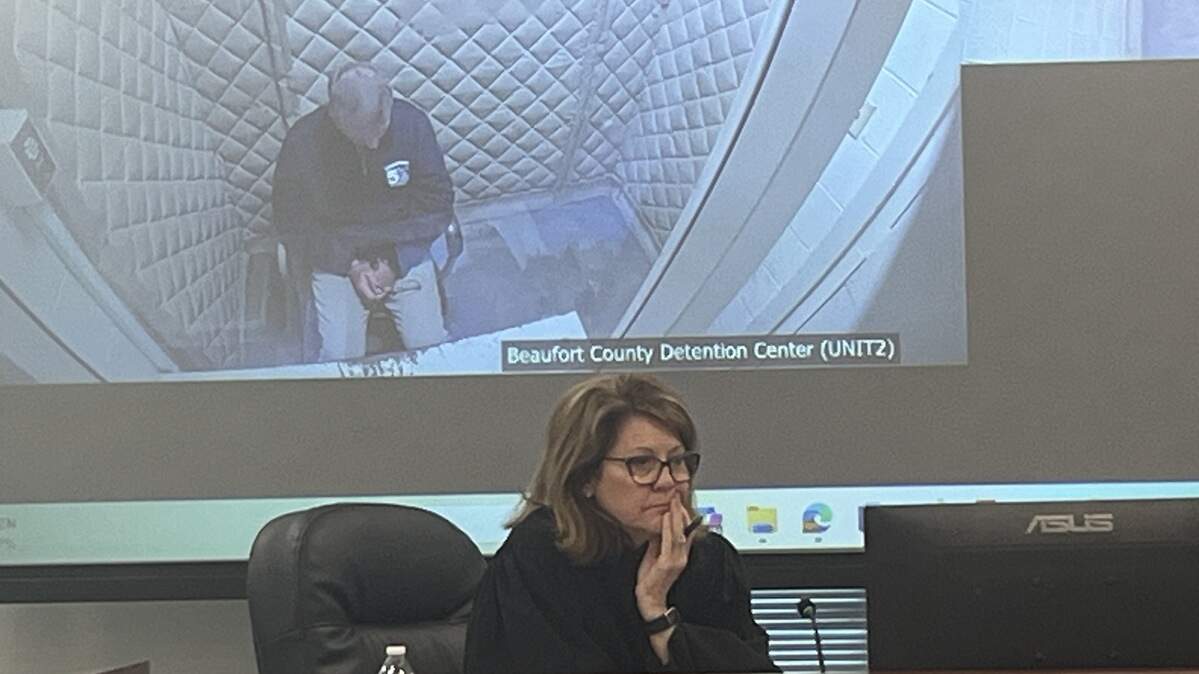
A magistrate appeared in magistrate court on Thursday as a defendant, not the presiding judge, in a case that’s being closely watched in legal and law enforcement circles in Beaufort County.
Magistrate Thomas Holloway is charged with DUI less than .10, first offense.
Scott Lee, Holloway’s defense attorney, contested the state’s contention that Holloway refused to take a blood-alcohol test, a move a jury may not look upon favorably, if true.
Lee also argued the case should be thrown out because some law enforcement officers muted the audio on their video cameras at the scene, which Lee said amounted to the destruction of evidence.
Lee also told the judge that bond amounts Holloway set as a judge before he was arrested — which were criticized by Beaufort County Sheriff P.J. Tanner — provide context in his DUI case.
Prosecutor Meagan Chinnis Askins said Holloway should be tried before a jury — not just a judge — because he’s a public figure. Her request for a jury trial was granted by Judge Meree Williamson at Thursday’s three-hour pretrial hearing.
The collision
Holloway, 61, of Fripp Island was traveling south on Sea Island Parkway Oct. 29 when he hit a vehicle driven by Katrina Sellars, who was trying to turn left onto Sea Island Parkway from Seaside Road. She was cited for failure to yield.
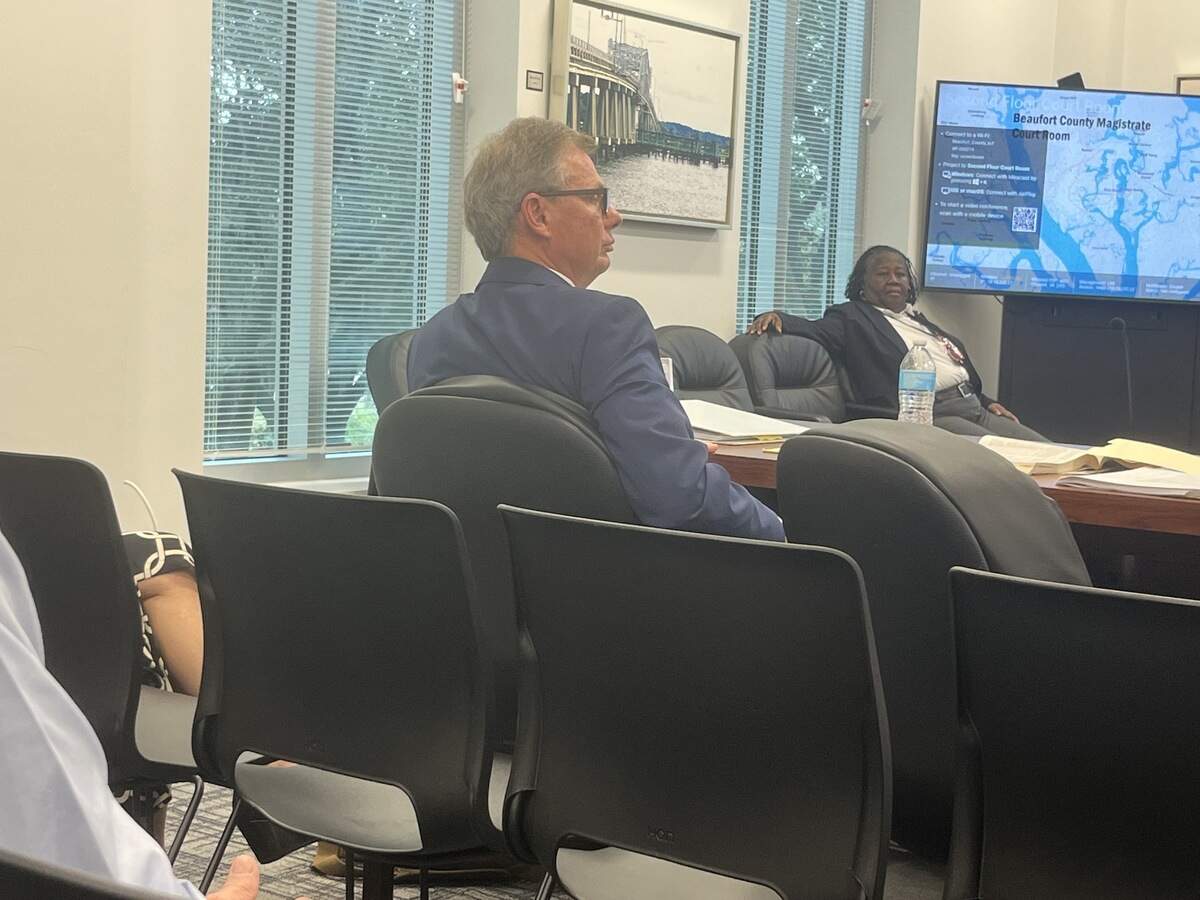
Wearing a blue suit, the 61-year-old Holloway appeared much different from his disheveled appearance after he was booked. During the hearing, he sometimes wrote on a yellow legal pad or handed papers to his attorney, Scott Lee. During a break, he rose and put his arm around his wife, who was seated in the first row behind him.
Lee pressed Williams to allow the trial to begin immediately, arguing Holloway was eager because the case had put his judgeship on hold and caused “tremendous harm” to his reputation due to the media publicity.
Bench or jury trial?
A “bench trial,’’ a trial that would be heard before a judge, not a jury, was originally scheduled to begin Thursday. Holloway had waived his right to a jury trial.
But the mode of trial and the start date where changed after prosecutor Askins refused to agree to Holloway’s waiver of his right to a jury trial.
A jury trial, Askins said, was appropriate in this case because it would offer more transparency in light of Holloway being a public figure.
Lee, Holloway’s attorney, objected, saying bench trials are the default practice in magistrate court.
“Nothing is being hidden,” Lee told the judge.
Lee suggested the real reason the state asked for a jury trial, which would require additional time to pick a jury, was because it wasn’t ready to go to trial.
“That’s outlandish your honor,” said Askins, adding she was ready to go to trail that day.
Williams agreed to an April 27 jury trial but chided Askins, the prosecutor, for filing the last-minute motion calling for a jury trial.
“I was not happy to receive this on Friday afternoon after every party was prepared to go forward today,” she said.
Did judge refuse test?
After the October crash, Holloway told Lindsey Romagnino, a senior trooper with the South Carolina Highway Patrol who was in court Thursday, that he was driving home from his property in Colleton County, where he had been hunting. He said Sellars’ vehicle pulled out in front of him. Sellars suffered minor injuries. Holloway was seen for a broken nose and a concussion.
Another point of contention during Thursday’s hearing was whether Holloway refused to submit to a blood-alcohol test, as the state contends.
When Romagnino initially asked whether he would submit to a test, Holloway asked to talk to an attorney a few times, which Romagnino eventually took as a refusal.
But Lee, Holloway’s attorney, argued that Holloway did not explicitly refuse, and only asked for an attorney, then was not given an opportunity later to provide a sample. As a result, Romagnino, the trooper, denied him the statutory “escape route” that a test could have provided, Lee argued.
“Had he taken the test he may not even be here,” Lee said.
The prosecution’s Askins said it was not as if Holloway said, “‘Wait a minute, I do want to take it.’”
Williams ruled Holloway delayed the administration of the test, “So I do rule the refusal is valid.”
Camera muting questions
Beaufort County Sheriff’s Office and Highway Patrol responded to the scene with the troopers responsible for the investigation.
Lee noted several deputies at the scene “did an awful lot of muting” of audio on their body cameras. He called the muting extensive and “quite concerning.” One deputy alone muted four times for a total of 21 minutes out of a total of 38.
Lee asked the judge to dismiss the case because he said evidence had been destroyed. At the very least, he said, all the video should be suppressed as evidence in the trial.
“We can’t prove what was exactly on the tapes because you can’t hear them,” he said.
Lee suggested that at least one sheriff’s deputy appeared to be excited a judge was involved and ran up to Trooper Romagnino when she arrived with Holloway’s license in hand. Did they have their mind made up? he asked. He wasn’t suggesting a conspiracy, he said, “but where there’s smoke there’s fire.”
Out to get him?
The context to this behavior, Lee suggested, was incidents involving Magistrate Holloway in the weeks preceding his arrest.
One was criticism of judges, including Holloway, that came from Sheriff Tanner for setting what Tanner said was low bond amounts for suspects in cases where devices called “switches” are used to convert legal semi-automatic handguns into illegal machine guns. Tanner’s criticism came at a press conference following an October shooting that left four dead at a bar on St. Helena Island.
Another incident involved off-duty Beaufort County Sheriff’s Office Master Sgt. William “Billy” Squires. Squires pointed a gun at group of teenagers on Hilton Head Island. A day before he was charged with DUI, Holloway set a $40,000 cash bond for Squires release for pointing and presenting firearms at four people, and a $25,000 personal recognizance bond was set for aggravated breach of peace.
“I don’t know if anybody is out to get him,” Lee said. “I’m just providing this to you to put this in context.”
The Sheriff’s Office fired Squires.
Askins, the prosecutor, rebuffed those claims.
The sheriff’s deputies, she noted, were only handling the scene until the state troopers arrived. “She was the only one on the scene who arrested and charged this defendant,” Askins said of Romagnino, the Highway Patrol officer.
In regard to the muted audio on the cameras, Askins said, there was no destruction of evidence, because evidence has to exist first in order for it to be destroyed.
Judge Williams said it was “disturbing” to hear about the missing audio.
She refused to dismiss the case based on that information. However, she withheld a decision on whether to suppress the videos with muted audio from evidence.
This story was originally published February 26, 2026 at 6:06 PM.