Hilton Head’s 20% water supply pipeline must move for bridge project. What’s the cost?
Beaufort County and the Town of Hilton Head are due to provide the state with a viable funding plan for the U.S. 278 corridor project in the next 40 days, but an underground variable has been quietly lurking: one that ensures the island’s population has an uninterrupted supply of drinking water.
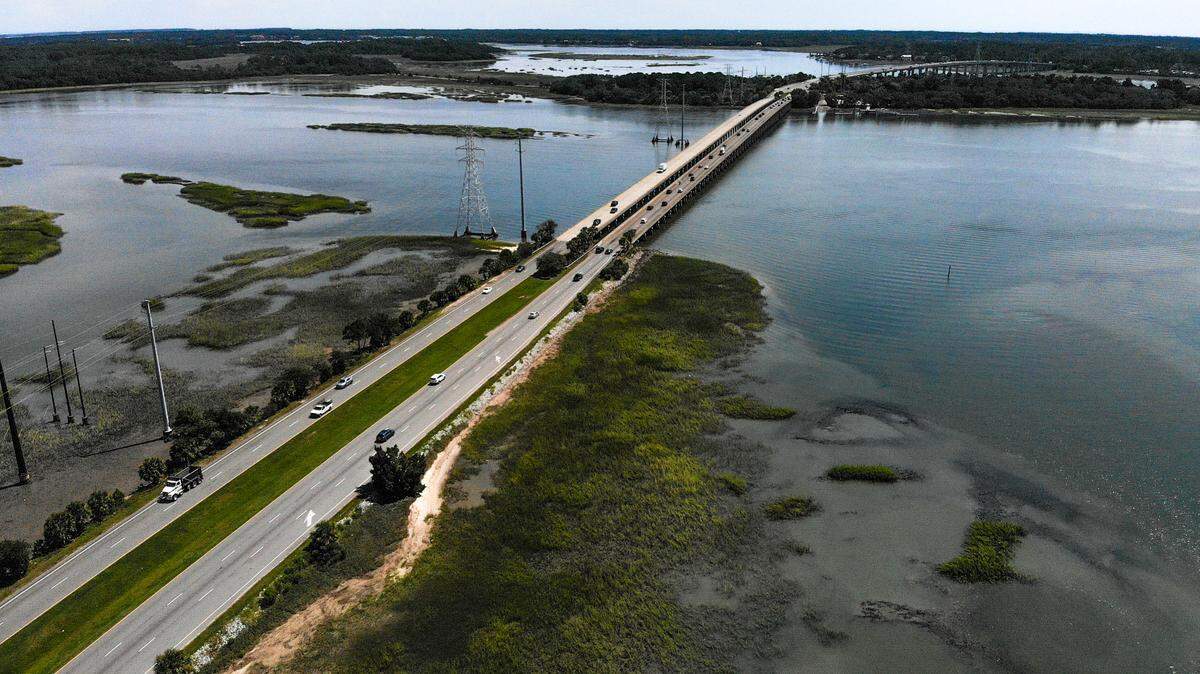
Beneath the bridges that connect Hilton Head to the mainland sits a two foot-wide pipe providing 20% of the island’s drinking water to residents and visitors.
Details on relocating the pipeline, a necessary component prior to bridge construction, have been a lesser concern compared to the larger conversation about a new bridge design. Recently, it has risen to the top of leaders’ priority lists as funding gaps could potentially fall on the island’s rate payers.
Option 1 is the focus
Both municipalities are currently leaning toward “Option 1” — a within-budget design that aims to replace the eastbound Mackay and Skull Creek bridges with a three-lane bridge without a walking and biking pathway. This plan means the drinking water pipeline will need to be relocated southeast of its current location to mitigate potential damage to the existing pipe from the installation of new creek bed pilings.
Hilton Head Public Service District’s General Manager Pete Nardi said a preliminary current estimate for relocating the pipeline is about $15.2 million, but future construction bids may be as much as $20 million.
“We cannot be without the pipeline,” said Nardi.
The existing pipeline provides drinking water from the Beaufort Jasper Sewer & Water Authority, delivering 8 million gallons, or 20% of the clean drinking water to the island each day, said Nardi. For comparison, 8 million gallons of water could fill roughly a dozen Olympic-sized swimming pools.
When necessary the pipeline can carry even more water, especially during natural disasters such as hurricanes, Nardi said.
How to pay for the new pipeline
Given a state funding statute and local cash that has been set aside, Assistant County Administrator Jared Fralix estimated that the PSD will receive nearly $15.5 million for relocation. This may cover the total cost, but nothing is for certain as the funding plan continues to change weeks before the county must present it to the state. And until bids are in hand, construction costs are just estimations.
A drafted joint resolution between the town and the county states that any additional dollars necessary for the relocation will be left to the PSD, and in other words, their customers.
Where is the current pipeline?
The pipe, constructed of high-density polyethylene and encased in steel, starts on the mainland at a meter box off the causeway. It was created when machines bored underneath Mackay Creek and came back up at Pinckney Island. From there the pipe transits under Skull Creek and resurfaces at the island’s water distribution center. At its deepest, the pipeline is 72 feet below the creek bed, said Nardi.
When driving onto the island, the current pipeline is under the creek bed off the right-hand side of the bridge. It sits under where the right-of-way was located on the old swing bridge connected the island to the mainland.
While the majority of the island’s drinking water supply comes locally from the PSD’s reverse osmosis treatment plant, Nardi said, the pipeline is a critical component of delivering on the island’s total need. It was put into place in 1999 to provide an alternative water source, as the island’s ground water started to experience the effects of salt water intrusion.
Are water rate changes part of the equation?
The impact to Hilton Head water rate payers is far from certain at this point. It could be nothing or significant depending on a variety of variables, but nothing is final until construction bids are in hand.
Relocating the pipeline will be funded in part by local and state dollars thanks to a relatively new state law, and in part by additional funding set aside in the drafted project costs.
The project’s current funding plan allocates nearly $15.5 million to PSD’s pipe relocation, according to a cost breakdown from Assistant County Administrator Jared Fralix. If construction bid numbers are closer to $20 million, this could leave the PSD with millions in expenses to cover.
The majority of funding is due to a 2019 state law requiring that public water and sewer facilities affected by publicly-funded transportation projects received 4.5% of the project’s original construction bid amount to relocate. In this case, the PSD could receive just short of $9 million.
According to Fralix, the 4.5% is taken only from total construction costs, which amount to $199.7 million for “option 1.” This does not include soft costs such as right of way and environmental mitigation, he said. In short, the cost of the bridge plus the cost of the roads would equal the construction cost, said Fralix.
The “utility relocation” section of the table above is the budget that accounts not only for the 4.5% dedicated to water and sewer relocation, but relocating other utilities affected by the project as well.
Local funding reduced
Project leaders anticipated allotting an additional $10 million to the PSD on top of the mandated percentage to subsidize a funding gap, but that has since changed. A revised draft of a joint resolution between the town and the county suggests that only $6.5 million would be allocated as such.
It came after a notice from SCDOT that the proposed funding plan laid out in the joint resolution was short $15 million. The transportation department realized that they had not included remaining engineering costs into their estimates, Fralix said. During a joint meeting between the town and county on Feb. 12, Fralix said that the additional $15 million would have to be cut from reserve funds, the PSD relocation funds and the Stoney Community Safety Project fund.
This was an oversight by the department that Patsy Brison, councilwoman from Ward 2 in Hilton Head, referred to as “a bombshell” during a town council meeting earlier this week.
During the same meeting, Mayor Alan Perry, along with council members Melinda Tunner, Tamara Becker and Alex Brown vocalized concerns about rate payers taking on the burden through their water bills. Perry was hopeful that PSD be “made whole” through grants or additional funding opportunities.
Town Manager Marc Orlando said during the meeting that he is currently drafting edits for the joint resolution to address concerns raised about funding the PSD’s portion of the project.
This story was originally published February 20, 2025 at 8:34 AM.