New Pine Island lawsuit takes aim at ‘racially explicit terms’ in county zoning laws
As promised, lawyers representing a developer in a controversial Pine Island golf course project have filed a new federal lawsuit against Beaufort County. The suit is again challenging the cultural zoning standards that have repeatedly barred the developer’s efforts to break ground on the remote coastal property.
Filed April 20 in the U.S. District Court of South Carolina, the lawsuit alleges St. Helena Island’s cultural protection overlay (CPO) is “unconstitutional on its face” because it favors one race “at the inherent expense of others.” The attorneys have asked for an order ending enforcement of the CPO and its “vague” and “arbitrary” guidelines.
“Preserving demographic segregation of St. Helena Island in the name of ‘cultural protection’ is not a compelling governmental interest,” the lawsuit reads.
The developers levied similar allegations against the CPO in another federal lawsuit that was dismissed in February, but attorneys said U.S. District Judge Richard Gergel’s ruling did not address the CPO’s “underlying legal issues” and that the case “can and will be refiled.”
Adopted in the late 1990s, the CPO bans developments like gated communities, resorts and golf courses on St. Helena in order to protect the island’s cultural heritage. The ordinance focuses on Gullah Geechee residents, descendants of enslaved people who were brought from West Africa and now call the state’s barrier islands home.
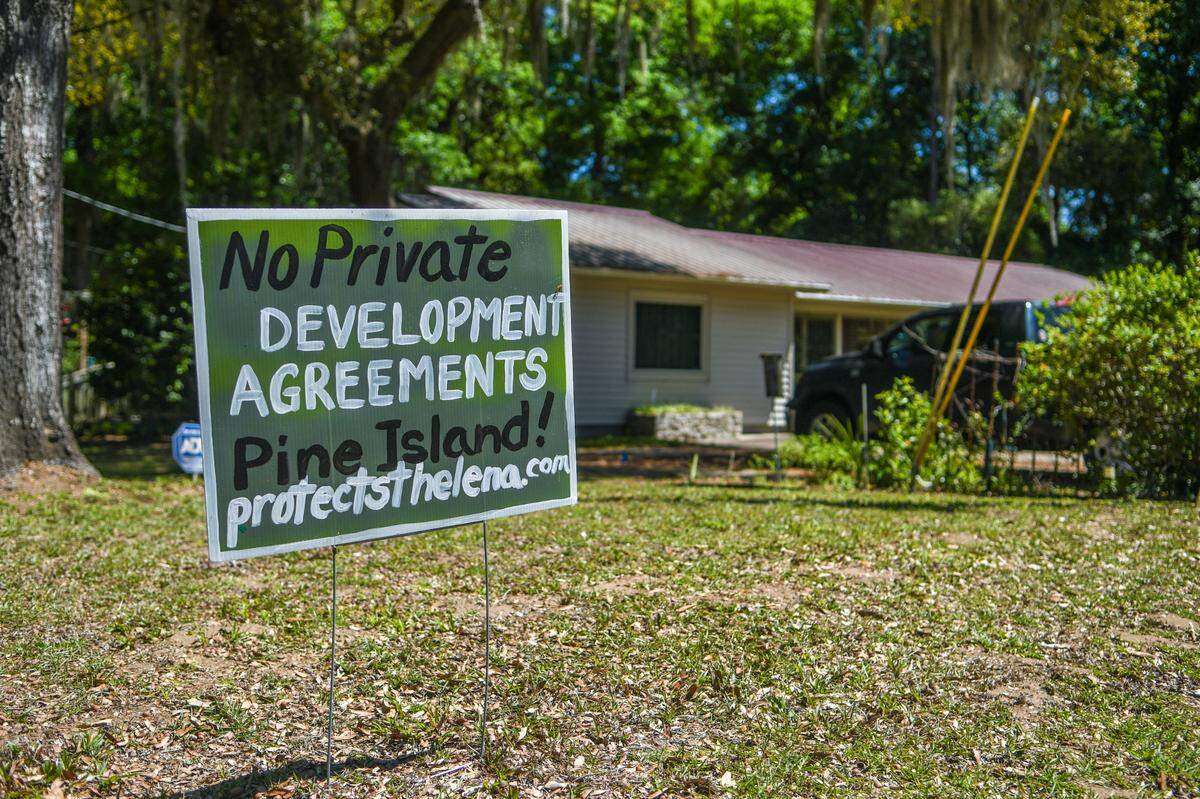
The Protect St Helena Island advocacy group, whose name became a rallying cry for opponents of the Pine Island project, says the proposed golf course threatens the “pristine landscape” of one of the largest undeveloped tracts on St. Helena. Its website cites a 2005 study by the National Park Service that says golf courses, resorts and other coastal development on the state’s barrier islands have led to “steadily increasing property values and skyrocketing taxes.”
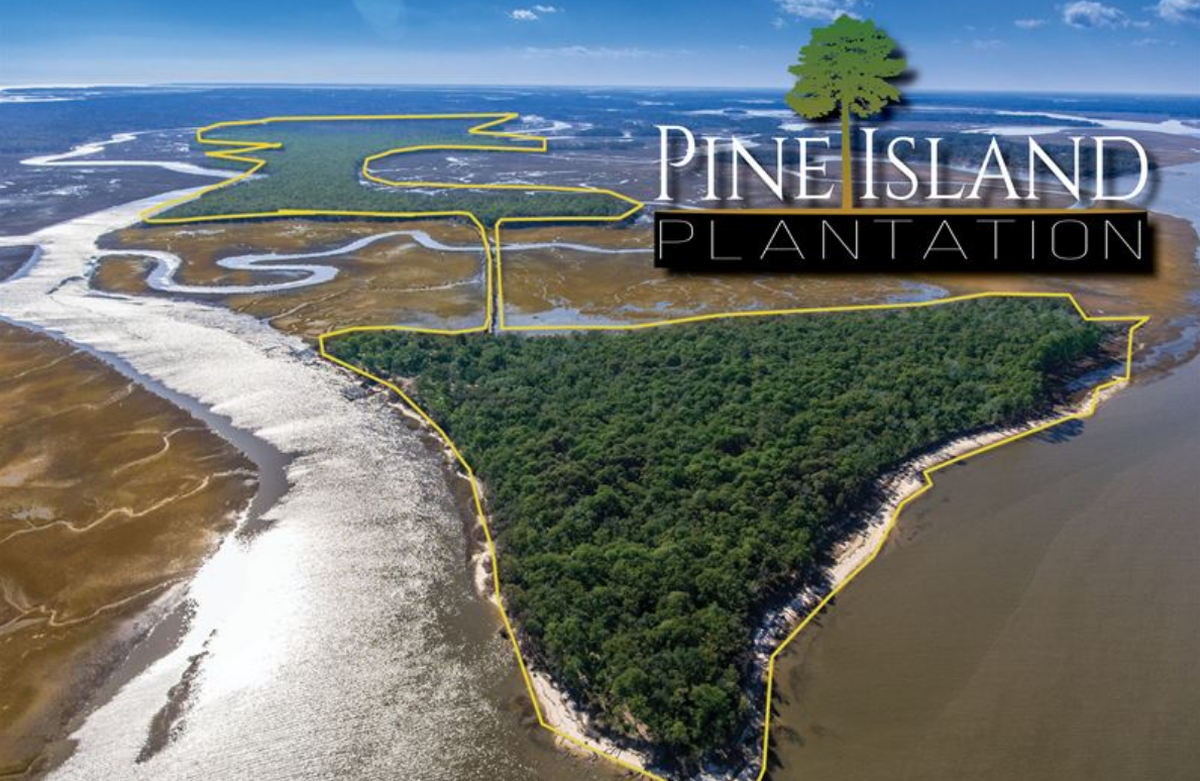
Developer Elvio Tropeano’s 503-acre property, known as Pine Island Plantation, includes two listings on the National Register of Historic Places. One is a plantation complex and the other is an archaeological site with reported observations of 19th-century ceramics and amethyst glass fragments.
The fight to develop the land
After Tropeano bought the peninsula and small island on northern St. Helena for $18 million in early 2023, his fight to develop the land sparked years of public backlash, litigation and contentious county council votes. He has steadily introduced new and revised plans despite a stream of rejections from county officials.
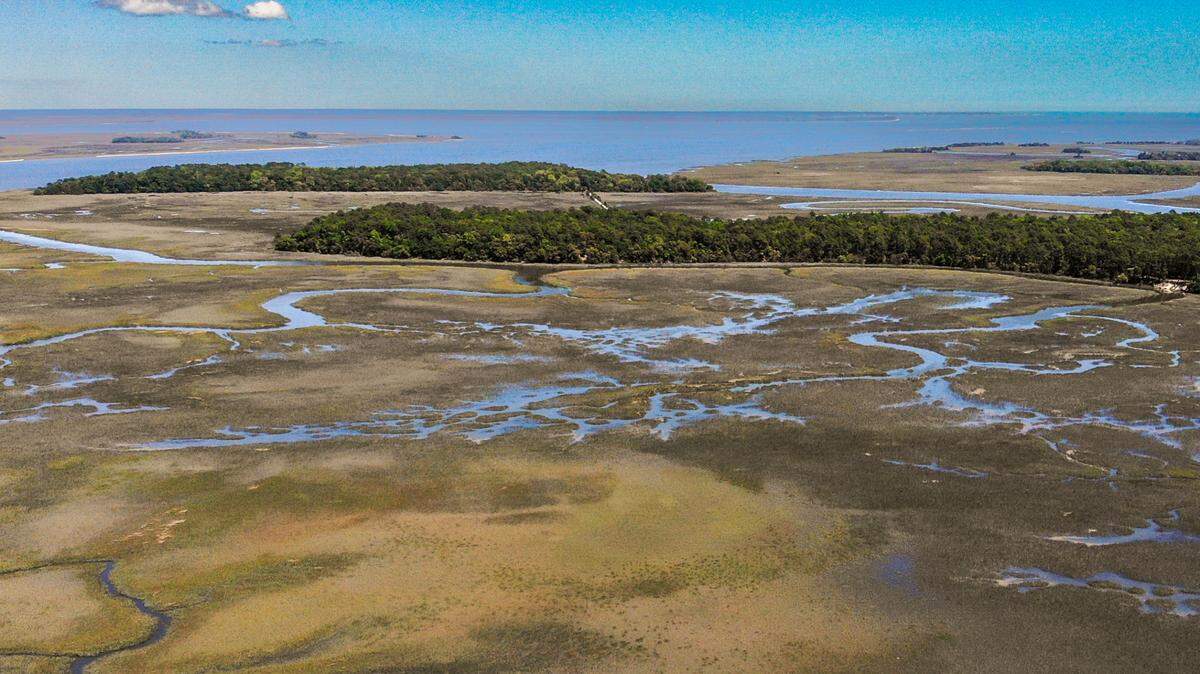
Tropeano’s property includes the 77-acre Pine Island and a larger tract known as St. Helenaville, which are connected by a causeway. St. Helenaville was once a small antebellum village and summer retreat for plantation owners. Pine Island was a hunting plantation that had been managed as farmland and a family retreat for about a half-century.
Tropeano and his team say their “low-impact” vision for Pine Island Golf Club — 49 homes and an 18-hole golf course — is more sustainable than the high-density option of 168 homes and 100 docks that would be allowed under current zoning regulations.
But hundreds of residents have opposed Tropeano’s blueprints since his first proposal in late 2022, flooding meeting spaces and public comment periods with pleas to “protect St. Helena.” A number of local advocacy groups, including the Coastal Conservation League and S.C. Environmental Law Project, spearheaded their own legal battles against the development.
“We don’t want to become another Hilton Head,” one resident said during a 2022 meeting at the Penn Center, the former school for freed slaves on St. Helena that today works to preserve African American heritage in South Carolina. The center has played a prominent role in the fight against developing Pine Island.
Still, a sizable number of locals, including some Gullah Geechee residents, have come to support the Pine Island project, citing the economic vitality the golf course could bring. Tropeano lobbied for community support in part through a revised development plan that allotted millions of the developer’s dollars toward construction of a new cultural center, affordable housing units, a survey of Gullah Geechee cemeteries on the nearby Daufuskie Island and several infrastructure improvements.
That plan was denied last year.
The vision of homes and a golf course
Beaufort County officials in January approved Tropeano’s proposal to build 20 residential units on St. Helena, but the project is far from his longtime vision of 49 homes and an 18-hole golf course.
The new lawsuit goes to great lengths to emphasize it is not challenging the county’s past denials of project proposals. Their complaints “flow directly from the (CPO’s) text and operation, not from any particular application denial,” court documents say.
What the lawsuit says
The new federal lawsuit takes aim at the CPO’s core mission, arguing the use of “racially explicit terms” to outline zoning law is a violation of the 14th Amendment’s Equal Protection Clause.
Court documents include a count of how many times certain words appear within the CPO and its amendments, such as “Gullah” (2,079 occurrences), “Black” (508 occurrences) and “race” (44 occurrences).
“No other local document in the United States has adopted a zoning ordinance that deploys more than 4,062 references to race to justify zoning restrictions for the express purpose of prompting racial separation in a community,” the lawsuit claims.
Attempting to prove the county’s adherence to an “illegitimate” and “race-conscious” vision of the CPO, court documents quote several county officials who spoke out against the development over the years.
One inclusion is Beaufort County Attorney Brian Hulbert, who publicly said that golf courses are “repugnant to the Gullah cultural community,” the lawsuit claims.
Pine Island’s attorneys also argue the county unfairly “targeted” the project through its amendments to the CPO, which were finalized in the months before council members rejected one of Tropeano’s proposals.
The lawsuit says the golf course project should be allowed under the county’s T2R rural zoning, which covers all 502 acres of Tropeano’s property but is superseded by the prohibitions of the CPO. It argues the T2R designation “already protects the rural character of property in a race-neutral manner.”
“When a local government has the intent of protecting rural character of land, race has no role in the analysis,” the suit says. “Rural is rural, regardless of race.”
Developer’s fight has lasted years
Tropeano, a 38-year-old Boston native, graduated from Vanderbilt University before moving to New York to pursue a career in finance.
It wasn’t until the COVID-19 pandemic, when Tropeano moved in Charleston, that he learned Pine Island was for sale.
“I came down here one time, then I packed a bag and never left,” he told The Island Packet and Beaufort Gazette during a 2023 interview on the property.
Tropeano initially sought an exception to the CPO as he proposed an 18-hole golf course, 10 docks, a museum and about 60 homes in late 2022.
But Beaufort County Council voted to strengthen the CPO in May 2023, further clarifying that golf courses are banned on St. Helena. Tropeano went on to challenge the legality of the CPO in one of two lawsuits filed by his companies the following July.
Tropeano then introduced new plans for three six-hole golf courses instead of one 18-hole course — a move opponents described as a questionable circumvention of the law.
Beaufort County officials delivered successive blows to Tropeano’s plans in June 2023, rejecting his new proposal before denying his request for the entire property to be rezoned.
A ‘downsized’ proposal
Tropeano submitted another proposal last year to remove his Pine Island property from the CPO, presenting what he called a “downsized” plan for a gated golf resort with limited houses and docks.
Council members again shot down the proposed development — but Councilman Logan Cunningham, who is running to represent the Lowcountry in U.S. Congress, made a rarely used motion to “rescind” the vote in December. The motion failed and the county’s denial was upheld.
Days after that decision, Tropeano’s lawyers voluntarily dismissed a July 2023 lawsuit in state court that appealed the county’s rejection of the golf course proposal.
The development team’s second lawsuit against Beaufort County, filed two days after the first, called into question whether the CPO’s restrictions on hotels, resorts and golf courses violated the developer’s constitutional rights to due process, and whether the ordinance posed an unconstitutional burden on interstate commerce.
U.S. District Judge Richard Gergel dismissed the second lawsuit in February, later denying Tropeano’s motion asking the judge to reconsider. The developers have sent the case to the Fourth Circuit of the U.S. Court of Appeals, where Pine Island attorneys are scheduled to present their required legal briefs in June and July.
The most recent legal measures signal Tropeano’s fight to develop Pine Island — and residents’ fight to protect it — isn’t ending anytime soon.
“I’ve never thrown in a towel,” Tropeano said last year.
This story was originally published May 6, 2026 at 9:44 AM.