
6 ways this hurricane season is different
You might have had your fill of the 2017 Atlantic hurricane season, but there are still more than two months of it left, more than half in the so-called “peak season” for tropical cyclone formation.
An active hurricane season was forecast by the National Oceanic and Atmospheric Administration in May, then revised upward in August to predict 14 to 19 named storms, five to nine hurricanes, and two to five major hurricanes.
Those expectations have either been met or are on pace, so if you’ve been feeling like this hurricane season is worse than any other you’ve experienced, in many ways you are right.
Earlier
The Atlantic hurricane season starts every year on June 1. Occasionally tropical cyclones will pop up before then, but this year, like a particularly annoying party guest, Tropical Storm Arlene showed up particularly early, on April 20.
Arlene is one of only two tropical storms to form in April during the satellite era. The other was Tropical Storm Ana, in 2003.
Of those two storms, Arlene was the stronger as measured by central pressure.
The current central pressure of TS #Arlene of 993 mb is the lowest pressure for any April Atlantic TC or subtropical TC on record. pic.twitter.com/sotMclrtBI
— Philip Klotzbach (@philklotzbach) April 21, 2017
Stronger
Hurricane Irma held sustained winds of 185 mph for 37 hours, longer than any other storm in history.
While Hurricane Allen in 1980 reached sustained winds of 190 mph, the duration of Irma’s winds make it an overall stronger storm, according to Dennis Feltgen, spokesman for the National Hurricane Center.
Irma also had the third highest Accumulated Cyclone Energy (ACE) index of any storm in history. The ACE index is used to catalog the wind energy of seasons and individual storms over their lifetimes, and Irma had a higher ACE than this season’s previous eight named storms combined.
The 7 Atlantic seasons with more ACE thru 9/16 than 2017 in descending order are: 1933, 1995, 2004, 1950, 1893, 2005, 1926.
— Philip Klotzbach (@philklotzbach) September 17, 2017
According to The Weather Channel, nearly 40 percent of a season’s cyclone energy occurs after Sept. 18, and even an average amount of build up in that index for the rest of this season would put 2017 in the top five strongest Atlantic hurricane seasons on record.
Harvey, Irma and Jose set a collective record as well, as each reached Category 4 status or stronger, marking the first time that three consecutive storms accomplished the feat.
Longer
Tropical Storm Jose has remained a named storm for the last 15 days, according to meteorologist Philip Klotzbach, which ties it for the 10th longest named Atlantic storm in the satellite era.
Meteorologists expect Jose to maintain its status through Monday, which would make it a 20-day named storm.
#Jose has been named storm for 15 days - longest lived Atl. NS since Nadine (2012) & tied for 10th longest Atl. NS in satellite era (>=1966) pic.twitter.com/vJuYmUT3fy
— Philip Klotzbach (@philklotzbach) September 20, 2017
Meanwhile, Hurricane Irma spent more time as a Category 5 storm — longer than three days — than any other of the satellite era. Only one storm in recorded history maintained Category 5 strength for longer, the hurricane that struck Cuba in 1932, before today’s naming conventions existed.
The eye of Hurricane Irma at Category 5 strength
Please be patient. This file might take some time to load fully.

Source: NASA
Hurricane Harvey maintained tropical storm wind speeds longer than any previous storm on record post-landfall. Once coming ashore, the storm maintained tropical storm strength for 117 hours, shattering the previous record of 54 hours set by Hurricane Fern in 1971.
Faster
Hurricane Maria ramped up from Category 1 to Category 5 in a little more than half a day. Hurricane Wilma developed faster in 2005, but Maria’s climb was still unusual.
While #Maria has intensified very quickly, Wilma 2005 was still faster: cat 1 to cat 5 in less than 12 hours vs Maria about 15 hours.
— Dr. Rick Knabb (@DrRickKnabb) September 19, 2017
Looked at from initial formation to Category 5, Maria might still have set a record, though.
Per HURDAT2, #Maria may be the fastest deepening from formation to Cat 5 (57 hrs). Felix & Matthew currently tied (60 hrs).
— Tomer Burg (@burgwx) September 19, 2017
Wetter
When Hurricane Harvey hit the Gulf Coast of Texas, it loosed a torrent the continental U.S. had never seen.
Rainfall of 51.88 inches was recorded in Cedar Bayou, Texas, according to researchers at Colorado State University. That is the most rainfall on continental U.S. soil in recorded history, beating the previous record set in 1979 by Tropical Storm Claudette by nearly four inches. It nearly tied the national record of 52 inches set in Hawaii.
Rainfall above the previous continental U.S. record of 48 inches was recorded during Harvey’s pass through the Houston area at three weather stations in addition to Cedar Bayou.
Busier
Twice so far this hurricane season we have seen three named storms at the same time. Hurricanes Irma, Katia and Jose spun simultaneously, and then Jose, Tropical Storm Lee and then-Tropical Storm Maria.
Hurricanes Irma, Jose and Katia spin at the same time
Please be patient. This file might take some time to load fully.
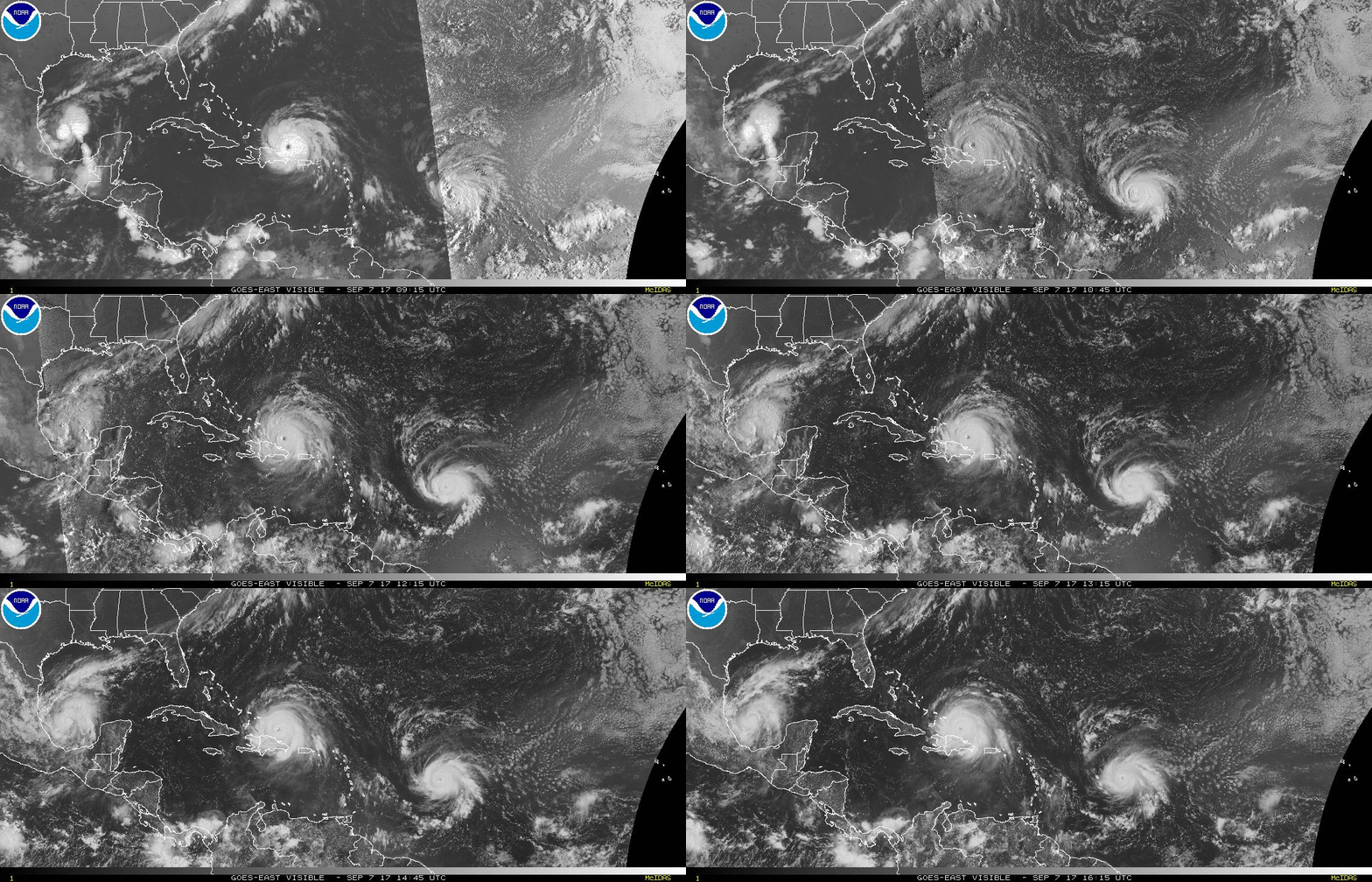
Source: National Oceanic and Atmospheric Administration
According to CNN, the last time the Atlantic hosted three hurricanes at the same time was 2010.
This is the first Atlantic hurricane season on record where two Category 4 hurricanes have made landfall in the U.S., with Harvey and Irma making landfall barely two weeks apart.
It is also the first time in history when two storms with sustained winds above 150 mph spun in the Atlantic at the same time. That occurred with Irma and Jose on Sept. 8.
There is a lot more season
The strongest Atlantic hurricane season on record was in 2005. It had more named storms than there were letters to name them (the letters Q,U, X, Y and Z are skipped because so few names start with them), so letters from the Greek alphabet were used for the last five.
Through Sept. 20 in 2005, there were more named storms and more hurricanes than there have been this year, and the same number of major hurricanes.
And from Sept. 20 forward, the Atlantic saw 10 more named storms, five of them eventual hurricanes. Two of those hurricanes were major.
The peak of hurricane season runs through the end of October, and the season itself officially ends Nov. 30.
In 2005, four named storms formed after the peak of the season, and two of those were after the season had formally ended. The last named storm, Tropical Storm Zeta, lived into January 2006.
This means that the 2017 season has plenty more time to throw tropical cyclones our way. While 2005 might still hold the crown for most active hurricane season, this year is still in the running.
Tropical storm timelines
2016
2017
Michael Olinger: 843-706-8107, @mikejolinger
This story was originally published September 20, 2017 at 2:31 PM with the headline "6 ways this hurricane season is different."