
Rough roads in paradise

Aiken Place, a dirt lane off Marshland Road, is full of large pools of standing water after recent April rains. (Jay Karr/Staff photo)
BACK TO THE INDEX
What they said
"Everybody pays taxes. I think it's time we start focusing on the people who live here, and have lived here. It seems like 'limited government' is only limited for some people."
-- Ward 1 Councilman Marc Grant, a native islander and local business owner
"It's not a God-given right to live on a paved road. If you want to live on a paved road, move to a paved road. If you live somewhere that's on a dirt road, presumably you made the choice to live there."
--Ward 3 Councilman Lee Edwards, representing parts of Spanish Wells, Long Cove Club, and Wexford and Shipyard plantations
Away from the beaches, resorts and golf courses, exists a Hilton Head Island that many don't know.
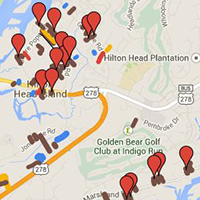
The path to get there is along unpaved roads. The resort town has 94 dirt roads -- some of them rocky, pitted and prone to flooding -- the vast majority existing in low-income neighborhoods on the north end of the island. Communities comprised of primarily black and Hispanic residents rely on them to get to work and school. They're also the only routes by which fire and rescue services can respond to emergencies.
They symbolize what some residents say is a town government that ignores those who have lived on the island the longest.
"It shows you, 'We don't care about anything outside of the gated communities,'" said Irvin Campbell, a native islander and president of the Spanish Wells/Jonesville Property Owners Association. "(Town leaders basically say) 'You guys that are not on these main arteries, long as you stay quiet, we'll be all right.'"
The town's spending habits prove that sentiment, critics add. In the past 20 years -- since a landmark study claimed the town failed to meet its obligations to taxpayers partly because it did not provide paved streets for all residents -- the town has spent only about $1.2 million to pave two of the 100 dirt roads on the north end. Beaufort County has paved 15.
By comparison:
- During the same 20-year span, the town has spent nearly three times the amount -- $3.4 million -- on paving dirt roads and fixing drainage problems on the south end where higher end homes and tourists spots are plentiful.
- Also during the same time, the town has spent more than $18 million to build more than 60 miles of bike paths. That's nearly 15 times the amount it has spent on paving dirt roads on the north end.
- The town is set to spend nearly $1 million this year on stormwater services for the island's private, gated communities, according to budget documents. That's nearly the amount it has spent on acquiring and paving potentially dangerous dirt roads on the north end in the past 20 years.
By the numbers
42: Number of Hilton Head Island roads paved by the town and Beaufort County since 1995.
94: Dirt roads remaining on the island.
84: Dirt roads left on the north end of the island.
513: Homes located on the town's private dirt roads
Source: Town of Hilton Head Island
"Everybody pays taxes," said Ward 1 Councilman Marc Grant, a native islander and local business owner. "I think it's time we start focusing on the people who live here, and have lived here. It seems like 'limited government' is only limited for some people."
But the solution is not as simple as buying and paving a road, officials say.
The process can involve a painstaking condemnation process and costly legal fees. Many of the dirt roads run through heirs' property, which is land passed through generations with no clear title-holder. Town attorneys must navigate webs of ownership before the town can acquire and pave roads.
While some of the town's dirt roads are little more than driveways -- measuring less than 0.1 miles and serving only a few homes -- more than half serve at least five homes. Murray Avenue, only 0.14-miles long, serves 22 homes. Great Barracuda Lane, less than 0.1 mile, serves 10.
And, in the end, not all dirt-road owners want their paths paved, say town officials and some residents.
"It can be a real mess out there," said town engineer Scott Liggett. "It is markedly more difficult, and more time-consuming and more expensive than people realize."
But new Mayor David Bennett is fighting to prove to council members and town staff the paving difficulties can be overcome, even seeking out untapped pots of federal money for the work and presenting it to town staff.
Bennett considers paving roads a basic government service. He's among several council members calling for the town to jointly pave roads and install sewer lines in areas lacking both.
"It's embarrassing that we as a community, one of the wealthiest communities on the eastern seaboard, are still talking about sewers and paved roads," he said during his election last year.
As this year's budget talks begin May 5, residents in the underserved neighborhoods hope Bennett and other council members will prove such campaign rhetoric wasn't empty promises.
"It's been talked about a lot," said Rochelle Williams, a native islander who ran against Bennett in November's race. "But it's always been talked about. Let's see someone do it."
'MISPLACED PRIORITIES'
For 30 years and counting, every time it rains hard, Earl Mitchell has to go to work — but not for a job. Mitchell's, and his sister's, driveway, as well as their street, Evelina Road, is unpaved. Asreports, the family's work to minimize flooding, sinkholes, puddles and other problems caused by rain, never ends, and they've had enough.
When Elnora Aiken saw the fresh pavement along Marshland Road about 10 years ago, she was furious.
The new two-lane bike path, with its smooth, new pavement, fresh yellow lines and miniature yield signs, intersected with Aiken's bumpy, unpaved street, Evelina Road.
At the time, the 0.1-mile Evelina Road also did not have access to water or sewer lines.
For about 10 years, Aiken had attended town council meetings to demand changes on her street, with nothing to show for it. The bike path reignited her anger.
"I am sure that when you, the Town Council and staff, look into the mirror you can stick out your chest and feel proud about your ability to do whatever you want to the Native Islanders (in) Ward One because they cannot or will not fight back," she wrote to local newspapers in 2004.
Aiken, 67, said she feels the same way today. And she's still waiting for a paved road and sewers.

Elnora Aiken, left, stands with her brother, Earl Mitchell, and great grandchildren Saniyah Aiken, 11, and Jessie Tyson, 1, at the end of Evelina Road on April 14, 2015. The only portion of Evelina Road that is paved is the stretch that crosses the bike path running along Marshland Road. Elnora Aiken would like to see pavement and sewer service extended down her road. Jay Karr/Staff photo
"It's just a matter of saying things could be better -- should be better -- than the way it is," Aiken said. "But in order to get things done, you have to care. And if you don't care, nothing gets done."
Many native islanders such as Aiken point to the town's extensive network of bike paths as a reflection of its priorities: The wants of tourists win out over the needs of residents.
For example, this year the town set aside more than $2 million for bike paths.
In comparison, it marked $125,000 to acquire roads. There is no dedicated funding source for paving roads.
Some say this inequality goes further. They contend services such as stormwater maintenance show the town helps out residents in high-end communities more than those in low-income neighborhoods. Since 2001, the town has slowly taken over stormwater services for Hilton Head's gated communities.
"It kind of shows you where the priorities are," said Alex Brown, a native islander and chairman of the town Planning Commission.
Town officials counter that the bike paths were paid for by hospitality taxes -- a funding source that cannot legally be used to acquire and pave dirt roads.
The stormwater maintenance, they say, benefits the entire island, since all of the island's stormwater drains into the same waterways.
Even so, at the current funding pace, it would take decades to buy and pave the roads.

William Drive is photographed on April 16, 2015. The lane off of Marshland Road is another of Hilton Head Island's remaining dirt roads. Jay Karr/Staff photo
In the past 20 years, the town and Beaufort County paved 30 percent of the island's 136 dirt roads, leaving 94 still dirt. The town paved 15 of those roads; the county paved 28.
Moreover, the location of the roads that were paved hints at some neighborhoods being prioritized over others, according to some residents.
On the north end, where the unpaved roads are primarily in low-income neighborhoods, the town and county have paved 17 percent of dirt roads in the past 20 years.
On the south end, which primarily services tourists, 69 percent of the 36 dirt roads have been paved during the same span.
Town staff members attribute the slow progress to a 2009 decision by Beaufort County to stop accepting Hilton Head roads because maintaining the roads grew too expensive.
Five years ago, the town began its own dirt-road program to acquire and pave the bumpy paths.
And in those years, the town has made progress, officials say. It's moved from not acquiring dirt roads to acquiring two a year, and now four a year, town manager Steve Riley said.
"I would disagree that we haven't made changes," Riley said. "We're moving forward."
A MATTER OF PUBLIC SAFETY
But some town officials say the conditions of the roads makes it too risky to wait.
Many are torn up by potholes. Others flood when it rains.
"What happens when an ambulance can't get down a road because it's in bad shape?" asked Grant, the Ward 1 councilman.

Vanessa Miller points, on Wednesday, to ruts along the shoulder the road she lives on: Benjamin Drive off of Jonesville Road on the north end of Hilton Head Island. Miller would like to see the road paved, like Jonesville Road was several years ago. (Jay Karr/Staff photo)
Vanessa Miller, 59, lives on Benjamin Drive, which ranks 42nd on the town's priority list of 75 private dirt roads.
Today, though, Miller worries most about Bluebell Lane, a dirt road where an elderly friend lives.
When Miller visits the 81-year-old woman, Cornelia Cohen, she no longer drives onto the horse-shoe shaped street. Instead, she parks near Grace Community Church on Spanish Wells and cuts through backyards.
"I'm just scared for her if they should ever need an ambulance. It's just crazy," Miller said. "If it's dry, they might chance it. But if it's raining, they're not going through there, period."
Cohen's granddaughter, Shakena Cohen, said she worries, as well.
Joheida Fister, fire marshal of the Hilton Head Island Fire & Rescue Division, said no roads on the island are impassible, though members identify problem spots each year when they go into communities to inspect fire hydrants.
The division works with the town to get potholes filled on public roads, but can't make residents pay for repairs on private streets, Fister said, so the roads sometimes deteriorate further.
What's getting paved when?
- Combined, the Town of Hilton Head Island and Beaufort County have about 300 dirt roads. Some are private roads. Others are owned and maintained by the local governments as dirt and will be for the foreseeable future. Still others are in line to be paved in the next few years.
- How is it determined which road gets paved when? Each road is ranked based on the number of homes and other features along it, such as parks and utilities. Also taken into consideration is each road's condition, concerns from fire and rescue personnel, the existence of drainage problems and whether there is an existing right of way or easement on which to build a road.
- The town's paving priority list includes 77 roads. At the top are Blazing Star Lane, Rhiner Drive, Wiley Road, Murray Avenue, and Cobia Court, all located on the north end of the island. Three of these roads were acquired in recent years. The town is still working to take possession of Murray Avenue and Cobia Court, along with Alfred Lane and Aiken Place. Next on the town's list of roads to acquire are Gibson Drive, Pine Field Road and Manatee Way.
- The county's paving list is larger, at 212 roads, and includes five on the island. At the top of the county list are Almond Drive, Gillison Loop, Major Road and Devonwood Drive, which total 0.9 miles of roads on St. Helena Island and in Seabrook and Bluffton.
PUSH TO PAVE
Public safety is part of the reason Bennett wants to pave the roads.
Beyond that, he believes it's the just the right thing to do. He plans to concentrate on 30 roads in areas that also lack sewer service, he said.
Several council members are working on ways to find money to pave the roads.
One possibility is federal community block grants. The town qualifies for about $200,000 annually, and the money can go toward buying and paving dirt roads.
Council agreed this month to ask the federal government for the money. Five roads -- Blazing Star Lane, Rhiner Drive, Wiley Road, Murray Avenue, and Cobia Court -- would be paved with the money in the next five years.
Another possible funding source is increasing the stormwater utility fee, a $108 annual charge to taxpayers that funds the town's stormwater program.
In 2003, the town used the pot of money to pave roads off North Forest Beach. Those roads flooded because of drainage problems following a stormwater project.
Since many of the unpaved north-end roads flood, such a measure could work, Riley said.
The town could also take money from other planned projects and use it for dirt roads. Riley said U.S. 278 maintenance money, or a portion of the money that pays for the fire department, could be set aside for roads.
"We're looking at all options," said councilman Bill Harkins. "The main thing is we know it's time to do something more."
But not all council members feel that way.
Ward 3 Councilman Lee Edwards said it would be unfair to use public money to pay for private roads.
"It's not a God-given right to live on a paved road. If you want to live on a paved road, move to a paved road," said Edwards, who represents parts of Spanish Wells, Long Cove Club, and Wexford and Shipyard plantations. "If you live somewhere that's on a dirt road, presumably you made the choice to live there."
Other town officials say paving roads could raise property values and price-out low-income residents.
Such a property increase might give islanders an incentive to sell. And, ironically, installing such infrastructure might attract builders to areas where many want to limit development.
"The converse to that argument," Bennett said, "is by withholding roads and sewers, are we withholding economic development opportunities from citizens in our community?"
On a basic level, former council members warned that acquiring the roads in the first place is a difficult task.
Former Mayor Tom Peeples points to Jonesville Road: A paving project that lasted six years and went at least $500,000 over budget.
"Let's just say that's an example of how not to do it," said Peeples. "It definitely left a bad taste in our mouths."

Recent projects also have cost more than anticipated.
The town has already spent $162,000 to acquire roads this year -- about $37,000 more than it expected to pay. Rhiner Drive alone cost $71,000 to acquire.
Part of the problem is clouded titles. But there's also the issue of donation.
If a property owner doesn't want to give up the right-of-way, the town is forced to pay them through what can be an expensive condemnation process.
"And is that equitable?" Liggett said. "I have 14 property owners who donate, and one holds out. Then one person gets paid."

Standing water from rain on April 16, 2015, highlights ruts on Mitchelville Road. Jay Karr/Staff photo
Plus, not all dirt-road owners want smooth streets.
Some residents are reluctant to work with the town if it means giving up their land or losing the rural feel of their neighborhoods.
Eugene Orage, 75, worries his street off Gumtree Road would become a speed trap.
The former shrimper's brick home, with a red tin roof bearing his initials, is surrounded by the homes of his children, the beauty shop run by his daughter, and his sister's property. Further back, the 0.12-mile road serves 10 more homes.
He worries pavement in the neighborhood where his grandchildren ride their bikes would encourage drivers to speed.
"Sometimes the drivers come and apologize, but when you run into one of these kids, saying 'I'm sorry,' is not going to bring them back," he said.
Another resident, Newton Greene Jr., lives at the end of Jonesville Road. When the town paved the road, Greene's father decided not to give up his property.
Greene says he'll continue to maintain his dirt portion of Jonesville Road.
"My father wanted to keep it rural, like he remembered it," Greene said. "It's largely the way it was when I was a child. I like the ambiance."
The upkeep can be expensive.
Greene, a former IBM consultant whose mother was a native islander, says he spends several thousand dollars every few years to maintain the 425-foot dirt path. He and his wife, Kelley LeBlanc, are considering stone as a cheaper surface.
But many native islanders don't have the money to maintain their roads. That's why they are waiting on the town to help.
Irvin Campbell said he believes it will happen.
"We're to a point where you have different leadership now, you have people more concerned about the welfare of everyone instead of the welfare of a few."
BACK TO THE INDEX
Follow reporter Dan Burley on Twitter at twitter.com/IPBG_Dan. Follow reporter Rebecca Lurye at twitter.com/IPBG_Rebecca.
This story was originally published April 24, 2015 at 5:44 PM with the headline "Rough roads in paradise."