
Vanishing nets: Area shrimpers sail on despite rising costs, threats from imported seafood
For nearly 70 years, the Gay family has trawled for and sold local shrimp at its St. Helena Island market.
But these days, they often make more money selling t-shirts and coffee mugs than seafood.
"I think shrimping (in Beaufort County) will end eventually," said Charles Gay, owner of the Gay Fish Company. "You'll not even see the few trawlers that are left."
No one would have predicted the demise of the Lowcountry's most iconic industry just a few decades ago. Back then, the Gay's dock would fill up with trawlers forming a city of lights each morning before dawn.
"There would be dozens of shrimp boats all lined up, all lit up getting ready to work," Gay said. "Now if you see two or three shrimp boats together it's really something to see."
The problem, Gay said, isn't that there are fewer shrimp off the SC coast. And it isn't that demand for shrimp is down. In fact, shrimp is now far and away the most popular seafood in America, according to the National Oceanic and Atmospheric Association, with the average American eating more than 4 pounds of the shell fish a year.
Rather, foreign shrimpers have moved in to meet the demand, flooding the market with their shrimp and driving down prices. Most shrimp eaten in America today come from farms in Asia rather than trawlers off the coast hired by the Gays and other local families.
The cut-throat competition, paired with rising operating costs, has led many local shrimpers to hang up their nets.
"The shrimp business has always been hard. But there used to be good money in it," Gay said. "Not any more. Now people just stay in it because it's in their blood."
Consider:
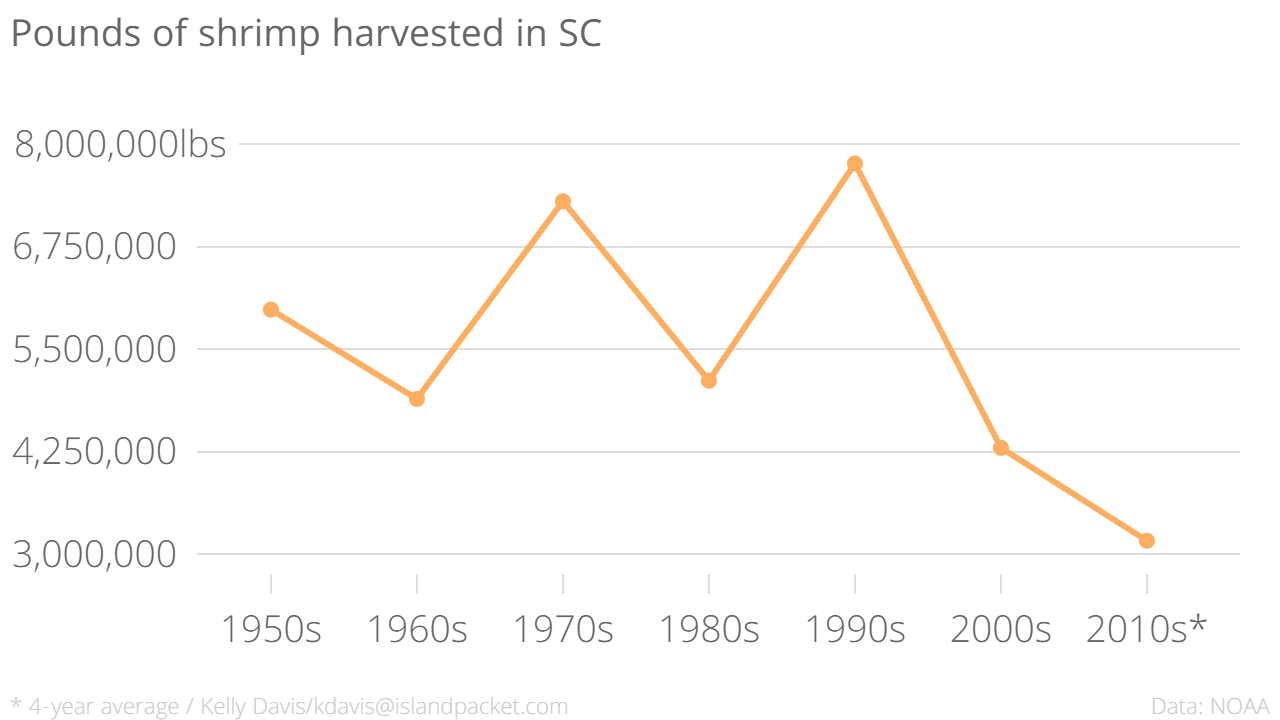
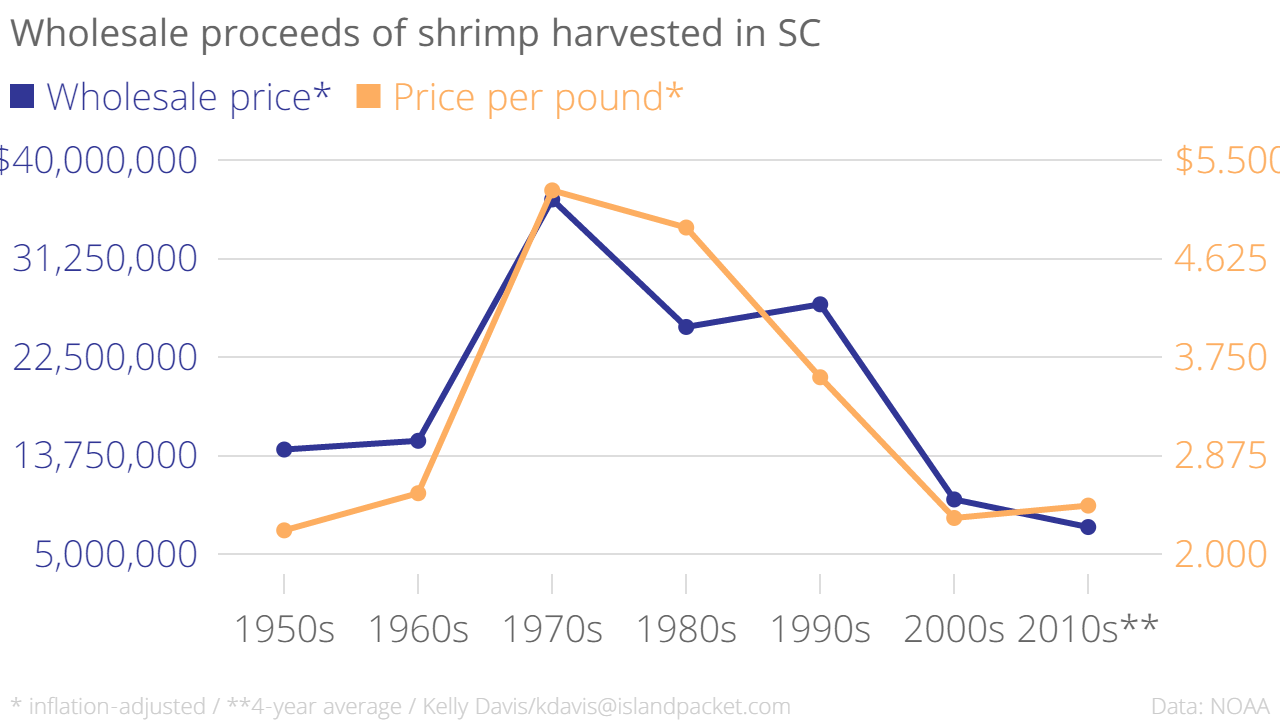
• Adjusted for inflation, the state's average annual catch values are now the lowest they've been since the National Oceanic and Atmospheric Administration began recording harvests in the 1950s.
• The average value of the SC shrimp catch from 2000 to 2009 was 80 percent less than it was in the 1970s -- South Carolina's richest decade for shrimping -- according to NOAA data that has been adjusted for inflation. Average prices for SC shrimp are down by about half since the 1970s, NOAA data show.
• The number of trawler boat licenses issued in the state is about one-fourth what is was in the 1980s with 434 issued this year, the SC Department of Natural Resources reports.
Local shrimp hard to find, even in Beaufort County restaurants
Even diners in Beaufort County, eating at restaurants along waters full of wild shrimp, may rarely be served a local product.
Part of the reason is a growing demand for a limited supply.
There aren't enough SC shrimpers now to meet even 13 percent of the state's estimated annual shrimp consumption, an Island Packet and Beaufort Gazette analysis of NOAA data showed. In 1984, South Carolina's shrimp nearly met the state's demand.
In Beaufort County, one of the state's largest shrimping areas along with Charleston and Georgetown, local shrimpers harvested only enough shrimp to feed 175,643 average American shrimp eaters last year, the analysis showed. That is less than the county's 175,852 full-time resident population estimated for last year, let alone the more than 2 million tourists that visit the county each year.
Restaurants say this limited supply keeps them from serving local shrimp consistently. In fact, when 10 popular seafood restaurants in the county were surveyed, each said they used local seafood as much as possible but were unable to exclusively serve local shrimp.
Most of the year, restaurants instead turn to seafood caught in the Gulf of Mexico or, in some cases, foreign shrimp farmed more than 8,000 miles away.
"I think people out to dinner here just go off the assumption that the shrimp is local," said Tonya Hudson-DeSalve, owner of the Benny Hudson Seafood market on Hilton Head Island. "Some have trawlers out front that never move, while I know they have shrimp from Thailand in the kitchen. It might as well be Universal Studios."
But the limited local supply does not always give chefs a choice, restaurants say.
"We serve local shrimp whenever possible, and I refuse to sell foreign shrimp," said Dave Peck of the Lowcountry Backyard restaurant on Hilton Head Island. "I would love to serve a local product every day because I do care about local seafood, but you just can't get a hold of it."
Peck regularly calls shrimpers to ask for fresh, local product, but has only been able to get about 13 deliveries so far this year as many shrimpers have longtime deals with other restaurants or markets that can monopolize their catch, he said.
Other restaurants say they have trouble affording the higher prices for local shrimp, which can be several dollars more a pound than imports.
Captain Woody's restaurant in Old Town Bluffton, for example, carries SC shrimp less than 10 percent of the year, manager Lauren Jordan said. Most of the time, the restaurant relies on the more consistent Gulf of Mexico product.
"There is the problem of trying to get your hands on local stuff and when you do the cost is too high," Jordan said. "Everybody says they want local shrimp, but we have to keep our menu prices level. Not everyone is willing to pay."
But those in the shrimp business say a local product is worth the higher prices.
"You can't compare a local shrimp to an imported shrimp," Hudson-DeSalve said. "It's like comparing apples to oranges."
The price of local shrimp can't compete with most imports because the local product is almost always wild, while imports are almost always farmed, which is more efficient.
Wild shrimp is produced by higher-wage workers, who must adhere to wildlife, health and seasonal restrictions that shrimp farmers in Asia and South America don't have to meet, industry officials say.
Fewer restrictions and cheaper labor has caused problems though. Some of their farms have been accused of creating enviornmental havoc in local waters through runoff and destroying valuable habitats to expand land used in farm production. Practices using slave labor have been found in major distributors in Thailand, according to reporting by The Associated Press this year.
Members of the American seafood industry argue that beyond those issues, the freshness and benefit to the domestic economy should make buying local worth it for customers.
"I think people do care about where their shrimp comes from in the Lowcountry," Hudson-Desalve said. "Some restaurants do well about buying local stuff, and I hope customers recognize that."
But diners set on eating seafood to support South Carolina may face difficulty identifying a local product. Menus typically have no information about the orgins of the shrimp served.
Even if a shrimp is labeled, that still might not be enough to ensure it is from the U.S. The advocacy group Oceana found in a 2014 study that about 30 percent of shrimp in the U.S. is mislabeled, most often as wild when it was actually farmed.
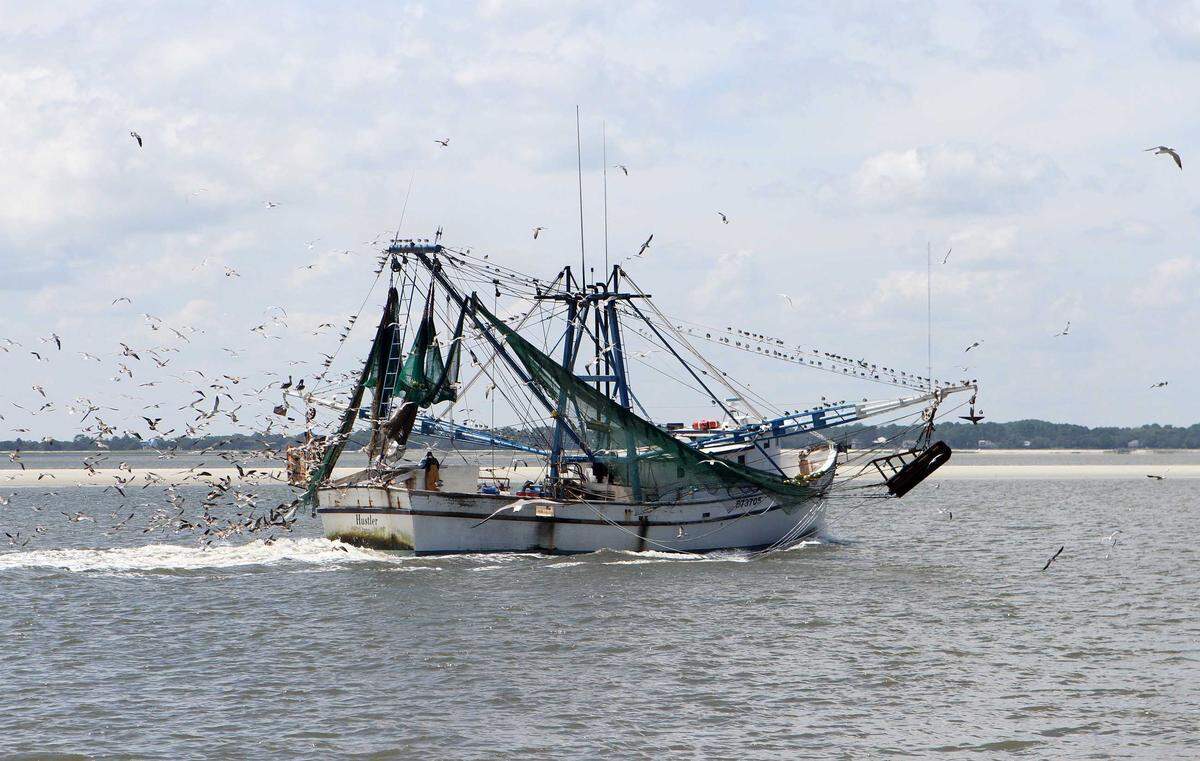
Above: Seagulls try to steal from a trawler's catch Sept. 6, 2015, near St. Helena Island. (Delayna Earley/dearley@islandpacket.com)
National trawling troubles
Meanwhile, costs for shrimpers are on the rise.
Fuel, ice to freeze the shrimp and equipment have all gotten more expensive. Diesel fuel, for example, averaged about $1.10 per gallon in 1994. It cost about $3.00 to $4.50 in recent years, according to the U.S. Energy Information Administration. Some trawlers can burn 30 gallons of diesel an hour, making fuel the number one cost to run the boats.
And affordable dock space in coastal communities has begun to disappear, said Frank Blum, executive director of the South Carolina Seafood Alliance said.
"There is only one publicly owned dock for shrimpers in the state left in Port Royal," Blum said. "And that just had a fire. Values of land on the coast are going up so a lot of the docks are raising their prices or are closing down for a big house or business to move in."
South Carolina also lacks the infrastructure that exists in the biggest shrimping states on the Gulf of Mexico.
That infrastructure, paired with large volumes of shrimp catches in the gulf, make the shrimping business profitable in Louisiana, Florida and Texas.
For example, South Carolina had a shrimp catch of just 2 million pounds in 2013, compared to Louisiana's 100 million, NOAA data show. Because of that volume, most shrimp processing facilities that wash, remove heads and veins, package and freeze shrimp are located in states on the gulf, Blum said.
If SC shrimpers wanted to sell their shrimp to mass-processors, they would have high costs transporting shrimp from the Carolina coast.
"We need our own processing facilities if we really want South Carolina to cut into shrimp imports," Blum said. "We hope that can happen."
Now most of South Carolina's catch stays in the state. Many businesses operate like the docks at Gay Fish Co. in St. Helena or Benny Hudson Seafood in Hilton Head, selling product locally to individuals off the dock.
"They can make a living that way; they get a good price," Blum said. "But that won't help the industry stay alive and it's hard work to catch it and sell it yourself.
Blum said there has been some interest in building processing facilities here, "but they all came to nothing. There just isn't enough volume."
Local shrimpers could pool their catches to pay for a processing plant, but Blum said that is unlikely.
"Getting shrimpers together is like herding cats," Blum said. "They are all individuals sometimes to a fault."
Trawling for a future
Despite hard times, some Beaufort County shrimpers are still eeking out a living.
Mark Smith, who has been shrimping for some 40 years, reguarly wakes up at 3:30 a.m. and ships out of the Port Royal docks, hoping for a good day of dredging. He can be out on the water up to three days at a time on the trawler he runs, the High Tide.
"You have to love it," Smith said. "This isn't something you can stay in for the money. We stay because we love being out there on the water."
In many ways a shrimp trawler is like Smith's second home, but with an added sense of freedom, Smith said.
"When we leave the dock we are totally independent," he said. "It's a different world when you get out there. You leave behind everything. A lot has changed, but that part hasn't."
In his early 50s, Smith is one of the younger shrimp boat captains in the county, with many still working the hard hours into their 60s or 70s.
But Smith said that he, for one, is confident the next generation will take up shrimping as the industry evolves. The freedom and culture of a shrimp trawler will always attract people willing to fight the odds, he said.
"There will be people who love this enough to keep doing it," Smith said. "I don't know if they'll make the kind of money we used to, but they'll be out there anyway."
Farm-raising shrimp is part of a movement that might be the future of the domestic industry. | READ
Local shrimper and business owner Laten Reaves sees success despite storms rocking the local seafood industry. | READ
Follow reporter Erin Heffernan at twitter.com/IPBG_erinh.
Related content:
- Is that seafood fresh, local? How to tell, May 20, 2014.
- Port Royal losing money on shrimp dock operation, May 30, 2011.
This story was originally published September 25, 2015 at 2:43 PM with the headline "Vanishing nets: Area shrimpers sail on despite rising costs, threats from imported seafood."