
Aquaculture: From open ocean to pond
The 5,500 pounds of shrimp in Scott McNair's backyard hide in plain sight most of the summer.
A one-acre pond McNair reclaimed from a failed development is barely noticeable from the road in his rural Yemassee neighborhood.
But when McNair dips and raises a net from the pool, a bounty of large Pacific white shrimp magically appears.
McNair is part of a shrimping movement that, according to experts, might one day save the struggling domestic shrimp industry. It's called aquaculture and refers to farm-raising shrimp.
McNair runs one of only two commercial shrimp farms in the state.
"It was something almost no one else is doing or considered doing, having a backyard full of shrimp," McNair said. "I like that part of it."
Though aquaculture may be novel in the US, it has quickly dominated global seafood markets. Farms now produce most of the shrimp Americans eat, but very little of it is domestic. Instead, 90 percent of the world's farmed shrimp comes from Asia, with more than 60 percent produced in China alone, according to the Food and Agriculture Organization of the United Nations.
Shrimp farm production exploded in the 1980s, flooding US markets with farmed products that are much cheaper to produce than those wild catches.
From the 1980s to 2012, the annual crop of farmed seafood grew from 5 million to 75 million tons throughout the world, the UN reported.
But the US has not benefited from that growth, with aquaculture declining here in the past 30 years.
In South Carolina there were once 15 shrimp farms in the 1980s and early 1990s, but an outbreak of disease and escalating land costs forced most out of business, SC Department of Natural Resources experts said.
But people such as McNair are trying to change that, proving that a locally farmed product is possible.
And he is the near ideal man for the job.
McNair has had 30 years of experience in seafood farming and lights up discussing the innovations in the still developing practice.
He began studying aquaculture as a marine biology student at the University of South Carolina, traveling to Taiwan to study Asian farming methods at the peak of aquaculture's development and growth.
That knowledge has allowed him to innovate and experiment with his small pond operation, building solar-powered feeders and designing a harvest system to get the shrimp from his pond, up a hill and into his yard.
"You have to be a bit of a Macgyver," McNair said. "There are a million things that can go wrong that can wipe out your entire crop and that keeps a lot of people from succeeding. You always have to figure out how to fix a problem."
Each April, McNair stocks the pond with thousands of immature shrimp, then raises them through the summer by adding feed and maintaining the water quality.
Last week, McNair harvested thousands of the shrimp by sucking the crustaceans out of the pond through a blue tube. The shrimp traveled about 100 yards up a hill in McNair's backyard and poured by the hundreds onto a trailer where McNair and his friends and neighbors loaded them onto ice and into boxes for customers.
"I have no problem selling this stuff," McNair said. "We've been able to develop a niche market for people and restaurants that want a local product."
McNair sells to co-op customers that await his harvest every year in Columbia as well as neighbors who stop by his home to buy shrimp just after harvest. The rest of his crop he sells to a local seafood distributor.
He makes enough money on the enterprise to provide a comfortable supplemental income for his family, but not near enough to quit his day job as manager at the Auldbrass Plantation in Yemassee.
"In order to make money you have to do everything economically," McNair said. "Or a lot of what you make is lost right away for the next year."
Those tight margins, the threat of disease outbreaks and high upfront costs have put many shrimp farms out of business in the state and cause some to question whether it will ever be profitable.
"If there was profit in it more people would be doing it," Julie Davis, a marine specialist at the South Carolina Sea Grant said. "There is expertise in the state, but the profit margins don't seem to be there yet."
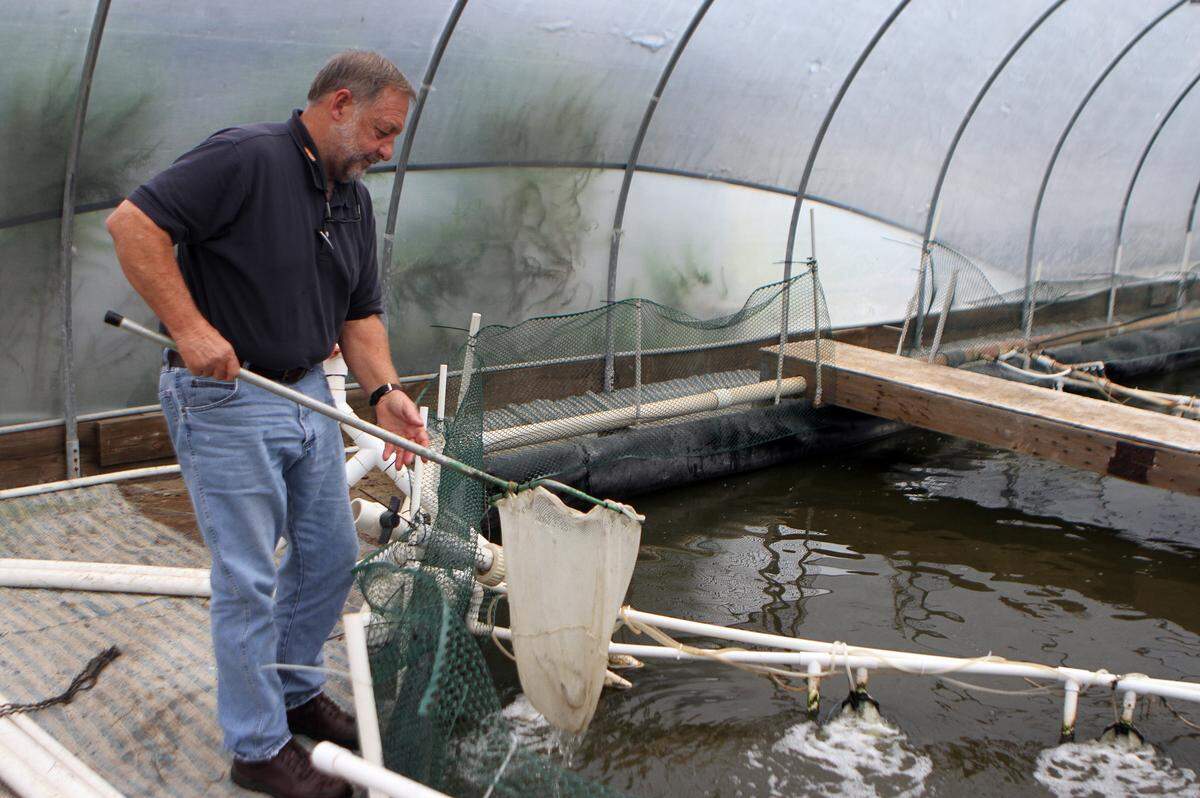
Above: Al Stokes, executive director of the Waddell Mariculture Center, uses a net to dip shrimp from the indoor pond at the center in Bluffton. Stokes predicts shrimp farming, called aquaculture, is the future of the shrimping industry. Delayna Earley/dearley@islandpacket.com
Beaufort County is home to an internationally recognized aquaculture research center, the Waddell Mariculture Center in Bluffton, that is working to study ways to make sustainable shrimp farms profitable for domestic farmers.
"I think that as demand rises for a local product, you'll see shrimp farming take off," Al Stokes, the center's executive director said. "It is about finding people willing to pay and creating ways of farming that can make money."
The Waddell Center is developing ways shrimp farmers can spend less on feed and waste management to more closely compete with the price of foreign farmed products.
Farms in Asia have a competitive advantage, benefiting from cheaper land and labor, Stokes said.
They also benefit from warm waters year-round, allowing for more harvests, Stokes said.
But Stokes said he hopes markets for locally-farmed products will make shrimp farms worth the investment in the U.S.
"We're already seeing 'fresh midwestern shrimp,'" Stokes said. "And people are paying for the novelty of it."
Stokes said that aquaculture may be the best option for replacing imports with a local product years in the future.
"There is not enough SC shrimp caught now for even just South Carolina's population," Stokes said. "We have to find another way to get it if we want more local shrimp -- and this is going to be it."
Local shrimper and business owner Laten Reaves sees success despite storms rocking the local seafood industry. | READ
Follow reporter Erin Heffernan at twitter.com/erinh.
Related Content:
- Haley abandons Waddell Center, June 2, 2013.
- Students raise tilapia, learn about sustainable food production, May 7, 2012.
- Marine life: Former serviceman finds success, peace of mind on flourishing oyster farm, April 8, 2012.
This story was originally published September 25, 2015 at 2:54 PM with the headline "Aquaculture: From open ocean to pond."