Michael Jordan testifies at NASCAR trial in Charlotte. Here’s what he said
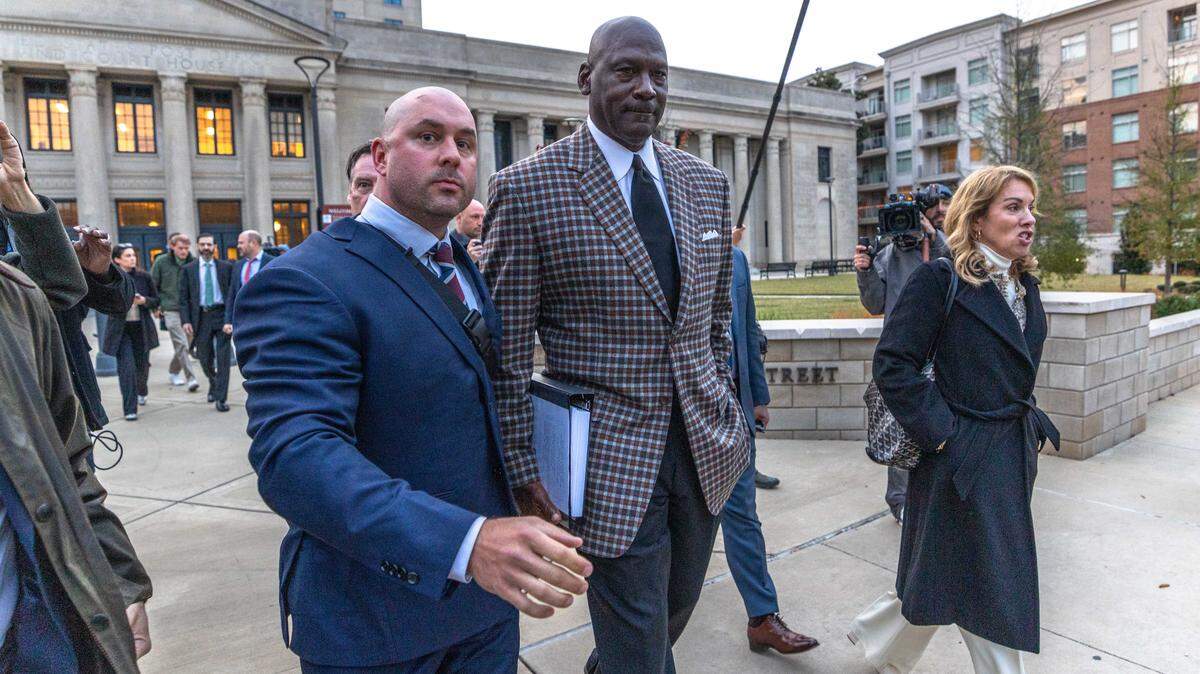
The sixth witness of the trial that could change NASCAR forever was asked to introduce himself to the jury on Friday afternoon.
He obliged: “Michael Jeffrey Jordan.”
Then plaintiff attorney Danielle Williams began working through some basic biographical questions: Did you grow up playing any sports in Wilmington, North Carolina? Were you any good at those sports? Did you play for any other NBA teams after the Chicago Bulls?
The last question sparked a chuckle from the packed Potter Courtroom and the nine-member jury: “I did, though I try to forget it.”
Such was the beginning of Jordan’s official testimony Friday at the U.S. District Court for the Western District of North Carolina in uptown Charlotte. But his presence wasn’t the only spectacle; the sports icon had a lot to say.
Jordan went on to identify himself as the majority owner of 23XI Racing, the Cup Series team suing NASCAR on the grounds that the stock car racing series is an unlawful monopoly. He spent the next hour being interrogated by attorneys for both the plaintiff and defendant, and through it all kept to a non-adversarial refrain: He wanted a partnership with NASCAR — financially, from a governance perspective, “in every way,” he said.
“They don’t have partnerships, they have contractors,” Jordan testified of NASCAR’s business relationship with its Cup teams. He added, “If the model ever comes to a (compromise), we can grow this business.”
Michael Jordan and the NASCAR business model
Jordan and his longtime business partner Curtis Polk joined Cup Series star Denny Hamlin to buy charters and ultimately compete in the NASCAR Cup Series in 2020. Its first season of competing was in 2021. 23XI competed under the terms of the 2016 charter agreement — an agreement that for the first time in the sport’s history made each Cup team a “charter,” not all that dissimilar from how “franchises” work in other sports leagues.
That 2016 charter agreement expired ahead of the 2025 season. Negotiations for years leading up to 2025 were tense. Teams wanted to make those charters “permanent” — making the teams that they paid millions of dollars to obtain belong to them as opposed to “leasing” them from NASCAR, as the plaintiffs have put it. That way, teams argue, they could own what they have invested so much time and money in and watch the asset appreciate — or depreciate — as the sport fares over time.
NASCAR wanted to maintain its business model, more or less, under the 2016 agreement. In the end, 23XI Racing was one of two Cup teams to not sign the renewed charter deal, instead opting to file a lawsuit in October 2024, claiming that NASCAR used “anti-competitive” acts to benefit the racing series at the expense of the teams and forced teams into an unfair deal.
Fourteen months after that, Jordan was explaining why he was in this chair.
“I was a new entity” coming into the sport who “could challenge” the status quo of NASCAR. Jordan made clear he respected the institution and what CEO Jim France and his family built — he was a NASCAR fan from 12 years old throughout the rest of his life, he said — but also that there were several flaws with the 2025 charter agreement.
The economics of NASCAR charters
Jordan’s main grievances centered on the economics of the deal. He disagreed with how the teams weren’t true partners with NASCAR — though he acknowledged that it’s different because the series is a private company — and didn’t like the fact that the revenue split in NASCAR was “way less” than “any other business I’ve been a part of.”
“We never thought we’d get what basketball (NBA teams) was getting,” Jordan testified, “but we were hoping to move in the right direction.”
He added: “I want to push NASCAR to be better. … When you talk about (permanent) charters, when you talk about partnership, that’s ideal.”
In cross-examination, Jordan admitted that he never read the 2016 agreement and that he hadn’t “word-for-word” read the 2025 agreement, so he couldn’t speak to every specific concession NASCAR made in the new deal.
Lawrence Buterman, attorney for the defendant, smiled and thanked Jordan for making his 9-year-old son think his father was cool.
Jordan responded and smiled: “I see you’re not wearing your Jordans today.”
Notes from Day 5 of NASCAR vs. 23XI Racing-Front Row Motorsports
—Jordan was merely one of four witnesses who took the stand on Friday. NASCAR president Steve O’Donnell finished his six-plus-hour testimony, that had started Thursday, on Friday morning. Co-owner of Joe Gibbs Racing Heather Gibbs was next, then Jordan, then Race Team Alliance (RTA) executive director Jonathan Marshall, who helped teams during the 2025 charter negotiations, the catalyst to the lawsuit.
—Gibbs provided an emotional testimony on Friday, opening up for the first time publicly about the death of her husband, Coy Gibbs. Coy passed away in his sleep in November 2022, a few hours after watching his nephew, Ty Gibbs, win the Xfinity Series championship in Phoenix. She teared up as she explained what it was like losing her husband, for her children losing their father, for her father-in-law, Joe Gibbs, losing a second son.
She used this testimony to explain how much is at stake for her team. She explained that starting a NASCAR team began with “a dream on a napkin” written by some people who are no longer here — and that she and Joe felt they had a duty to sign the agreement to keep some people’s legacies alive, even if it required holding her nose and signing a charter agreement she deemed unfair.
“That’s the legacy of JD (Gibbs, who passed in 2019), the legacy of Coy,” Gibbs said. She added, “And without the charter, we wouldn’t be able to keep going.
She even appealed to NASCAR CEO and chairman Jim France personally, she said, the night before the 2025 charter agreement deadline.
“I’m done with the conversation,” she recalled France telling her. “If I wake up and have 20 (charters), I have 20. If I have 30, I have 30.”
NASCAR, conversely, has repeatedly labeled the teams’ characterization of NASCAR’s deadline for the 2025 charter — a “gun-to-the-head” negotiation tactic — as false. The sanctioning body’s legal representation continues to say that it sent out a proposed charter agreement to all teams on Aug. 30 and that they set a deadline for parties to reach an agreement on a new contract the following week.
—Marshall, the aforementioned negotiation leader for the race teams, took the witness stand on Friday and largely regurgitated what the jury has already heard. He recalled a conversation with Hendrick Motorsports leader and NASCAR Hall of Famer Jeff Gordon, who told him at the end of charter negotiations: “This is the first negotiation I’ve been a part of where we’ve gone backward.”
One tense moment between Marshall and Buterman sprouted when Buterman accused Marshall of unjustifiably representing that he had intimate knowledge of race-team financials. Buterman asked if Marshall had seen any financials as leader of the RTA; Marshall responded he hadn’t, adding that his concerns were listening to the teams’ challenges and ensuring that their needs were reflected in the 2025 agreement.
—Judge Kenneth Bell addressed the jury before court broke for the weekend and told the nine-member group that he didn’t want to “encourage or discourage” the possibility of ending this trial “on time” — by Friday, Dec. 12. He previously told counsel that the proceedings were moving too slowly and that there was a hard deadline by next Friday, Dec. 19.
This story was originally published December 5, 2025 at 2:57 PM with the headline "Michael Jordan testifies at NASCAR trial in Charlotte. Here’s what he said."