
‘Live oaks don’t have to die’: Iconic Okatie tree to live another day – or forever?
Editor’s note: After enjoying retirement for six months, columnist David Lauderdale returns to The Island Packet and Beaufort Gazette with a new column each Sunday. Here is the first. Welcome back, David!
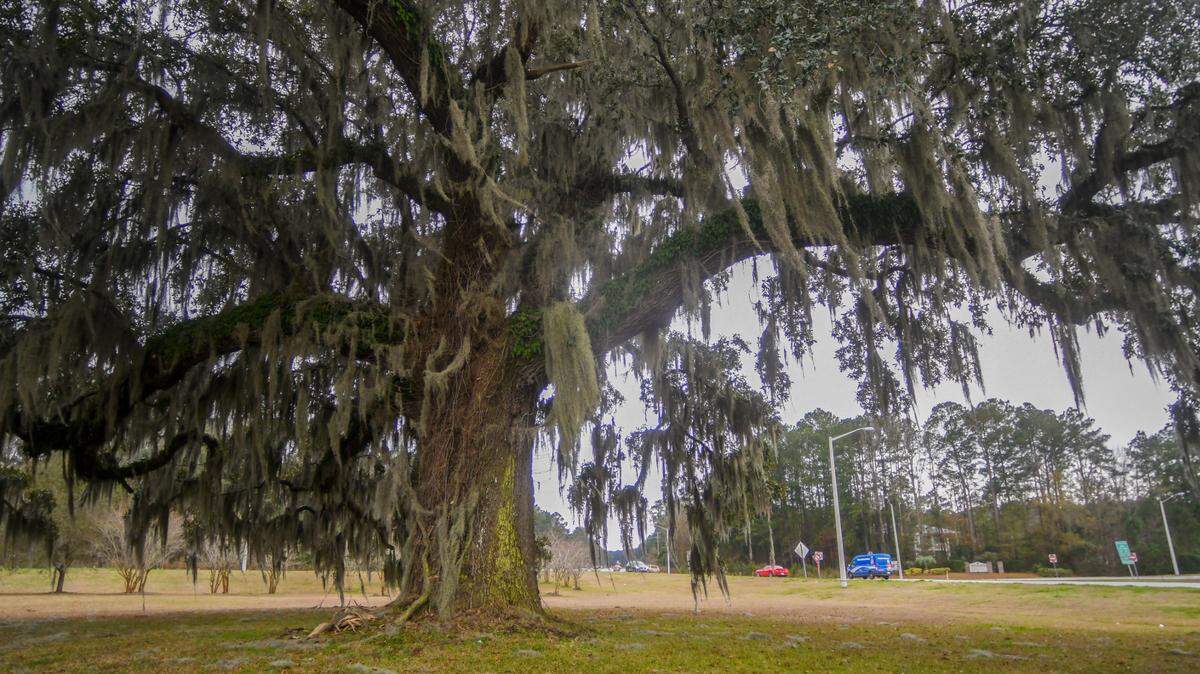
It’s not an especially pretty live oak tree.
In fact, it looks a little snaggletoothed and cockeyed as it peers over one of Beaufort County’s busiest intersections, outside Sun City Hilton Head.
“But you know what? It’s a survivor, and we’re all survivors,” said Chris Campbell of Sheldon, chairman of the Keep Beaufort County Beautiful board.
That organization is working to keep the tree alive, and it’s at least the third time people have rallied to spare it from the potential sad fate of the Secession Oak in Bluffton. That historic tree recently collapsed, taking tales of fire-eating “Bluffton Boys” rallying for secession with it.
This oak is not as storied as the Secession Oak, as pretty as the tree in the Beaufort County seal, or as star-studded as the oaks in the movie “Forrest Gump.”
And it’s not as magnificent as the county’s largest live oak, for centuries a fixture near the banks of Battery Creek in Port Royal.
But it clings to life boasting the local motto: Location, location, location.
And it has certainly seen a lot.
We might call it the McGarvey Oak because its 75-foot height and 110-foot wingspan beautifies the intersection of U.S. 278 and S.C. 170, known locally as McGarvey’s Corner.
Just a few decades ago, it was a dark intersection of two-lane blacktops, a flashing yellow light and an all-but-hidden directional sign the only markers for motorists trying to find Hilton Head.
Now the tree, with age estimates ranging from 150 to 250 years, is often overlooked in the sprawling half-cloverleaf intersection in the heart of booming Okatie. Tens of thousands of vehicles roar by each day, and “For Sale” and “Now Open” signs show that the growth explosion in an area once dotted with Native American villages has only just begun.
“The tree kind of documents something in our Lowcountry history,” said arborist Michael Murphy of Beaufort, now tending his second revival of the old oak.
“We need to keep that connection with this history,” he said, noting the old Barrel Landing School and St. Luke’s church buildings nearby.
“The tree can live,” he said. “It doesn’t have to die. It doesn’t have to fall apart.”
Murphy and Campbell have a plan that could enable it to live almost forever.
‘SAVE IT’
Murphy was relatively new to the Lowcountry, a transplant from New Jersey where he was once named the state’s Arborist of the Year, when he first noticed the McGarvey Oak.
That was in 2010, a decade after the tree was literally spared because another local arborist took pity on it.
Gary Mullane had taken it upon himself in the early 1990s to save the tree’s life after the fancy new intersection was built.
“It was a big, old, lonely tree in the middle of a construction site, and no one was doing anything,” Mullane told our newspaper a decade ago. “The tree was 90 percent dead. It got beat up from construction. I figured I could save it.”
Besides construction scars to its root system, the tree had been ripped at least twice by lightning bolts that left their telltale coup de sabre slash from crown to root.
Mullane led the resuscitation with fertilizer and mulch, and the tree thrived.
But 15 years later, it needed to be goosed again.
This time Murphy led the effort. The group killed the grass beneath it and replenished the mulch, fertilized it, removed sun-blocking moss, and pruned it. He added lightning protection.
Now, Murphy wants rejuvenation and more — a permanent plan for upkeep and maintenance.
The tree is on state land that is maintained by Beaufort County.
Murphy and Campbell say both the public and private sectors are once again receptive to saving the tree.
And with what arborists know now, Murphy said, “the tree can almost live forever.”
NO CRAPE MURDER
Murphy talks about “regenerative pruning” and “differential response trees” in outlining a bright future for the snaggletoothed oak.
A live oak, like a crape myrtle, is blessed with a “different response” to pruning, which can help it thrive, he said.
Murphy said it should be pruned to reduce weight at the outer edges, which keeps the tree from collapsing under its own weight, and frees limbs to regenerate ad nauseam.
“You don’t prune as drastically as you do the crape myrtle, which people call ‘crape murder,’ ” Murphy said. “Actually, it’s more like ‘crape mayhem.’ But you won’t see the live oak trimmed like that.”
The concept has been used for 800 years in Europe, he said, where wood could be harvested from limited forests without felling the whole tree.
This method can’t save a tree like the Secession Oak from falling over tomorrow, but when applied over 15 to 25 years, it could produce a truly sustainable tree, Murphy said.
And that could be done to live oaks all over Beaufort County, where mature trees are desperately needed, Murphy said.
“We could have live oaks that would live forever — 800 years or more,” he said.
Murphy likens a permanent maintenance plan for the McGarvey Oak to a conservation easement that preserves land.
Campbell said, “We’ve got the money to do what we’re going to do this year.”
They will restore the mulch, put up a rustic fence to prevent maintenance workers from parking under the tree and damaging the root system, check the lightning protection and do regenerative pruning.
Campbell said it has taken a village to give the McGarvey Oak its newest new lease on life. Besides Murphy and Keep Beaufort County Beautiful, he cites:
Eric Greenway, interim Beaufort County administrator; Elizabeth Penn-Sanders with the S.C. Department of Transportation; Leland and Chris Rentz of LCR Construction; Laura Lee Rose of the Clemson University Extension Service; Cindy Carter of the Beaufort County solid waste and recycling division; Allcare/Kolcum Tree Service of Bluffton; and Mark Roseneau, director of Beaufort County Facilities Management.
“We see this as a win-win,” Murphy said. “An educational program will come along with it to let people know what they can do to help their live oaks.
“Live oaks don’t die, they just fall apart.”
David Lauderdale may be reached at LauderdaleColumn@gmail.com.
This story was originally published February 20, 2021 at 8:00 AM.