
How a Port Royal photographer made birders go all aflutter
Kelley Luikey’s world has gone all aflutter.
A great kiskadee flew into her life on Feb. 9 and the next thing you know Rudy Mancke is talking about her.
For a nature photographer like this young mother of two in Port Royal, making Mancke’s “NatureNotes” program is like being kissed by the pope.
Or capturing a photograph of a dashing yellow bird that to our knowledge has never dashed in South Carolina before, and probably not even the entire east coast.
“Birds like this, sometimes they ease along the Gulf of Mexico, but never, ever here, till now,” Mancke said Wednesday morning on his S.C. Public Radio program.
Nobody knows how it got here. It should be in South America, Central America, Mexico, or maybe the edge of Texas.
“I assumed it would pique some interest,” Luikey said, “but I definitely did not expect the intensity of the birders. I had no idea it would be such a big deal. People say photographers are crazy, but I think the birders have us beat.”
When Port Royal town manager Van Willis crowed on Facebook about Rudy Mancke mentioning Luikey, Ashley Brown Dando responded: “I heard it too! We knew her when ...”
We knew her when she came in out of the cold 11 years ago, moving from Cape Cod to our funky little town, which they say has been “cool, coastal and far from ordinary” since 1562.
We knew her before she became a Master Naturalist through Spring Island’s Lowcountry Institute. We were there when one of her photographs was selected last year in the initial ArtPop Beaufort competition to be plastered on an area billboard.
And we knew her when she took one giant leap out of the ordinary and into our coolest coastal haunts with a camera in hand. Not that life is ordinary when you’re married to a NetJets pilot. But two and a half years ago, Luikey felt tugged to the art form that fascinated her so in the darkrooms (you remember darkrooms) at Appalachian State University.
That’s how she ended up with a business called Nature Muse Imagery, and how she ended up stalking the rare and wondrous great kiskadee.
It was early on “opening day” at the Bear Island Wildlife Management Area in Colleton County. It’s part of the glorious ACE Basin hugging U.S. 17 between Beaufort and Charleston, one of the world’s “last great places” that’s more a chamber of the Lowcountry heart than a dot on the map.
“Opening day,” she said, is the first day the general public can get back in after the winter hunting season. She was in search of big pockets of wading birds, or gliding tundra swans. They weren’t there, but out of the corner of her eye she saw something unusual and scrambled to find it in her 400 mm lens.
A birding friend confirmed that the image she texted him was a bird that was not supposed to be here.
Next, her phone exploded with calls and texts. Where is it? Where is it? I want to go see it.
She reported the precise location on her rare bird report. By the next morning, Bear Island was cluttered with cars. By now, lots of people have seen the bird. And they called Luikey a heroine.
“Things went crazy after that,” L:uikey said after a chilly photo shoot Thursday morning at the Pinckney Island National Wildlife Refuge.
“I didn’t realize birders were so intense,” she said.
But she well knows the thrill of the Lowcountry wildlife.
Like the four barred owls and a quail seen in her backyard.
Or the day her family saw a leatherback sea turtle in Port Royal Sound off Land’s End. She told her children, “You’ll never see one again.”
Then they saw a second one, and a third one, and ... her world had gone all aflutter.
David Lauderdale: 843-706-8115, @ThatsLauderdale
Special report
ACE Basin: A 'Last Great Place' turns 25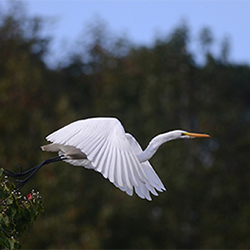
Nov. 16, 2014 A quarter century ago, the lands straddling the Ashepoo, Combahee and Edisto rivers in coastal South Carolina were mostly private holdings covered in forest, creek and marsh. Not much has changed -- and that took hard work. Visionary men and women, landowner and public servant, have achieved a 217,000-acre conservation jewel in an area destined for sprawl. | READ
Special report
Cracking the nut that is a birder's brain
Dec. 28, 2014 On the occasion of Audubon’s 115th annual Christmas Bird Count in 2014, we tried to discover what makes a birdwatcher tick. | READ
This story was originally published March 17, 2017 at 6:08 AM with the headline "How a Port Royal photographer made birders go all aflutter."