
Beaufort County is targeting illegal immigration. Do you feel safer? | Opinion
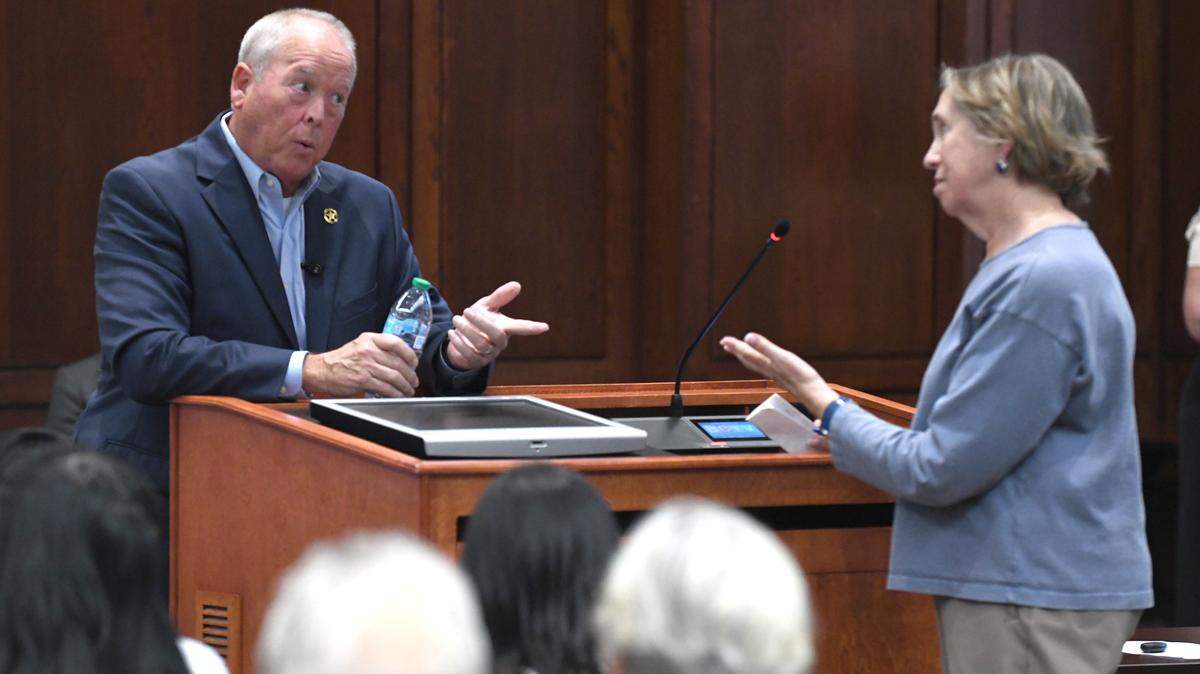
On July 31, the Beaufort County Sheriff’s Office became the 20th in South Carolina to sign a deal to help the U.S. government enforce federal immigration laws.
What it will look like is anyone’s guess. Whether you feel safer now is up to you.
Beaufort County Sheriff P.J. Tanner isn’t saying much about what to expect. In a recent 40-minute interview with me, Tanner shared some new details about the program, explained why he’s for it and expressed why his critics are wrong. He didn’t change my mind.
An earlier column of mine made clear that I am one of those critics. I have concerns about economic and public safety impacts in a part of the county that’s reliant on tourism, where undocumented immigrants hold cleaning, construction and agriculture jobs, and where a lot of Latinos live, work, attend school and need to know reporting a crime won’t leave police looking at them.
(It’s rarely employers who are punished, by the way. It’s usually the people trying to hold down tough jobs so that they can feed themselves and their families and generally stay out of trouble.)
The issue is divisive. The response to my last column made that clear.
One reader worried about illegal immigration driving down entry-level wages for everyone, about criminals and terrorists entering the U.S. illegally and about how “absurd” it is to say crimes won’t be reported or profiling will result.
My response? 1) Americans aren’t going to work many of those jobs. 2) Immigrants can commit crimes, but multiple studies show documented and undocumented immigrants commit fewer crimes than native-born Americans. And 3) would you report a crime if you saw the profiling that is happening to people who look like you or worry you’ll be arrested if you report it?
Another reader wrote that I had “sealed” Tanner’s 2026 re-election.
Maybe. But it’s not my job to reelect or to remove Tanner, who has been sheriff for 26 years and seems likely to keep the position next year. It’s my job to discuss issues in South Carolina and arm readers and residents with facts (and, yes, opinions) so you can decide what to feel and do.
With GOP gubernatorial candidates saying South Carolina needs an immigration detention center like Florida’s “Alligator Alcatraz” or Indiana’s “Speedway Slammer,” I called Tanner to talk about Beaufort County’s renewed fight against illegal immigration.
Third time’s the charm?
I appreciated him talking to someone who has raised concerns publicly.
Last month, I tried to explain his and his critics’ perspectives and to offer insights as someone who spent 25 years in the border city of San Diego and now lives in and loves South Carolina.
I hope that column — and this one — show readers that I may have strong feelings about this issue, but I am willing and eager to hold it up to the light to see its many facets, based on facts.
Tanner says he expects he’ll have two deputies working within two months with contractual powers “to interrogate any alien or person believed to be an alien as to his right to be or remain in the United States” and “to arrest without a warrant” those in the U.S. without documentation.
There’s already a shift from a July public forum where Tanner told the crowd he’d use just one deputy and that Beaufort County wouldn’t see armed, masked officials patrolling the streets.
Now he won’t rule out any application of the law. He says he’ll figure out what to do as he goes.
“My plan is to provide public safety in Beaufort County,” Tanner told me. “How I do that is based upon the need.”
One of the issues I have is that he’s not more forthcoming — even with information that should be public. After he told a crowd of detractors at a public forum that the emails he personally has received show that the program has as many local supporters as critics, I submitted a public records request for all emails he or the office had received since he applied to the program in February.
When the response included none from the public, I sent the office Tanner’s exact comment, and asked if there were any emails from the public. After I got a few more emails, Tanner told me in our interview that he had more that I should have been given, so I put in a third request and received three other emails that supported Beaufort County’s inclusion in the program.
Is that all of the emails he and the office have received?
I honestly don’t know.
Shredded paperwork
The assigned deputies will report to U.S. Immigration and Customs Enforcement supervisors.
But first Tanner has to designate and train the officers who will report to the federal government.
He may reassign existing deputies, bring back retired ones or hire new personnel, he said.
The contract specifies that training for this work will cover an officer’s immigration authority, relevant immigration law, use of force policies, civil rights laws, liability issues and cross-cultural issues, and that the federal government will cover the training costs. The Beaufort County Sheriff’s Office will cover salaries and benefits, overtime, local transportation and equipment.
At the first of two public forums on his program application, Tanner told a crowd he’d just have one deputy in the program. He now says he’ll have two working together for safety reasons.
He told me he’d first look to rehire deputies in the program when Beaufort County took part from 2008-2012.
Back then, Beaufort County had five deputies involved, up to three at a given time.
Tanner said he was unable to release records from that period because he had shredded them all at the direction of the Obama administration that ended the program in 2012. That sounds convenient, and problematic. But he said the program was effective then, and it would be again.
“We’ve been down this road before,” he said. “The only difference is now a lot of people don’t like the current president in office, and I think that’s driving a lot of the rhetoric. The program is really not very different than when we had it before.”
Except that it is different. It’s exploded in popularity.
A tsunami of agencies
President Barack Obama was called the deporter-in-chief during his two terms in office.
Now President Donald Trump has launched what calls the largest deportation program in history in his second term. Hundreds of state and local law enforcement agencies are helping him.
Look, everyone wants it to be safer and for crime to stop. But a lot of people disagree about whether mass deportations make neighborhoods better off or hurt both the economy and public safety by removing people employed in jobs many Americans don’t want and by keeping people worried about deportation from reporting crimes in the first place, a distinct possibility.
The targets tend to be Latinos, and there are many Latino families in Beaufort County who could be caught up in a law enforcement dragnet, raising concerns about potential racial discrimination and civil rights violations for everyday Americans. Elsewhere, there are horror stories of U.S. citizen children being deported and immigrants being sent away without due process.
Those who don’t see the complexity of the issue, or how views of it change over time, haven’t looked at it closely, so let’s do that.
Almost half the state’s 46 counties are now partnering with the U.S. government. Many Americans support it. Others worry about economic effects, moral obligations and our future.
After decades of congressional wrangling over potential pathways to citizenship, is the answer really to kick all those out of the country whose only failing is they crossed the border illegally at some point in the past, a category chock full of hard-working, law-abiding, productive citizens?
These days, the U.S. government is comfortable making immigration arrests at immigration hearings, churches and schools, places where many immigrants in the country are trying to follow the law and their faith, trying to make a future better for their kids.
Yet here we are, with a tsunami of state and local agencies signing up to help detain and deport undocumented immigrants amid a massive federal agent hiring spree and federal budget boost for Immigration and Customs Enforcement.
As much feeling as fact
Just three of the state’s counties were taking part in the so-called 287(g) program before this year when Trump and Attorney General Alan Wilson began imploring more agencies to sign up to assist the federal government with detention and deportation.
The program was created by a Republican-controlled Congress in 1996, but documented cases of racial profiling and civil rights abuses led President Obama to discontinue it in 2012.
Trump revived the program in his first term in 2020 and sheriffs in Horry, Lexington and York counties all signed up. It atrophied under President Joe Biden, who paused but did not end it. In Trump’s second term, a record 900 state and local agencies take part.
Richland County is the only one of South Carolina’s 10 most populous counties not to participate. Only six of the 20 largest counties don’t. Including Richland, the holdouts are Aiken, Florence, Sumter, Orangeburg and Laurens. Eleven of the 20 sheriff’s offices and all four police departments taking part — Coward, Duncan, Holly Hill and Scranton — have joined since June.
The South Carolina Law Enforcement Division signed up in March.
In the end, nothing critics said would have dissuaded Tanner from rejoining the federal program.
“I appreciate their comments,” he told me. “I value their comments. I understand to some extent some of what they were saying. Everybody has a right to air their opinions either for or against programs like that, but it’s my job to apply and use what tools are necessary to provide public safety in Beaufort County.”
He added, “If Beaufort County was an unsafe place to live, work and play and vacation, our economy would suffer greatly. But our crime rate in Beaufort County is well below the national average, and we intend to keep it that way… We’re going to keep the crime rate low, and in order to do that, you use every tool.”
Tanner said the program will work as a tool beyond any arrests.
“It acts as a deterrent as well, but my biggest thing is … it gives us a seat at the table and allows us to share our opinions and thoughts about what should be done in Beaufort County,” he said.
Ultimately, public safety is as much a feeling as a fact.
So ask yourself: Do you feel safer now, and what would it take for you to feel safer?
New crime statistics will be available in time, and serious criminals will be punished, as they must be. Local agencies and the U.S. government will tout some of the arrests, as they always do. Activists, immigration lawyers and anyone who is wrongfully detained or whose civil rights are violated will discuss misapplications of the law, as they should.
There are so many questions, but right or wrong, this is Beaufort County now, this is the United States.
In a speech on illegal immigration in 2006, President George W. Bush said, “There is a rational middle ground between granting an automatic path to citizenship for every illegal immigrant, and a program of mass deportation. That middle ground recognizes that there are differences between an illegal immigrant who crossed the border recently and someone who has worked here for many years, and has a home, a family, and an otherwise clean record.”
In that speech, Bush also said, “America needs to conduct this debate on immigration in a reasoned and respectful tone. Feelings run deep on this issue and as we work it out, all of us need to keep some things in mind. We cannot build a unified country by inciting people to anger, or playing on anyone’s fears, or exploiting the issue of immigration for political gain. We must always remember that real lives will be affected by our debates and decisions, and that every human being has dignity and value no matter what their citizenship papers say.“
That this country hasn’t implemented comprehensive immigration reform is the most incomprehensible thing about it.
Matthew T. Hall is McClatchy’s South Carolina opinion editor. Email him at mhall@thestate.com.
This story was originally published August 13, 2025 at 5:00 AM.