
‘Make sure we have the right guy.’ A 67-day false arrest gets worse in SC | Opinion
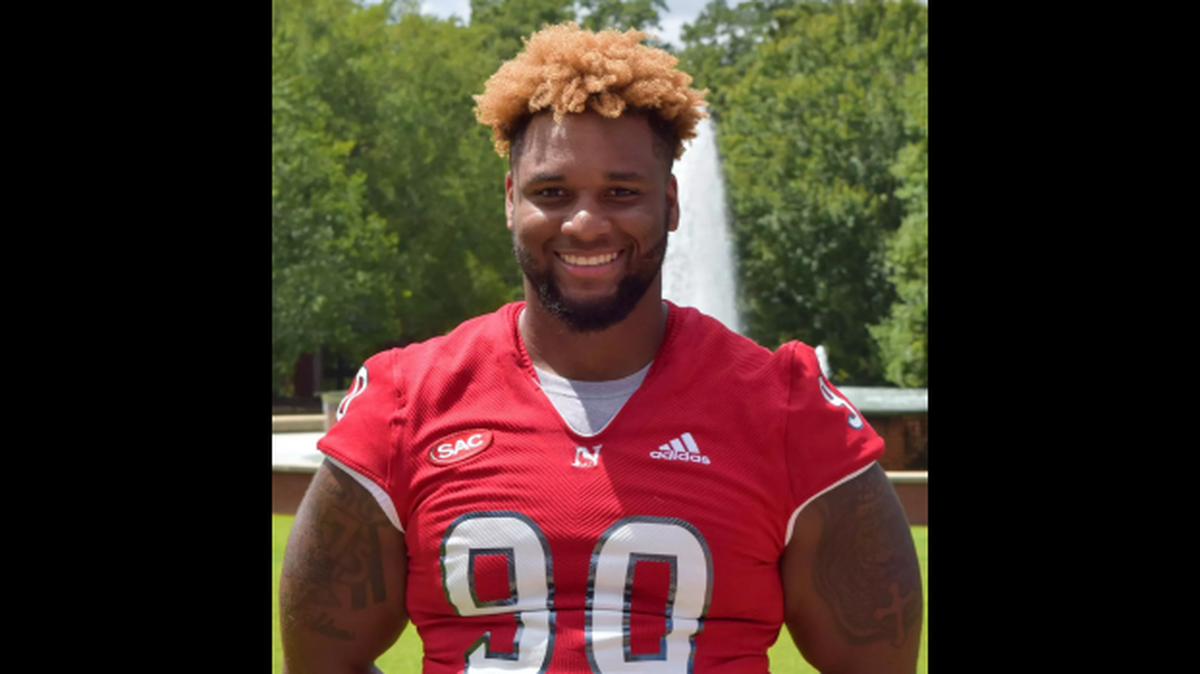
Last month, I brought you the stunning story of former star Newberry College defensive lineman Ty’Ran Dixon, who followed his dreams of professional football to Finland then flew back to South Carolina for his school’s 2024 homecoming only to find himself behind bars for 67 days.
Dixon was wrongfully detained for killing someone he’d never met in a county he’d never visited.
His lawyers Robert Goings and Joseph McCulloch sued the Barnwell County Sheriff’s Office for negligence, false arrest, malicious prosecution and defamation in state court in April, and the office’s formal response actually said he was released quickly once it realized its mistake. As if 67 days is fast.
Now Dixon’s lawyers have filed a federal lawsuit, alleging that “abject incompetence” by elected Barnwell County Sheriff Steven Griffith and four other officials — two from the Sheriff’s Office, one from the Aiken police department and one from the South Carolina Law Enforcement Division — locked Dixon, the wrong man, in a “special unendurable hell,” violating his civil rights.
Incompetence and hell are words that usually don’t need adjectives, but even these descriptions don’t do this case justice.
Just how hellish was it?
My earlier column documented the poor police work that left Dixon behind bars while Tyren Dickson, a man investigators now believe to be the killer, roamed free until authorities admitted their “mistake,” released Dixon and charged Dickson with killing pregnant, 21-year-old Jasmine Roach. Dickson’s criminal case is proceeding in court.
The errors documented in Dixon’s first lawsuit were only the tip of the iceberg.
One email that’s surfaced asks if the Sheriff’s Office has “the right guy.”
A ‘highly credible source’
Dixon had just deplaned in Boston from a European flight when he was cuffed in front of dozens of passengers, guided through Logan International Airport and interrogated. His slow return to South Carolina included stops at five detention centers in four states. In one, he slept on a steel slab as rodents crawled over him at night. In another, he broke down and wanted to die.
Dixon’s detention from Sept. 30 to Dec. 6 came as Griffith coasted to the end of his first term in office. He is so popular he beat a challenger in the Republican primary in June by a spread of 90.5% to 9.5%. He didn’t even face a Democratic opponent in the November general election. If there was a candidate then, and this colossal mistake emerged, Griffith might not be sheriff.
Unfortunately, he’s not talking about the case or the culture of his department. He didn’t return calls before my first column or before this one.
Everyone deserves their day in court, but the new lawsuit, which demands a jury trial, documents that someone characterized as a “highly credible source” actually texted the sheriff Dickson’s name, photos and social media profile within 12 hours of the shooting that killed Jasmine Roach Oct. 15, 2023. Twelve hours!
Screenshots of those text messages were made public for the first time in the federal lawsuit.
Yet not only did investigators not immediately follow up on that lead, they arrested Dixon, who looks nothing like the other man wanted in connection with the killing two years ago.
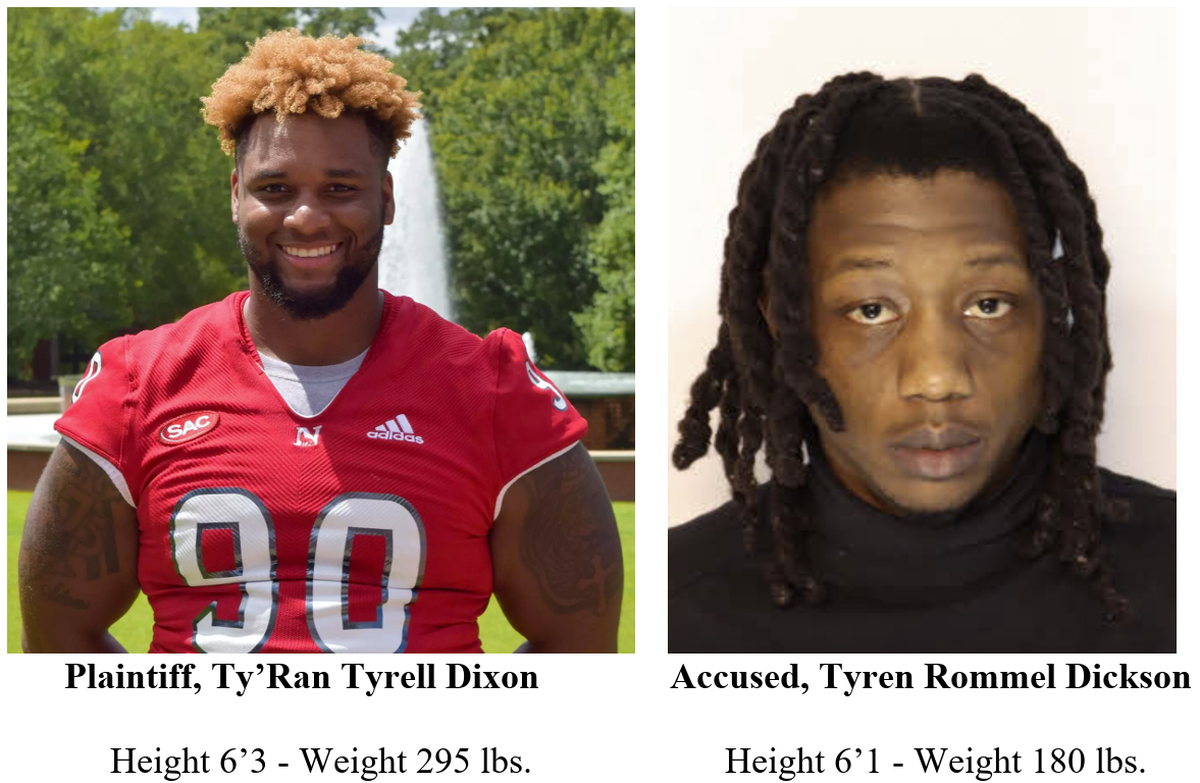
That night, Dixon was at Newberry College for Homecoming 2023, nowhere near Barnwell County. In fact, he has never even been in the county that first elected Griffith sheriff in 2020.
As Dixon’s lawsuit states, “The failure of Sheriff Griffith and the defendants to properly pursue the information and immediately apprehend the actual suspect left the entire community and state at risk of the commission of further violent and illegal acts for 15 additional months.”
Just wait. It gets worse.
‘Make sure we have the right guy’
According to the lawsuit, nine days after the shooting, on Oct. 24, 2023, the South Carolina Law Enforcement Division pulled Dixon’s driving record and inserted his photo into a “suspect chart.” That photo array did not include Tyren Dickson even though the sheriff had his name and photo.
Later a witness to the shooting told an investigator with the Barnwell County Sheriff’s Office that Dickson shot Jasmine Roach, but that witness was not shown photos of Dixon or Dickson for identification purposes that day or at any time prior to the release and exoneration of Dixon.
The jailhouse informant’s interview happened the morning of Aug. 14, 2024. That afternoon, the Barnwell County Sheriff’s Office obtained felony warrants for Dixon for murder and attempted murder.
Then, nine days later, an Aiken Department of Public Safety officer emailed an investigator with the Barnwell County Sheriff’s Office to ask if he could “do me a big favor.” He attached a photo of Tyren Dickson to his email and asked if the investigator could show it to his witness.
The email, made public in the federal lawsuit, says, “I just want to make sure we have the right guy so if someone could run up to your jail and show [him] this DMV photo without showing the name and info and see if [he] will identify him as Tyren Dickson.”
I just want to make sure we have the right guy.
That was a month and a half before Dixon’s wrongful arrest.
Yet no such visit took place, according to Dixon’s lawsuit. No photo was shown.
Instead, arrest warrants for Dixon were entered into the National Crime Information Center, a centralized database law enforcement agencies use to share information about wanted persons.
Those warrants were the basis of Dixon’s detention as he deplaned in Boston on Sept. 30.
The next day Dixon signed a waiver of extradition and a judge ruled “S.C.” could pick him up “directly.”
Yet the Barnwell County Sheriff’s Office instead let the U.S. Marshals Office pick him up and escort him back to South Carolina, slowly, so slowly, over the next 67 days.
A sheriff’s deputy the office said in a court filing was “in the area on a personal matter” retrieved Dixon’s cellphone in Massachusetts, but did not return home with Dixon himself.
It was the latest example of a bad decision that could have clued authorities in on their mistake.
No investigator ever contacted or interviewed Dixon or anyone in his family to look into his involvement in the killing of Jasmine Roach. No one took Dixon’s mother seriously when she went to the Barnwell County Sheriff’s Office to implore deputies to release her innocent son.
No one acted when Dixon himself professed his innocence continually to anyone who’d listen.
The new lawsuit says, “Dixon, who is Black, was housed with professed NAZIs and white supremacists, as well as convicted murderers, rapists, gang and cartel members and other dangerous inmates,” and he “feared for his life and prayed to the Lord for safety and salvation.”
It says he “contemplated harming himself through suicide, as death was better than life.”
At times, the lawsuit has the feel of a police procedural, except that it really happened: “The small and dark cell that confined Dixon had graffiti written on the walls that sowed discontent and fear. He spent days and weeks trying to rub those messages off the walls with his bare hands — messages like, ‘If you’re reading this, the ghost of the guy that died in here will haunt you at night’ and ‘Rot in hell.’ The only sound Dixon could hear was other inmates yelling and screaming in misery.”
‘Quick, fast and incomplete’
I do hope Sheriff Griffith responds to my messages and I get the chance to talk to him. That’s important. I want to hear and share his side of the story, but the public deserves that as well.
Dixon deserves that.
Until then, his new lawsuit will have to speak for Griffith.
It says that the sheriff did not share the information he had about Dickson 12 hours after the shooting with any members of his office, including those investigating Jasmine Roach’s murder.
It calls “his failure to notify others of the incriminating information and identification of Tyren Dickson” “one of the negligent acts and omissions that led to the unlawful arrest and false imprisonment of Dixon.”
It says he “failed to properly train and supervise” employees in his office and “created a culture … of quick, fast and incomplete criminal investigations that led to the arrest, detainment and possible convictions of innocent individuals.”
It says he has failed to adopt “well-promulgated policies and well-established customs and practices” to ensure thorough investigations, that he “perpetuates incomplete and inaccurate police investigations by failing to ensure his investigating officers are thoroughly trained in criminal investigations” and that he fails to ensure his officers use the training they do get.
Sheriff Griffith should address this directly, and if he won’t, or if worse failures are documented as Dixon’s lawsuits progress, he should expect a serious challenger in the 2028 election. If Griffith won’t talk, that challenger should keep pressing him on all this, use it to unseat him from an important office of public trust and then do something to change that office’s woeful culture.
Matthew T. Hall is McClatchy’s South Carolina opinion editor. Email him at mhall@thestate.com.
This story was originally published August 12, 2025 at 5:00 AM with the headline "‘Make sure we have the right guy.’ A 67-day false arrest gets worse in SC | Opinion."