Frankenstein’s Highway: Will I-73 boost SC, or merely import mediocre jobs?
READ MORE
Frankenstein’s Highway
Interstate 73, the fabled Michigan-to-Myrtle Beach superhighway, has been in the works for more than 40 years. In this latest investigative series by The Sun News, J. Dale Shoemaker takes a deep-dive into the origins of the project, why it’s taken so long to complete and what the road could mean for South Carolina.
Expand All
Frankenstein’s Highway: How West Virginia convinced Myrtle Beach it needed I-73
Frankenstein’s Highway: How Myrtle Beach is still trying to will I-73 into existence
Frankenstein’s Highway: Will I-73 boost SC, or merely import mediocre jobs?
Frankenstein’s Highway: Hundreds have made money off of I-73. See the data for yourself
To hear South Carolina politicians talk, I-73 sounds like the Second Coming.
The highway will reduce traffic on local roads, they say.
It will give residents a faster, safer route inland during major storms.
And, most importantly, it will revolutionize and diversify the region’s economy.
“The number one thing that we can do — not just for Horry County but for this whole district — is I-73,” U.S. Rep. Tom Rice, one of I-73’s chief proponents, told constituents at a February town hall.
“That is the No. 1 thing holding everyone back because no industry, no industry of significance, is going to want to be here and have to deal with Highway 501.”
That’s a common sentiment among politicians.
“I-73…it’s the biggest economic, public safety, tourist-driven interstate that will ever be built in our lifetime,” Mark Lazarus, a candidate for Horry County Council chairman, said at his campaign launch in early March. “We need it today.”
But are any of those claims true?
The promise of reducing traffic? Perhaps.
The highway could, in fact, provide a faster alternative to U.S. 501 for tourists headed to the beach. Residents who travel from Myrtle Beach to western Horry County, too, could benefit, depending on where off-ramps are constructed.
But Carolina Forest, shopping and university traffic would likely remain on U.S. 501.
The same goes for I-73 as an evacuation route.
The highway could provide a smoother, faster way out in the event of a hurricane. Drivers evacuating the area during Hurricane Florence, for example, were nearly prevented from doing so because of flooding and traffic on U.S. 501.
And what about revolutionizing the region’s economy?
That’s where I-73’s promises may fall short.
“That’s the million dollar question right there,” said John Graber, a professor and the head of Clemson University’s city planning and real estate development department.
“There’s no guarantee that a roadway will do anything specific for a certain type of job.”
South Carolina lawmakers this spring could — for the first time in I-73’s decades-long history — allocate enough money to actually build the road.
And that’s got politicians at all levels of government — from Rice, to Gov. Henry McMaster to U.S. Sen. Lindsey Graham — making hearty pitches to residents about why spending millions on the highway is a good idea.
But a review of economic impact studies done on I-73 reveals a significant hole in those arguments: While economists agree a new interstate could certainly bring construction and service-sector jobs, there’s no guarantee it will lure new companies offering high-paying jobs.
“You can say, ‘Hey, we’re located off two major interstates,’” said Adam Prince, who works as a commodity manager but has researched interstates and other highways for years for his blog, Gribblenation.
“It’s more of a marketing thing,” he said.
So what’s the truth?
The money question
As you read this, South Carolina lawmakers are in Columbia hashing out next year’s budget.
That budget, thanks to a request from McMaster, could include $300 million for I-73, an initial injection of cash to build the first interchange and six miles of the roadway. Officials hope that commitment, plus funding from local governments in Horry County, will convince the federal government to kick in too.
But in the first draft of the budget, state House members didn’t include I-73 funding.
“I think the chances are dim that it will be funded this year and, namely, there’s a number of impediments,” Republican Rep. Murrell Smith, the head of the House Ways and Means Committee, said in an interview in March.
He said I-73 is not listed as a top priority by the state Department of Transportation, an exclusion that kept House members from funding it.

Smith, though, said the state Senate could include the funding in its version of the budget.
That’s something Sen. Greg Hembree, R-Little River, thinks is likely.
“We will be advocating for that money, there’s no question about it,” Hembree said.
“We’ll put up a good fight to put money in the Senate budget …. Our delegation is rock solid together in our commitment to advocate for that money.”
But until the two chambers meet for conference committee this spring, I-73 funding is up in the air.
Even if the legislature doesn’t honor McMaster’s request, Hembree said there are other “creative ideas” lawmakers could use to fund I-73, including using the state’s infrastructure bank.
“Nobody’s quitting,” he said. “ If it doesn’t work one way, we’re going to try another and keep going.”
I-73 equals good jobs? Maybe. Maybe not.
The handful of I-73 economic studies generally agree on one thing: Building it will create construction jobs.
A 2009 study by a Coastal Carolina University professor concluded work on the road could create 4,680 construction jobs — and 3,040 additional jobs while construction is ongoing.
It was unclear about future boosts to the local economy.
Dr. Donald Schunk, the CCU professor, reported in his study that I-73 construction could employ 7,718 individuals over the years. That would result in a combined household income of $1.4 billion, he said.
Schunk concluded that an interstate would likely increase the county’s tax base, but wrote that measuring the roadway’s long term impacts is difficult.
“Though difficult to quantify, it is generally agreed that providing adequate transportation infrastructure is among the most critical aspects of an economic development strategy,” he wrote.
A second study done by the firm Chmura Economics & Analytics predicted permanent jobs created by I-73, but concluded that the bulk of them would be in the tourism and service industries.
That study estimated the creation of 18,856 tourism-related jobs and 3,205 “roadside service” jobs. In South Carolina, those jobs tend to be low-paying, according to federal data.
Chmura said the highway could lure a single distribution center to its corridor, able to employ 286 people.
Xiaobing Shuai, a senior economist and the director of research at Chmura worked on the I-73 study. He said that while new highways can lure new industries and high-paying jobs to an area, measuring those jobs is difficult.
“I don’t think our report specifically addressed other major economic development, such as manufacturing or industrial parks,” he said. “We are not in the position to say that you’re in a position to get a big automobile manufacturing company.”
In a March interview, Shuai was optimistic the roadway would lure high-paying jobs, but said that growth in low-wage service jobs was most likely.
But the promise of I-73 is riding on that analysis — that new companies offering family-supporting jobs will crop up in abundance once the new highway is open.
It’s not clear, though, if building an interstate automatically attracts quality jobs.
Prince, who runs the interstate blog, said new highways can certainly lure new companies, but they’re likely not the saviors some leaders claim they are.
“Any positive is good, but I don’t know if it’s a be-all-end-all that these chambers of commerce say it is,” he said.
Chris McCahill, of the State Smart Transportation Initiative at the University of Wisconsin Madison, agreed.
Economic development via new interstates, he said, is “temporary.”
“That road will fill up, and then the economic impact will max out pretty quickly after that,” he said.
McCahill added that recent research has found that new infrastructure, like a highway, tends to pull economic activity from one region to another meaning “you’re not getting a huge net economic impact.” On top of that, he said, I-73 is unlikely to pull manufacturing jobs away from their current homes in places like Greenville.
That’s a disappointing conclusion for a region in need of an economic boost.
Throughout the 20th century, South Carolina transitioned to the textile industry, but those jobs have been on the decline since they peaked in the 1970s.
The state has also had right-to-work laws on the books since the 1950s, stifling union involvement in those jobs or in factory closures — a change from decades past.
A 2000 report by Schunk, for the University of South Carolina, showed that manufacturing jobs made up nearly 30% of the state’s employment in 1970, but only 17% in 1997.
Meanwhile, service and trade jobs have dominated.
The Grand Strand has embraced the service industry and emerged as one of the country’s top tourist destinations.
When the Myrtle Beach Air Force Base was open, enlisted men worked on the base and earned military pay. Their wives worked at the restaurants and shops. That dual-income built Myrtle Beach’s middle class through 1993, when the base closed.
The same went for farmers in western Horry County and rural parts of the Pee Dee. Communities such as Conway and Loris thrived.
Today, though, the children of those farmers are more likely to sell their land to developers than to continue farming it.
Other parts of the Pee Dee region have suffered, and good jobs are scarce.
Melissa Watson, an educator and Democrat who ran for Congress in 2020, has said she was forced to move away from the Pee Dee to find work, a situation she promised to change if elected.
Young people growing up in the region have told similar stories.
Still, some local politicians believe that building the road will be Horry’s key to luring large corporations, potentially even manufacturing jobs.
To that end, the county’s corporate recruiting agency is currently in talks with tech companies that could use the Grand Strand’s natural oceanography to build internet infrastructure. Horry County Council this week voted to move forward on such a project at its industrial park near the airport.
In interviews with The Sun News over the years, Rice has made it clear he believes building the road is the key to diversifying the region’s economy.
“I work every day to lift people up,” Rice said in a November interview.
“I don’t know of anything I can do to give people more opportunity than (to) get this road built.”
Some residents don’t buy the promises
Residents along I-73’s corridor from Michigan to Myrtle Beach, though, don’t buy that argument.
A teacher in Roanoke, writing a letter to the Roanoke Times more than 20 years ago, was blunt about his feelings.
“Folks who buy the I-73 economic-development myth had better be content to sling truck-stop hash to drivers who are rushing goods to market — foreign goods that once may have been made in Virginia,” public school teacher David Hurt wrote in April 2000. “Virginia’s laid-off workers deserve better prospects.”
Some Horry County residents, too, don’t buy the promised benefits. They want the county to funnel its advocacy and local dollars into other projects. Though it’s not official yet, Horry County could dedicate $4 million annually to I-73.
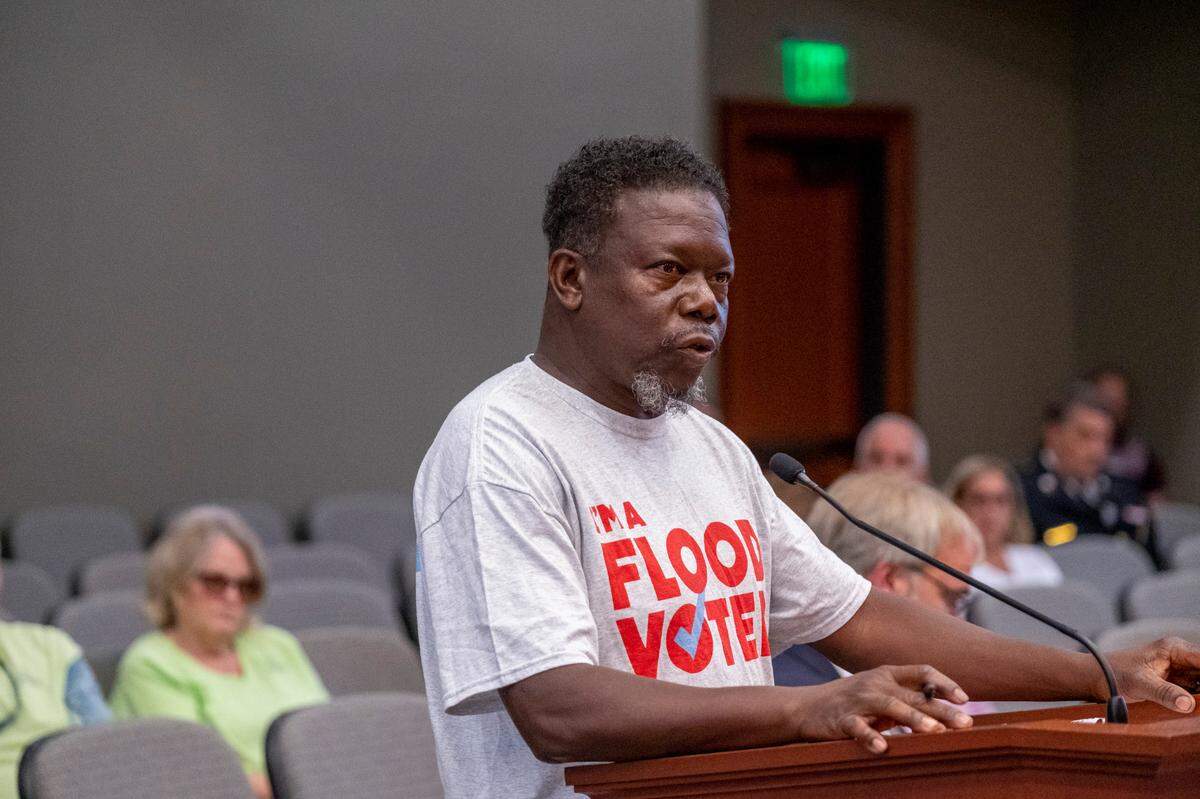
“Why pay for a new interstate that only benefits Myrtle Beach and the tourists traveling there?” asked Kevin Mishoe, a community organizer in Bucksport, at a November Horry County Council debate about I-73.
“Use this money to help communities like Bucksport who’re suffering from flooding. Repair our existing roads, bridges and communities that have flooded first as a priority.”
In Dillon, where Rice helped open the Dillon Inland Port — an industrial park and interstate shipping hub — new jobs are springing up, but many only pay lower wages, much to the chagrin of locals.
Residents and officials both said additional manufacturing jobs could do more for the area.
The lack of well-paying jobs is something that continues to bother Conway Mayor Barbara Blain-Bellamy.
In her decades living in Conway, she’s seen how Horry County has transformed.
Her mother worked at AVX — a manufacturer of electronic parts and one of the county’s largest employers — for 35 years, she said in an interview last year.
Today, Walmart, Horry County Schools and Horry County government rank as the county’s largest employers.
The Sun News has previously detailed how low wages contribute to county employees leaving their jobs.
And U.S. Census data shows that 45% of county residents earn less than $50,000 a year.
Blain-Bellamy said the region is “tourist-oriented,” something she doesn’t think will change any time soon.
But, she said, leaders haven’t done enough to lure well-paying jobs to the area.
“Too many of our residents are making minimum wage,” she said. “Too many families are relying on their compensation from manual labor and getting the lowest wages there are and oftentimes getting no benefits and trying to raise a family.”
“They can survive but I’m not sure if there’s much more than surviving.”
Blain-Bellamy isn’t fully sold on I-73.
She said she and other city leaders don’t “know enough” yet about the roadway’s impacts to support it, or dedicate city funds to its construction.
Still, in a region dominated by tourism and real estate, I-73’s supporters today continue to boost the project by arguing that it is needed to diversify the economy.
Residents, they argue, need jobs. Any jobs.
“What we recognized in South Carolina,” Brad Dean, a former Myrtle Beach Chamber of Commerce leader, said, “(was that) we had communities that had been left out, and we were late to the party.”
“That said, our lobbying efforts were always centered on … the local economic potential.”
What remains uncertain is whether I-73’s potential will become a reality.
How we reported this story: Over the course of six months, The Sun News interviewed more than two dozen people knowledgeable about I-73, its history and the U.S. interstate highway system. They included current and former members of Congress, current and former South Carolina and Horry County officials, area business leaders and others. The Sun News also reviewed legal documents and data from the South Carolina Department of Transportation, and conducted an extensive review of newspaper archives spanning three decades. Contemporaneous reporting from The Columbus Dispatch, The Roanoke Times, The Post & Courier, The Associated Press and The Sun News, among other outlets, from 1991 through 2019 was included in that review. Those sources, woven together, create the most comprehensive history of South Carolina’s newest interstate highway to date.
J. Dale Shoemaker researched, reported and wrote this project. Charles “Steve” Austin edited the project. Jason Lee captured original photos and videos and Gabby McCall created the graphics. Loumay Alesali produced this project’s video.
This story was originally published April 8, 2022 at 5:00 AM with the headline "Frankenstein’s Highway: Will I-73 boost SC, or merely import mediocre jobs?."