Beaufort County says $950M needed for transportation safety. Critics call it ‘nightmare’
While local elected leaders say the county needs nearly a billion dollars more for road repairs and new infrastructure, one Beaufort group calls the idea a ‘con game’ and ‘double dipping.”
Along with a full ballot of national and state races, one of the biggest pocketbook issues for Beaufort County residents is the proposed 1% sales tax increase. The “penny tax,” proposed to begin next year and last for the next 10 years would raise $950 million and fund a variety of transportation projects. If approved, it would be the longest and largest sales tax in the history of Beaufort County.
The transportation sales tax would mostly go to highway work in addition to roads, streets, bridges, drainage facilities, mass transit and greenbelts. According to supporters, the work is needed because of the area’s rapid population growth.
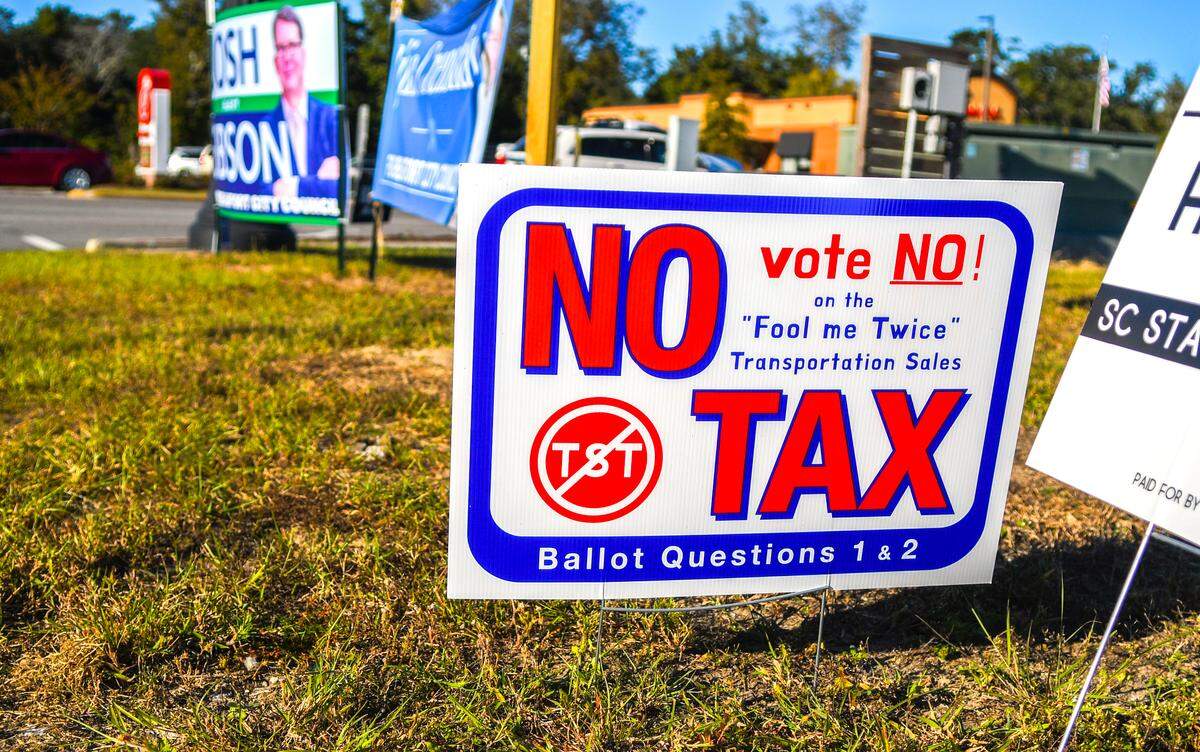
But one group, the Beaufort Tea Party positions itself against what it calls excessive spending and is waging a campaign against passage of the referendum, calling it a “sales tax nightmare.”
The sales tax would be levied on items that are purchased in stores. Exceptions would include medical prescriptions and supplies and unprepared foods like hamburger meat. The tax would not be applied to rent and mortgage payments or fuel.
Here’s how the county is proposing to spend the $950 million:
▪ $180 million, about 19%, would go for underfunded projects that were part of the 2018 transportation sales tax: $90 million for the U.S. 278 Corridor Project; $60 million for the Lady’s Island Corridor projects; and $30 million for sidewalks and multiuse pathways countywide.
▪ $50 million would be spent on land conservation.
▪ Mass transit would get $80 million.
▪ $120 million, the largest allocation, would be set aside for the Triangle Project at Highway 170, Highway 278 and Argent Boulevard.
▪ Ribaut Road improvements in Beaufort and Port Royal would receive $75 million.
▪ $50 million would go to Highway 46 improvements in Bluffton.
▪ $100 million is planned for “safety and traffic flow” improvements.
▪ $80 million is set aside for paving and resurfacing dirt roads.
▪ $50 million would go to pavement resurfacing and preservation.
▪ $20 million is planned for pathway projects.
▪ $30 million each would go to projects in Hilton Head, Bluffton and Port Royal/Beaufort/northern Beaufort County.
▪ And $55 million is earmarked for “resiliency/emergency evacuation” projects.
Jared Fralix, the county’s assistant county administrator-engineering, says growth and safety are driving the request.
“We’re experiencing high growth throughout the state, especially our county, and our roads have needs to make sure residents and visitors can drive safely throughout the community,” Fralix said.
But Ann Ubelis, chairwoman of the Beaufort Tea Party, says residents shouldn’t trust a County Council and administration with additional public funds in light of a number of recent ethics investigations. The group also opposes giving the county more funds to finish projects that were supposed be completed with money approved in the 2018 sales tax referendum. It also argues that a 10-year regressive sales tax “hits the poor among us, including the elderly.”
Bond issue part of question
The group is raising questions with how the two-part referendum question was approved.
A second question related to the $950 million sales tax question is on the ballot as well. That question will ask voters to allow the county to issue $515 million in general obligation bonds over 10 years.
Ubelis argues the $515 million bond issue never appeared in any of the public information that the county presented on the $950 million sales tax question. “At no time was the bond issue ever brought up for public discussion,” she said. She considers the $515 million bond issue a second referendum but says she only realized there was a second question about the bond issue after she printed out her sample ballot.
“It’s a con game by the County Council,” Ubelis says. “There’s no other way to look at it.”
But the county’s Fralix says the $515 million bond issue is not an additional tax and if the sales tax question fails, the bond question automatically fails, too.
Issuing the bonds, he said, would simply allow the county to begin working on the projects sooner, before all of the sales tax funds are collected, Fralix said. The sales tax revenue, he said, would be used to repay the bonds.
“It’s not an extra tax,” Fralix said. “It’s only using the revenue that would be collected from the $950 million to fund those bonds.”
Adding a bond issuance question following a sales tax question is not unusual, he said. A bond question was also presented to voters as part of the 2018 transportation referendum, when voters approved a 1% sales tax that collected $120 million over 4 years, Fralix said. But the county never issued the bonds because the sales tax funds came in faster than expenditures, said Fralix, adding “We predict that will happen again.”
Fralix acknowledged that there wasn’t a lot of public discussion about the bond issuance on the ballot but it was part of the sales tax referendum ordinance that went through three readings and the public hearing process, he said. “It was included in all the language as part of the sales tax ordinance that council passed,” he said.
Why would 2018 projects get funds?
The Beaufort Tea Party also opposes approving more money to fund projects that were supposed to get completed with the revenue that was approved as part of the 2018 sales tax referendum.
Of the $950 million that would be raised in the Nov. 5 referendum, $180 million would go for projects that were identified in the 2018 referendum: $90 million for Highway 278 bridge to Hilton Head; $60 million would go toward the Lady’s Island corridor; and $30 million for sidewalks pathways.
“That’s a double-dip,” says Beaufort Tea Party’s Ubelis.
The county’s Fralix says those projects were initially valued in 2018 but COVID-19 and inflation increased the cost by 70%. The additional funds, he added, “well help deliver those projects.”
The Beaufort Tea Party is already putting up signs in opposition to the referendum and also is planning an advertising campaign and rallies and sign waiving in front of the Beaufort County Offices in Beaufort and along high-traffic areas along Robert Smalls Parkway and Parris Island Gateway.
The county’s current sales tax rate is 7%. Six percent goes to the state and 1% goes to buying and preserving county green space. County officials are calling this new transportation infrastructure tax a “replacement tax” since it will begin when the current green space 1% ends. If approved, the tax would keep the rate at no less than 7% until 2035.
This story was originally published October 21, 2024 at 2:18 PM.