Sparse fire hydrants put Hilton Head homes outside gated areas at risk. What’s coming
While Hilton Head Island is often praised for its careful planning of gated communities with stately homes and amenities such as marinas and golf courses, some residents outside the gates live without access to life-saving services such as fire hydrants.
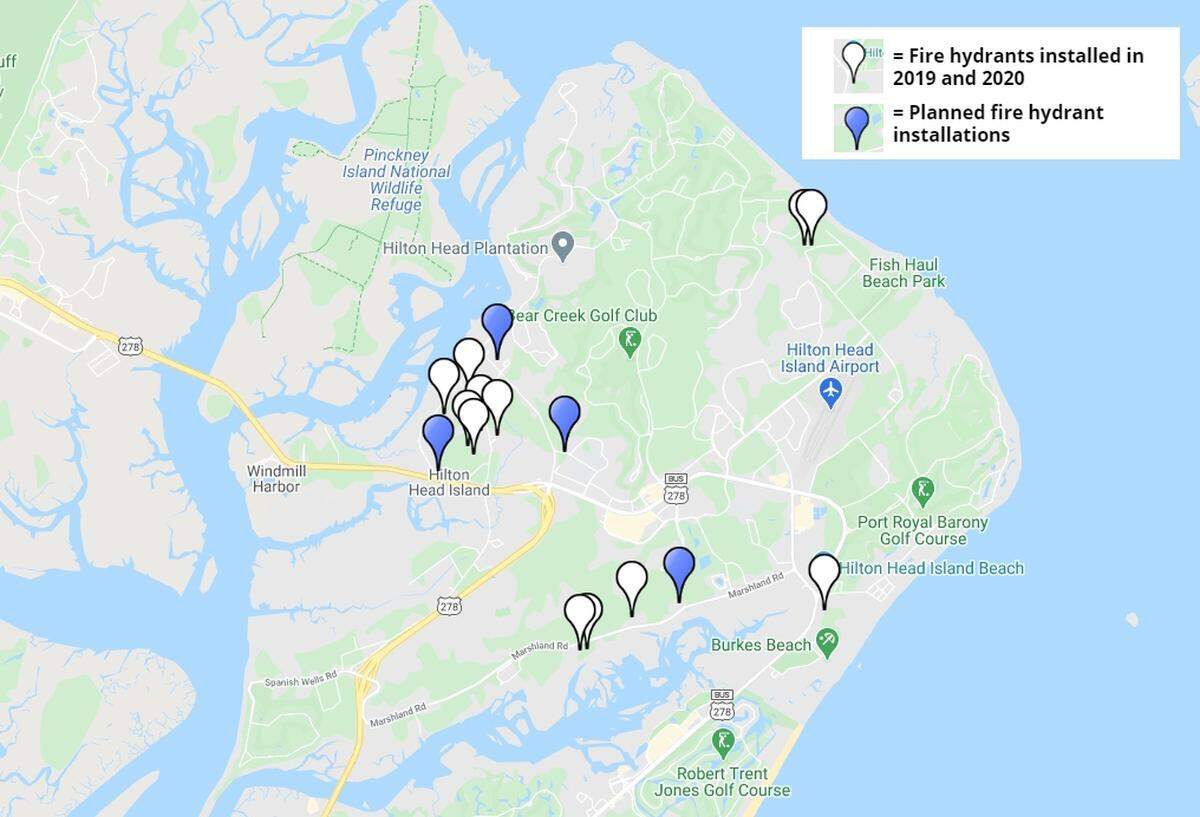
On Tuesday, the Town of Hilton Head Island and Hilton Head Public Service District announced it has added 10 fire hydrants in the past two years to get island residents closer to water in case of emergencies. The installations are part of a program launched in 2018 to put fire hydrants closer to Hilton Head homes, ideally within a 500-foot radius.
The new fire hydrants were installed in several historic neighborhoods where Gullah Geechee residents have lived for generations, including the Squire Pope, Stoney, Baygall, Marshland/Gardner and Chaplin areas. They are outside the gates of private communities developed between the 1960s and 1980s.
Some homes in those areas were more than 1,000 feet from the nearest fire hydrant. This increases the time it takes for firefighters to connect their hose to the hydrant and establish a sustained water supply, according to the town.
The dearth of fire hydrants was the subject of an investigation by The Island Packet and Beaufort Gazette newspapers in 2018 after a fatal fire killed two children in Seabrook. Their home was miles from the nearest hydrant, according to the report.

But it’s not clear how many properties on Hilton Head are too far from hydrants, then-Assistant Town Manager Josh Gruber told The Island Packet in 2019.
James Ladson, who lives on Cobia Court, said he feels lucky to live near the beginning of the street because his home is close to a fire hydrant that was installed in the past several years.
Residents at the end of his street have the same sense of relief because Cobia Court received another hydrant as part of the program.
New fire hydrants are planned for four more roads: School Road, Indian Pipe Lane, Evelina Road, and Orage Lane.
Why is this a problem on Hilton Head?
When Hilton Head was incorporated as a “limited services government” in 1983, it provided no services and owned very few roads.
Planned unit development builders were responsible for installing fire hydrants to serve the gated communities.
But an individual landowner cannot always afford to install a hydrant.
Those can cost between $5,000 and $8,000 each if a water main is readily accessible, Hilton Head Fire Chief Brad Tadlock said. If a water main isn’t accessible, the cost doubles — to between $10,000 and $15,000.
The hydrant installation partnership between the town and the PSD is the result of a complicated arrangement regarding Hilton Head’s fire hydrants.
Hilton Head PSD is responsible for the hydrant and the water that flows through it, and the Town of Hilton Head Island Fire Rescue is responsible for using it to extinguish fires.
In bigger governments, a public works department is likely to control all three of those variables.

In September 2019, the town adopted a controversial waiver that requires builders to hold the town harmless if they knowingly build outside of the 500-foot radius of a fire hydrant and a fire destroys their building. A signed waiver is a condition of obtaining a building permit on Hilton Head.
The waiver does not determine whether fire rescue will respond to a fire at the home, but leaders on the Gullah Geechee Land and Cultural Preservation Task Force compared it to signing away a resident’s rights.
Native islanders looking to build on their property said hydrants should be available whether there are 10 or 100 people living nearby. They say restrictive zoning and lack of access to utilities such as hydrants and sewer slows development of the north end.
This story was originally published February 10, 2021 at 4:00 AM.