Climate change may hurt Hilton Head’s ability to borrow money for projects, report says
The changing climate won’t only erode Hilton Head Island’s beaches and flood its neighborhoods. Bond rating agencies say climate change also may hurt the local government’s ability to borrow money.
Moody’s Investors Service and Standard & Poor’s, two of the three agencies that rate the Town of Hilton Head Island’s financial health each year, listed rising sea levels as one of their top concerns for the town, according to a presentation last week by the town’s finance director.
“Assuming all other credit factors remain stable, we could raise the rating if the town incorporates more comprehensive planning for potential weather-related impacts into its long-term capital and financial planning, given the town’s coastal location and tourism industry presence,” Standard & Poor’s wrote in its 2020 report, encouraging the town to plan more seriously for the effects of climate change.
The focus on potential environmental changes is new for Moody’s and Standard & Poor’s, town finance director John Troyer said. If Hilton Head’s bond ratings were to fall, it would get more expensive for the government to borrow money because the town would pay more in interest on each loan.
“It would be more expensive every time we go to the bond market,” he said. “Every dollar we spend in interest is money we can’t spend on roads, pathways, (and) parks. So everything that we can save on an interest payment is good for the town.”
A lower bond rating could put the town’s entire $11.1 million capital improvement project budget at risk, he said.
The potential for climate change effects did not reduce the town’s current top AAA rating by Moody’s or its AA+ ratings by Standard & Poor’s and Fitch Ratings. However, the warnings paint a new and more urgent picture of how coastal government financing could be more difficult due to rising sea levels, warmer temperatures and more frequent, devastating storms caused by climate change.
More money = less projects
Bonds are a way for governments to borrow money for expensive projects. Since most don’t have millions on hand for capital projects like new parks or stormwater improvements, governments issue bonds and pay them off over decades.
Last year, for example, Hilton Head Island issued $5 million in general obligation bonds to pay for the new fire station and to finish the sewer line extension. The town obtained a 2.53% interest rate on those bonds because of its high ratings — and still will pay nearly $2 million in interest on that bond issue.
If the interest rate were to double, a $5 million project and $2 million in interest could grow to a $9 million undertaking.
“If interest rates go up, it could be another percent easily,” Troyer said. “When you start adding that into the projects that town council and town residents want us to do, it adds to the cost of everything.”
He said a rise in interest rates due to lower bond rating could force the town to cut back on projects.
Moody’s new asterisk on the coastal location’s ratings comes as the firm publicly considers the national effects of climate change. Last July, Moody’s purchased a controlling stake in a company, Four Twenty Seven, that measures climate risks.
The New York Times called the move “the latest indication that global warming can threaten the creditworthiness of governments and companies around the world.”
Four Twenty Seven measures changes in the climate such as heavy rainfall, hurricanes, sea level rise and extreme heat. It uses its measurements to track the effects of climate changes on 2,000 companies and nearly 200 countries, according to The New York Times.
Climate change planning and tourism
The commentary on climate change comes as leaders on Hilton Head Island are completing a 20-year comprehensive plan.
It is unclear whether the plan will include specific information about climate change, but it will address “environmental sustainability,” and has established a work group to discuss renewable energy and ecosystem research, according to its website.
If bond ratings are any indication, sustainability may have to go beyond renewable energy and conservation to confront worsening storms that are associated with climate change.
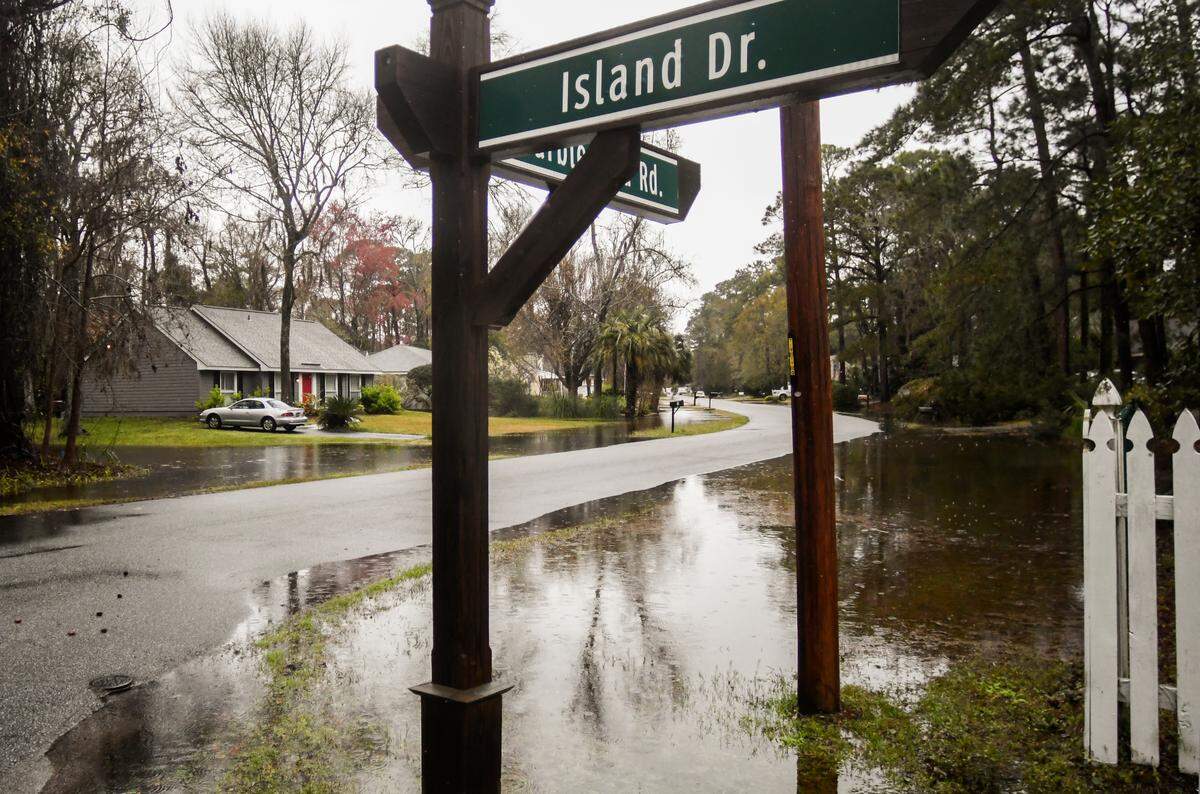
Hilton Head Island has been ordered to evacuate for storms four times in as many years, and the evacuations have crimped entire weeks in the island’s biggest industry and revenue generator: tourism.
In the two weeks that surrounded Hurricane Florence’s landfall near Wrightsville Beach, North Carolina, on Sept. 14 2018, Hilton Head hotels, more than 200 miles away, reported occupancy hovering around 15% if the hotels remained open.
Restaurants that stayed open reported 75% fewer diners and reservations after an evacuation was ordered by S.C. Gov. Henry McMaster and then rescinded.
That type of disruption worries credit rating agencies like Moody’s and Standard & Poor’s.
The reports cited the government’s dependence on “economically sensitive revenues” from tourism as a challenge.
When town council members discussed the reports, they pointed to the town’s disaster planning reserves that impressed the rating agencies.
Efforts to cushion the reserves after Hurricane Matthew in 2016 have resulted in a healthy fund the town can draw on in the event of another disastrous storm, finance director John Troyer said.
A five-year tax increase enacted in 2016 is set to expire at the end of 2021 after it raises $18 million for the disaster reserve. The reserve now has over $31 million in it, according to the town’s most recent budget.
“And in the meantime, town council can do what it does well: continue to focus on what it can control (with) prudent policies and operation of the town (while) encouraging investment and economic activity,” he said.