Neighbors sue over private Sea Pines seawall, say its construction was a surprise
Environmentalists and neighbors of a private seawall in Sea Pines on Hilton Head Island have sued the owners who paid for the wall, complaining that it will damage the beach, hurt property values and set a dangerous precedent for beach construction throughout the state.
On Friday, a neighboring property owner filed a complaint in the Beaufort Court of Common Pleas, where she said the seawall will reroute water toward her property and others around Piping Plover Road on the south end of the island.
The suit also says the seawall was not properly permitted by the Department of Health and Environmental Control, which fined the owners $15,000 earlier this month. The suit calls the fine, which is to be split among five homeowners, “entirely inconsequential,” considering the value of the defendants’ $4 million homes.
Seawalls won’t stop many types of flooding, but they take a toll on the beaches and marshes across the Carolinas and along the nation’s coastlines, Rob Young, professor of coastal geology at Western Carolina University and director of its Program for the Study of Developed Shorelines, told The State newspaper in June.
“If you build a seawall in a place where the water is rising, then that beach or the marsh is going to disappear in front of that seawall,” Young said. “In the state of South Carolina, we recognized three decades ago that building seawalls has problems, and that’s why you can’t do it on the oceanfront.’’
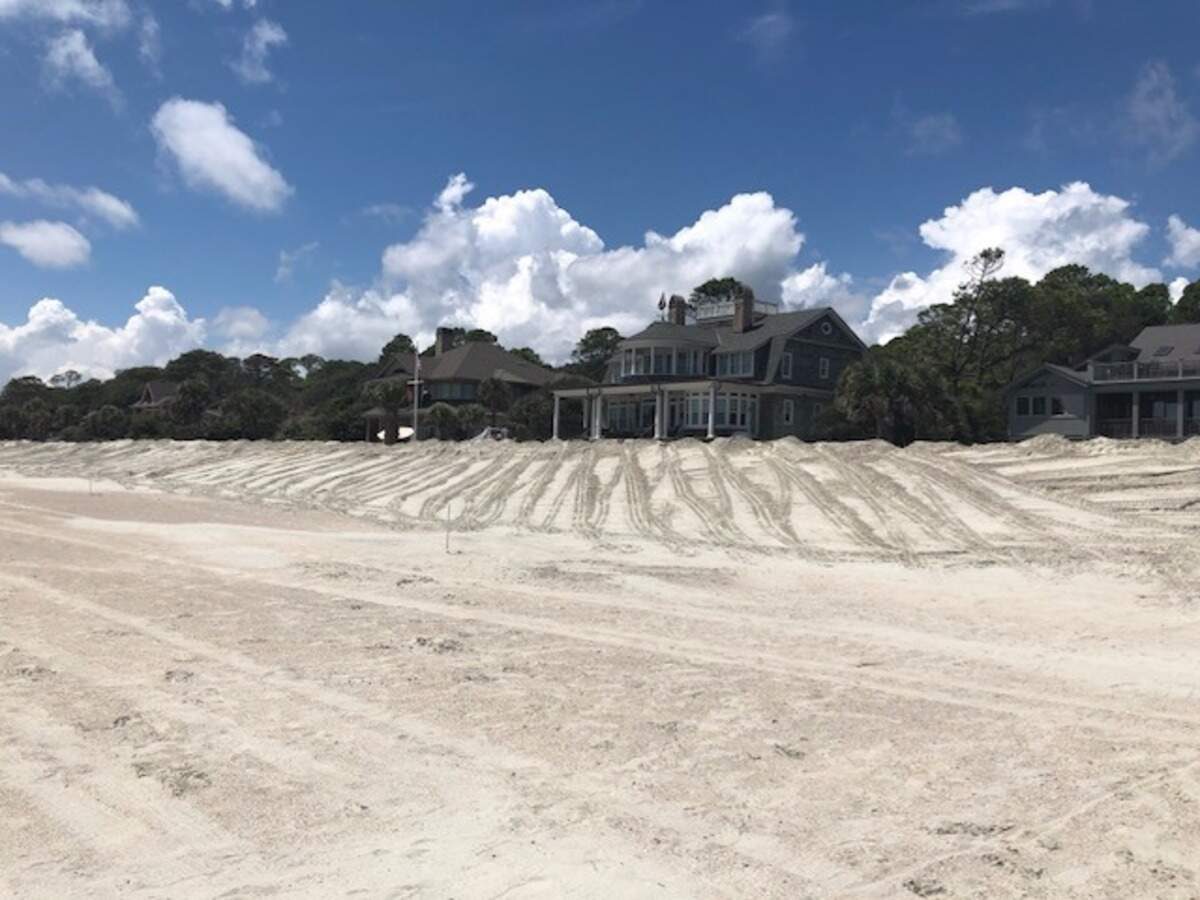
Many governments, including the state of South Carolina, have banned the installation of oceanfront seawalls because they give a “false sense of security to beachfront property owners,” according to the lawsuit. Neighbors of seawalls have often worried that the structures will divert seawater to their properties, causing flooding and erosion of sand on adjacent beachfronts.
According to previous Island Packet reporting, the Piping Plover Road seawall falls in a combination of gray areas because it is too far inland to require approval from the state and too close to private property to be within the town of Hilton Head’s jurisdiction.
Construction on the seawall began in April 2018, as The Island Packet has previously reported. Homeowners who were seeking to protect their properties after two years of damage from Hurricane Matthew in 2016 and Tropical Storm Irma in 2017 spent $750,000 on the project.

Opponents said the seawall would damage the public beach and make erosion worse.
“The beach in front of the wall will narrow and eventually disappear. Covering the wall with sand won’t fool the ocean,” Orrin Pilkey, Duke University professor emeritus of Earth and Ocean Sciences, wrote to The Island Packet. “As a consequence, the erosion rate on adjacent beaches will dramatically increase.”
DHEC issued a stop work order on the seawall on Aug. 29, 2018, after finding it was not properly permitted. However, the work was nearly complete.

Karen Wells, who owns a home 250 yards inward from the seawall and next to the pathway to the ocean, said in her lawsuit that the seawall will damage her property because it “diverts wave energy and more ocean water down the beach access walkway.”
She said her chief complaint is that neighbors didn’t know about the seawall’s construction — there was no public hearing or public comment period, her suit alleges.
Wells said she learned about the seawall when the dishes in her kitchen started to rattle as construction equipment arrived next door.
But at least one of those being sued said they did nothing wrong.
Bert Ellis, who lives on Piping Plover Road, said Friday that the group received certification from DHEC that they wouldn’t need state permits beyond those they’d obtained.
“Everybody signed off on our plan, and we constructed,” he said. “It’s all on private property, and we did it with private money.”
But earlier this month, DHEC’s board assessed a $15,000 fine because the project “violated the Pollution Control Act and Water Pollution Control Permits Regulation as follows: failed to obtain Department authorization prior to conducting land disturbing activities that exceed one-half (0.5) acre.”
In her suit, Wells said the effects of the seawall reach well beyond Piping Plover Road.
“If the structure risks harming people or property beyond your boundaries, that is where the difference is,” she said. “By fundamental nature, it endangers people and property outside the boundaries of where it has been built.”