Hilton Head leader shoved a critic’s arrest record in his face at public meeting. Why?
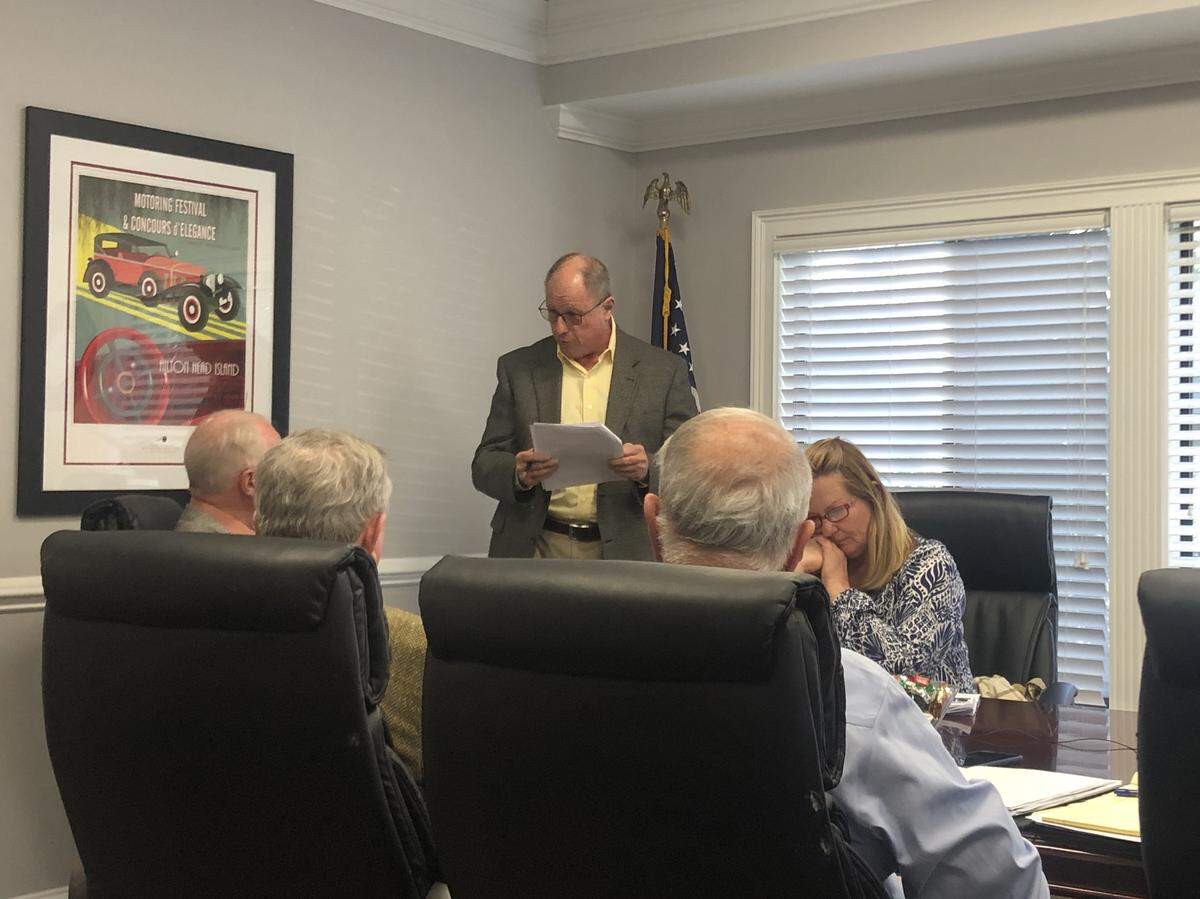
A Hilton Head Island council member confronted a public speaker Tuesday with a copy of the speaker’s felony arrest warrant from 2011, escalating his attacks on the man, a frequent council critic, and continuing his unprecedented vetting of a speaker at a public meeting.
The council member, Tom Lennox, was chairing the town finance committee meeting when part-time island resident Calvin “Skip” Hoagland, a regular at government meetings, rose during the time allotted for public comment.
As is typical, Hoagland criticized the island’s leadership and involvement with the Hilton Head Island-Bluffton Chamber of Commerce. After Hoagland reached his 3-minute time limit and began criticizing assistant town manager Josh Gruber, Gruber and members of the committee stood up to leave.
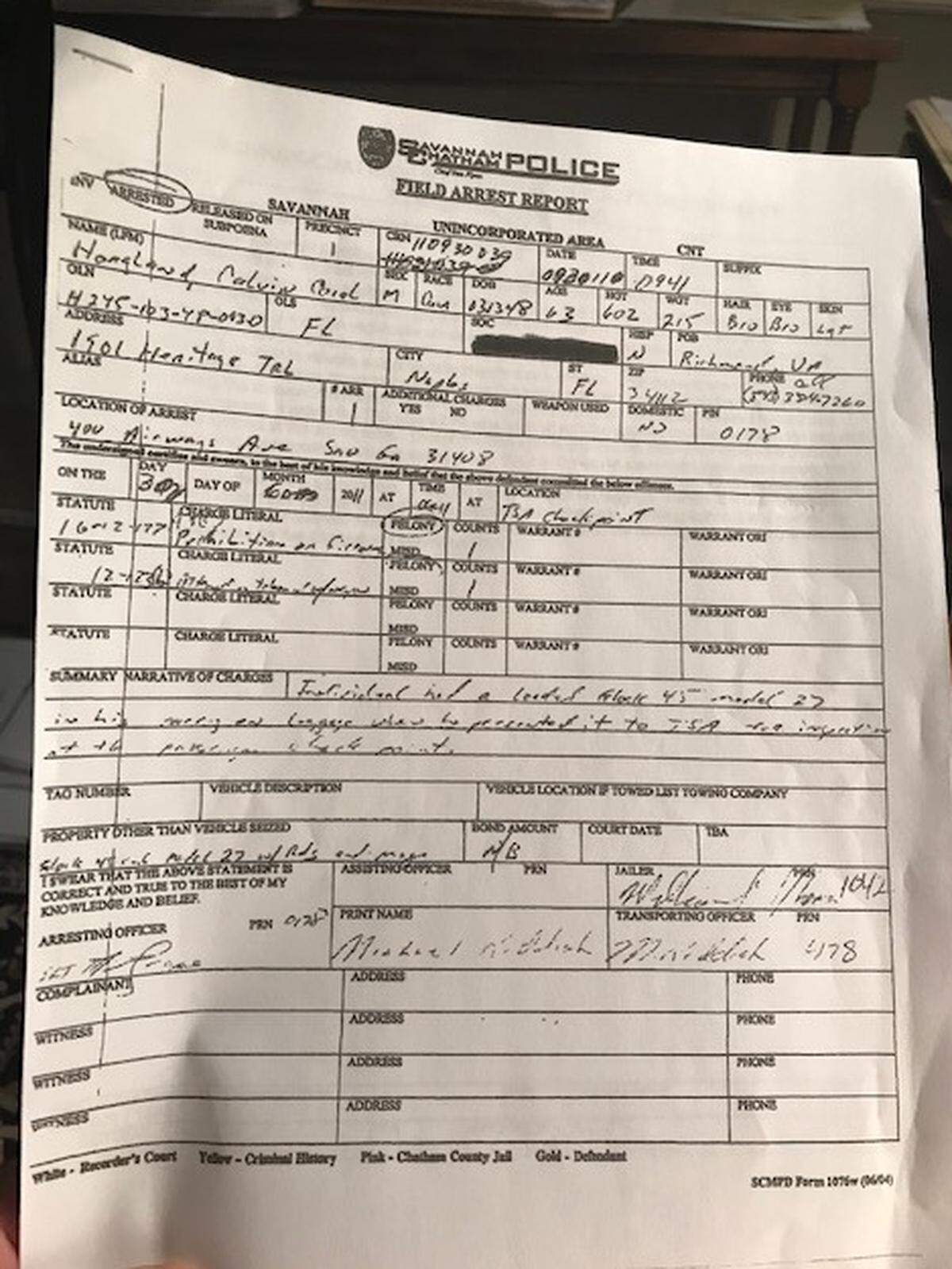
Lennox adjourned the meeting and swiftly handed Hoagland a copy of Hoagland’s 2011 police report.
“I had a loaded gun at the airport?” Hoagland exclaimed, reading the document.
The single-page scan outlined when Hoagland was arrested and charged with having a loaded gun in his bag at the Savannah/Hilton Head International Airport.
Hoagland, who has a concealed weapons permit, pleaded guilty to the charges and spent three days in jail.
Presenting his arrest report at the meeting “was just childish,” Hoagland said. “I felt intimidated, like he was trying to find stuff on me. Like this guy has the nerve to try and shut me down and investigate me.”
National experts on ethics and dispute resolution cautioned against the approach.
“It is unfair to highlight public records for the sole purpose of intimidating someone,” said Kelly McBride, the senior vice president of The Poynter Institute and chair of the Craig Newmark Center for Ethics and Leadership.
Patrick Field, author of ”Dealing with an Angry Public,” said being an elected leader comes with additional responsibility.
“Officials have a certain role and expectation,” he said. “They don’t get to be emotional the same way as citizens do in meetings, but they have a right to defend their integrity.”
When trying to keep a public meeting under control, “lambasting or calling out citizens for their failures is not what (he’d) recommend,” Field said. It “leads to a tit for tat” between leaders and their critics.
Lennox’s latest effort to present information on Hoagland in public meetings follows a verbal sparring in December when Lennox read Hoagland’s tax and property ownership information at a Town Council meeting.
“Calvin C. Hoagland takes excessive liberty with the term ‘voter and taxpayer,’” he said to applause from the audience and a handful of boos directed toward Hoagland. Lennox added that Hoagland does not pay property tax to the town or Beaufort County and owns no property here.
Lennox said Wednesday that he gave Hoagland the report to suggest to the public he may not be the law-abiding resident or taxpayer he says he is.
“My point was not to intimidate him, not to stop him from talking, but simply to say that given these facts he’s very, very liberal in the use of the words ‘taxpayers’ and ‘voters’” when he speaks for them, Lennox said.
‘Escalation’
Hoagland has been reprimanded in the past for making personal attacks and not sticking to the time limit imposed by councils. On one occasion he was forcibly removed from a Bluffton meeting by Bluffton police officers.
Members of the audience who recognize him often groan or sigh when he takes the podium, and public officials have exchanged shouts with him over procedural issues and his confrontational tone. Hoagland usually criticizes local governments’ failure to be transparent. But he has not threatened officials or used obscenities.
Lennox’s latest interaction with Hoagland goes beyond the normal protocol of a public official dealing with criticism. While town council members typically sit silently through lambasting and harsh comments from the public, Lennox appears to have gone out of his way to use Hoagland’s public records to embarrass him.
Usually, one deputy from the Beaufort County Sheriff’s Office attends Town Council meetings to maintain security. Three uniformed officers attended Tuesday’s meeting. Hoagland regularly requests police presence at all public meetings —including finance — to protect himself.
“I did not request the extra people, but I felt having police presence at the finance meeting would make them treat me civilly,” Hoagland said.
In June, Beaufort County Council chair Stu Rodman asked a deputy to remove Hoagland from a county meeting. The officer did not.
During Tuesday’s town council meeting, Mayor John McCann did not call on officers to remove Hoagland when he went over his allotted time for public comment. Instead, he adjourned the public part of the meeting and went into executive session.
Bill Harkins, a council member and mayor pro-tempore, said Lennox’s tactics dealing with Hoagland are “a way that he’s chosen, and we all have our own individual styles.”
“Why should we spend our time and effort trying to satisfy the queries of someone who is not even a resident,” Harkins asked.
Council member David Ames called Lennox’s move an “escalation.”
“It’s regrettable that we have this kind of discourse at town meetings. It’s disrespectful and uncivil, and the way we have been handling it as a council has been counterproductive,” Ames said. “I regret that it has only gotten worse.”
McCann and other local leaders, including the mayors of Bluffton and Port Royal as well as Beaufort County Council chair Rodman, plan to meet Jan. 15 with Sheriff P.J. Tanner to discuss how to maintain decorum at public meetings, The Island Packet and Beaufort Gazette newspapers have learned.
Is this allowed?
The First Amendment protects speakers from viewpoint-based discrimination, and most legal scholars agree that members of the public cannot be silenced because they are criticizing a government or specific council member.
But rules that require speakers to be residents of the city they are addressing have been upheld by federal courts, according to David Hudson, a first amendment scholar with the Freedom Forum Institute.
He said the 4th U.S. Circuit Court of Appeals found in 2004 that Florida residency requirements to speak at a city council meeting are legal and cannot be considered censorship because they do not restrict speech based on a speaker’s viewpoint.
Hilton Head, which is home to many part-time residents and hosts millions of tourists, has a residency requirement for speakers but chooses not to enforce it, according to town staff.

Hoagland told The Island Packet that he is a part-time resident and should be able to criticize the government on behalf of all.
But the law also gives governments power to control people who are disruptive.
“Disruption has been defined to include far more than noisiness and interference,” according to Hudson, the legal scholar.
In 2001, a federal district court in Ohio wrote that seriously disrupting government business at a public meeting can also be considered grounds for barring someone from offering public comment.
In January, Hilton Head’s town council amended its town code to include rules of decorum for speakers. It mandates that all speakers conduct themselves in “a manner appropriate to the decorum of the meeting and shall not use any profane, abusive or obscene language nor any fighting words or otherwise engage in disorderly conduct.”
The code was also amended to require the sheriff’s deputy or law enforcement present to remove disruptive people from council meetings at the instruction of the mayor.
This story was originally published January 8, 2020 at 3:46 PM.