Free speech or disruption? A town critic’s shouting match with Hilton Head councilman
A long, contentious feud between local governments and a relentless critic escalated to shouting and personal attacks at a Hilton Head Island town council meeting Tuesday night after a council member detailed the critic’s tax records and voting information.
The gadfly, Skip Hoagland, is a part-time island resident who takes the podium at nearly every public meeting in Beaufort County to complain about lack of transparency. He has attacked members of the Beaufort County Council, Bluffton Town Council and Hilton Head council, and is involved in several lawsuits against public officials.
Last week, building a case to prevent Hoagland from taking the microphone, Hilton Head Ward 5 representative Tom Lennox asked Hoagland his legal name, whether he owned property locally or voted. Hoagland declined to answer.
On Tuesday evening, Lennox announced from the dais that Calvin C. “Skip” Hoagland has no property in his own name on Hilton Head or in Beaufort County, hasn’t paid vehicle taxes in several years, and is not registered to vote in the county.
Those facts, Lennox said, disqualify Hoagland from speaking on behalf of voters and taxpayers during public comment periods of government meetings, where he typically criticizes elected leaders and the Hilton Head Island - Bluffton Chamber of Commerce.
“Calvin C. Hoagland takes excessive liberty with the term ‘voter and taxpayer,’” he said to applause from the audience and a handful of boos directed toward Hoagland.
Hoagland sees the effort to humiliate him by airing his public records as an attempt to chill his speech and block his First Amendment rights.
“I’m going to continue to speak. They’re not going to stop me,” he said Wednesday. “Everyone has their own style, and I have my own style. I don’t care if people like me.”

Hoagland has been reprimanded in the past for making personal attacks, not sticking to the time limit imposed by councils and on one occasion was forcibly removed from a Bluffton meeting by Sheriff’s deputies. Members of the audience who recognize him often groan or sigh when he takes the podium, and public officials have exchanged shouts with him over procedural issues and his confrontational tone.
But Lennox’s comments highlight the conflict between First Amendments rights and the right of governments to maintain decorum at public meetings and cut off speakers who are disruptive.
What happened?
At the Dec. 10 finance committee meeting, Lennox asked Hoagland his legal first name. Hoagland was defensive.
That exchange prompted Hoagland to start speaking Tuesday from the back of council chambers.
Once he approached the podium, Hoagland requested that the 3-minute timer be reset. After a brief back and forth, Mayor John McCann agreed.
“I’ll give you 3 minutes and not a minute more,” the mayor said.
“Mr. McCann, you are out of touch with taxpayers. We don’t need an entitled executive mayor that spends our tax money to go to Italy first class with his daughter,” Hoagland began, referencing a trip McCann took in June with Town Manager Steve Riley and Riley’s wife that cost the town nearly $15,000.

Hoagland also lambasted the Hilton Head chamber, which is likely to get the town’s $3 million marketing contract despite its lack of public accountability.
After his 3 minutes, Hoagland asked for more time to finish. McCann often allows speakers to wrap up their thoughts even after their time is up.
Once Hoagland sat down, council member Lennox said he wanted to bring to the council’s attention the details that he said disqualified Hoagland from speaking as a representative of Hilton Head residents, voters or taxpayers.
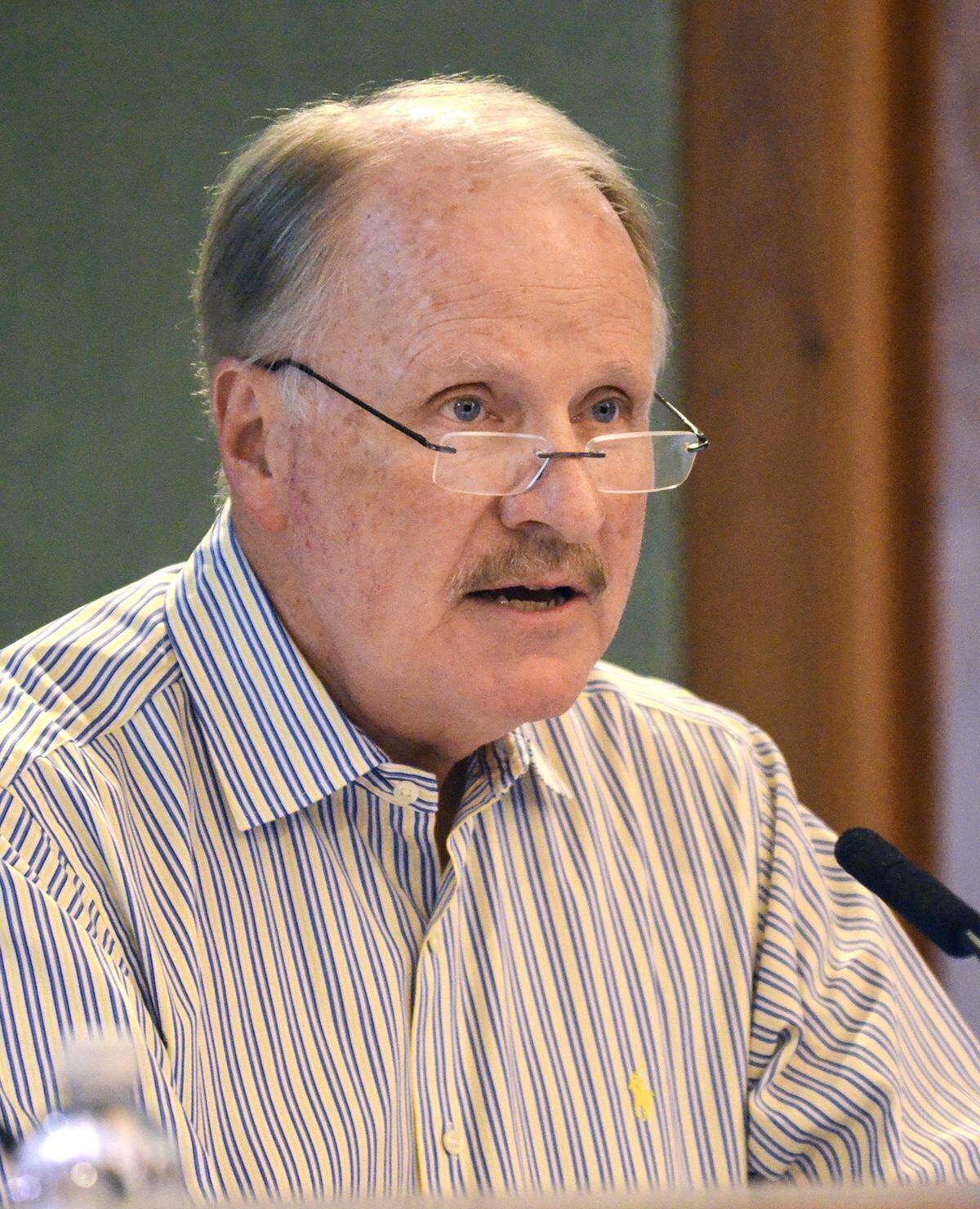
Hoagland, from the back of the chambers, yelled that even though he owns no property in the county, he lives with his wife in Windmill Harbour and has transferred all of his property to her name.
McCann called for the sheriff’s deputy, but the deputy didn’t budge from the back of the room.
A similar situation unfolded in June when Beaufort County Council chair Stu Rodman asked the deputy to remove Hoagland. The officer did not.
“The deputies were advised not to take any action,” Sheriff’s Office Public Information Officer Maj. Bob Bromage said at the time. “If you start removing people, you have a problem with constitutional rights. If we remove somebody, that’s a violation of free speech.”
Is this allowed?
The First Amendment protects speakers from viewpoint-based discrimination, and most legal scholars agree that members of the public cannot be silenced because they are criticizing a government or specific council member.
But rules that require speakers to be residents of the city they are addressing have been upheld by federal courts, according to David Hudson, a first amendment scholar with the Freedom Forum Institute.
He said the 4th U.S. Circuit Court of Appeals found in 2004 that Florida residency requirements to speak at a city council meeting are legal and cannot be considered censorship because they do not restrict speech based on a speaker’s viewpoint.
Hilton Head, which is home to many part-time residents and hosts millions of tourists, has a residency requirement for speakers but chooses not to enforce it, according to town staff.
Hoagland told The Island Packet that he is a part-time resident and should be able to criticize the government on behalf of all.
But the law also gives governments power to control people who are disruptive.
“Disruption has been defined to include far more than noisiness and interference,” according to Hudson, the legal scholar.
In 2001, a federal district court in Ohio wrote that seriously disrupting government business at a public meeting can also be considered grounds for barring someone from offering public comment.
In January, Hilton Head’s town council amended its town code to include rules of decorum for speakers. It mandates that all speakers conduct themselves in “a manner appropriate to the decorum of the meeting and shall not use any profane, abusive or obscene language nor any fighting words or otherwise engage in disorderly conduct.”
Hoagland, while loud in his remarks, has not used obscene language.
The code was also amended to require the sheriff’s deputy or law enforcement present to remove disruptive people from council meetings at the instruction of the mayor.
BEHIND THE STORY
MOREMore information about legal precedents referenced in this article
Two court decisions are referenced in this article that rule on when local governments can stop someone from addressing them at a public meeting.
In Rowe v. City of Cocoa (2004), a 3-judge panel of the 4th Circuit determined that a residency requirement was reasonable and viewpoint neutral and therefore constitutional.
In Luckett v. City of Grand Prairie (2001), a federal district court wrote that “being disruptive (in a public meeting) is not confined to physical violence or conduct, but also encompasses any type of conduct that seriously violates rules of procedure that the council has established to government conduct at its meetings.’”
This story was originally published December 19, 2019 at 4:30 AM.