Ted Turner’s former private island, now a state park, is eroding rapidly
On South Carolina’s barrier islands, the only constant is often rapid change.
St. Phillips Island, a state park and barrier island in northern Beaufort County, is eroding quickly. A recent analysis from the South Carolina Department of Environmental Services found that the island is receding between 5-10 feet per year.
The four-mile long, 4,600 acre island is managed under Hunting Island State Park, the most-visited state park in South Carolina. It’s undeveloped, save for two houses built by its former owner, billionaire media mogul Ted Turner, and it’s difficult for visitors to access as it is only reachable by boat. Coastal Expeditions, a local guide service, runs frequent day trips to the island. Both Hunting and St. Phillips islands are eroding quickly, a natural process that can be exasperated by rising sea levels and strong storms.
As the island continues to erode, the South Carolina Parks Service may need to consider how and if they should protect the house, Rob Young, geology professor and director of the Program for the Study of Developed Shorelines at Western Carolina University, said.
Turner sold St. Phillips island to the state for $4.9 million in 2017, a discount compared to its initial $23 million listing price. When Turner purchased the island in 1979, he quickly placed it under a conservation easement. It was later designated as a National Natural Landmark because of its ecological importance. To this day, the only two structures on the island are a five-bedroom house and a small manager’s cottage. Today, up to ten adults can rent the Turner house for five nights for a starting price of $12,000.
St. Phillips Island is disappearing rapidly, even when considering erosion on the entire East Coast, Young said. The two houses are protected from erosion by a rock revetment, a structure built from large rocks intended to prevent erosion. Hard erosion control methods, which also include seawalls and rock revetments, can often accelerate erosion in front of and around the structure.
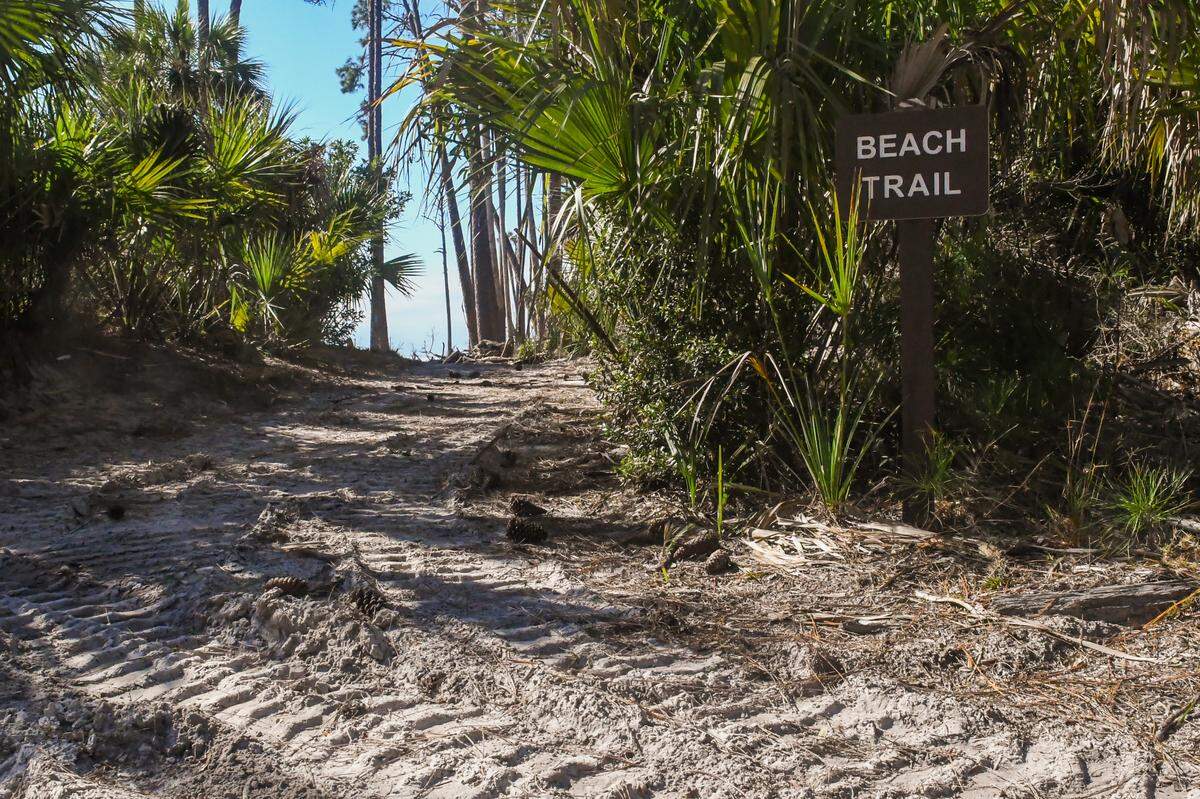
Over time, the beach has receded on each side of the rock revetment. A beach trail near the house is eroding and lined with beached oak trees, according to previous reporting from the Island Packet.
“[The revetment is] not gigantic, so it’s probably not having a huge impact,” Young said. “It’s just probably unsustainable over the long run.”
The cost to maintain the revetment will likely be high, Young said. A planned removal at some point in the future may be the best option, he said.
Born to move
St. Phillips Island is one of several barrier islands along the East Coast. The islands form out of sandbars that lie parallel to the main shore. Beaches and dunes on the ocean-facing side of the island are the first line of defense against waves and storms, which pull sand from the beach and deposit it further south.
This process also means that as some parts of barrier islands erode, the sand accumulates as it’s deposited further down, effectively causing the island to move.
“If you go up and look at all the little islands around Cape Romaine in the central part of the state, it’s stunning how quickly some of them are moving,” Young said. “Some of them have completely changed location.”
Islands in constant flux
Other nearby islands include Pritchards Island, which is owned by the University of South Carolina-Beaufort for research. Pritchards has a similar erosion rate to St. Phillips island, losing between 11 and 6 feet per year. A derelict research lab was torn down in 2022 as erosion threatened the structure, though research on the island has once again picked up with an influx of state funding.
To the south of St. Phillips is Bay Point Island, the site of a yearslong battle between environmental groups and a developer who planned to build an eco-resort on the small barrier island. The most recent analysis by DES finds that the island is eroding at a rate of almost 10 feet a year in some places, though other parts of the island are accumulating at a similar pace.
Because of its conservation easement, St. Phillips Island will never be developed beyond the two existing houses. But the threat remains for its neighbor Bay Point Island. In a world where barrier islands are intensely developed, allowing places like St. Phillips Island to erode naturally is a good thing, Young said.
“Thank goodness that we have some places protected, that we can allow to respond naturally to natural processes.” Young said. “Erosion is one of those processes.”
This story was originally published November 14, 2025 at 5:00 AM.