Why did a juvenile sperm whale wash up on Hilton Head? The proof isn’t in the blubber
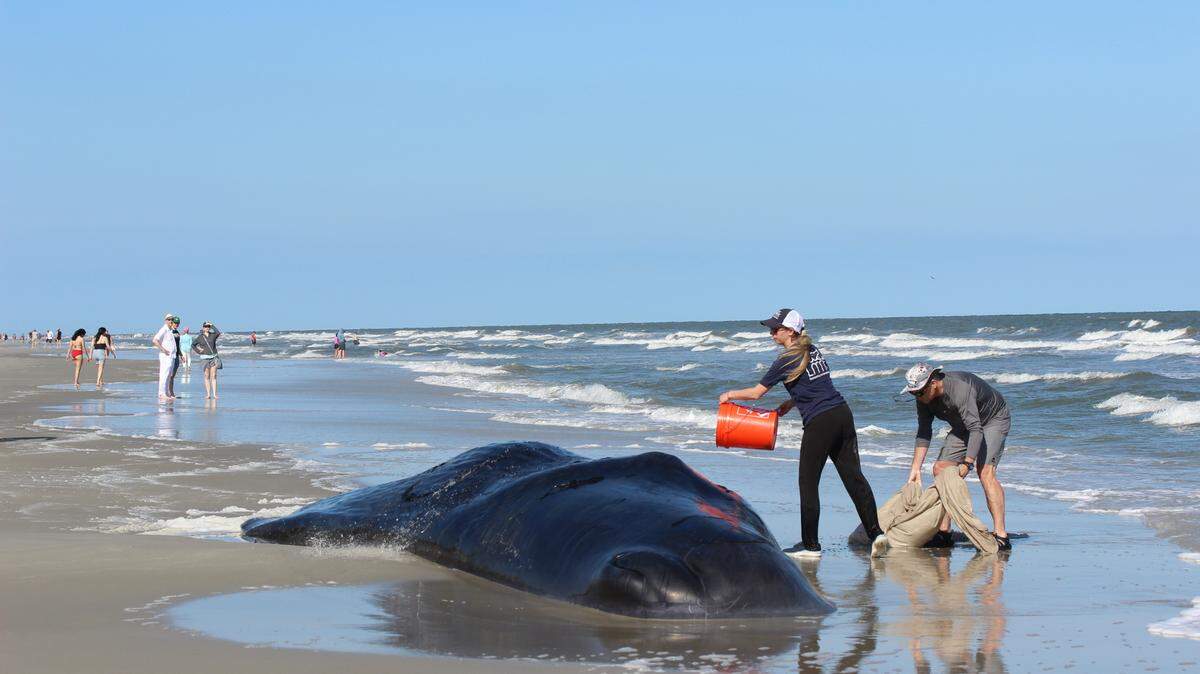
The juvenile sperm whale that washed up on Hilton Head Island Saturday evening has been laid to rest 10 feet under the sand.
A crew of roughly 25 performed a necropsy on the animal Monday. The whale, estimated to be about 10 years old, was euthanized Sunday night.
The necropsy didn’t reveal any obvious answers as to why the juvenile male was so skinny, according to Lauren Rust, executive director of the Lowcountry Marine Mammal Network. The team will send tissue samples from inside the whale to labs for further analysis, a process which could take weeks or months.
No ‘smoking gun’: Deep cuts find no obvious clues to whale’s troubles
Scientists cut deep into the deceased whale to look for clues to what led the animal to wash up on Hilton Head Island, but it’s still unclear what was troubling the young mammal.
“We didn’t find any kind of smoking gun,” Rust said.
The team found squid beaks in the whale’s stomach, a sign that it had been eating. No plastic or marine debris was found in the stomach, according to Rust.
To get inside a marine mammal of this size was no small feat. Underneath a whale’s skin is a thick layer of fat called blubber, which can be eight to 10 inches deep on a sperm whale. Then there’s a layer of muscle and an enormous rib cage protecting the animal’s internal organs.
It took about 25 people to perform a necropsy on the gargantuan creature, with about 15 people on the animal itself, cutting through the flesh with long sharp knives. A team was on standby just to sharpen the knives once they got dull.
To help peel away the thick layers of blubber and muscle, the team hooked chains to the flesh and used an excavator to pull it back.
It took about an hour and a half just to get inside the whale, Rust said. Scientists carefully analyzed the whale’s lungs, heart, and intestinal tract to understand what was going on inside the whale. They took photographs, measurements and samples of all of the animal’s organs.
The tissue samples will be sent to various labs, where scientist will look at the tissues underneath a microscope, and test the samples for viruses and contaminants. The results may take weeks or even months.
With a laugh, Rust said the whale didn’t smell too bad, because it was “freshly dead” and hadn’t had much time to rot underneath the hot South Carolina sun.
“It didn’t smell like it could,” Rust chuckled.
Colossal corpse laid to rest 10 feet under the sand
After scientists finished gathering information from inside the whale, the 31-foot beast was buried in the same spot on Hilton Head Island at around 5 p.m.
As a crowd of beachgoers watched from a distance, a large orange excavator dug a hole in the sand 10 feet deep, and fully covered the whale, flattening the sand on top.
“You’d never know it’s down there,” Rust said. “Pretty quickly, with the heat and the sand, it will decompose, break down and feed little critters down there.”
What to do if you see a stranded animal on the beach
The Lowcountry Marine Mammal Network is the only state entity in South Carolina that responds to stranded marine mammals, according to Rust.
If you see a stranded dolphin or whale, do not push it back into the water, as biologists say it’s likely sick and will wash up somewhere else. Instead, call 843-410-7990 to alert the LMMN.
(Sharks aren’t mammals. If you spot a stranded shark, call the South Carolina Department of Natural Resources at 1-800-922-5431.)