From Beaufort to Vietnam to Antarctica: Marine Corps pilot reflects on ‘unique’ career
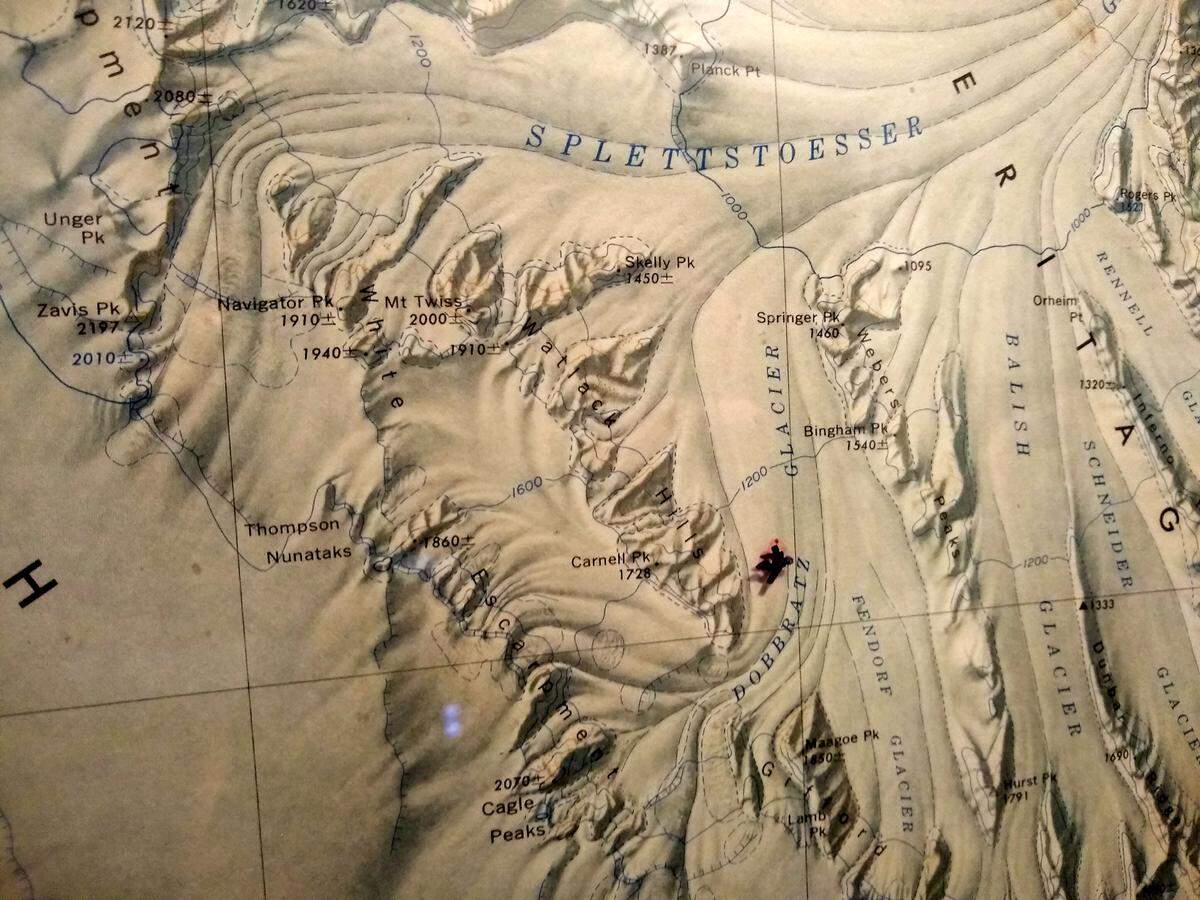
Between the peaks of the 100-mile-long Heritage Range in Antarctica’s icy Ellsworth Mountains, a glacier bears the name of a 93-year-old man who lives thousands of miles away, on Lady’s Island.
For Col. Joseph R. Dobbratz Jr., whose time serving in the U.S. Marine Corps spanned 30 years, the South Pole was just one stopover in a career that criss-crossed continents and conflicts.
He’s modest about it.
“I didn’t have a heroic career in the Marine Corps, but it was unique, I’d say,” he said, seated in the plush living room of his home this week, jets from the nearby Marine Corps Air Station Beaufort thundering overhead.
Veterans Day allows us a moment to honor those who, like Dobbratz, have served in the United States Armed Forces. It is also a chance to marvel at the places that service took them and their contributions to our understanding of the world around us.
On Nov. 11, you would usually find Dobbratz doing just that: parked on the corner of Boundary and Charles Streets in Beaufort, watching the parade that this year won’t go forward because of the COVID-19 pandemic.
Even so, he’s still willing to chart the ups and downs of the thousands of hours he logged flying as a Marine Corps pilot. Here’s the story of one veteran’s service, told as he remembers it.
From the sea to the air
Dobbratz marks the twists and turns of this career — from Korea to Antarctica to Vietnam — with the aircraft he piloted: a slew of helicopters, jets and airplanes that reads like a history lesson in U.S. military aeronautics.
A three-tiered cabinet in his home showcases miniature models he assembled of every one of them, some 20 in total.
But before he’d ever been in an airplane, Dobbratz began at sea.
Born in 1927 in Brighton, Mass., a neighborhood south of the Charles River in Boston, Dobbratz graduated from high school in 1945, as World War II was drawing to a close.
The very next day, he joined the U.S. Coast Guard and spent just shy of a year on different vessels before taking the exam for admission at Boston College, where he studied business administration.
In 1951, diploma in hand, Dobbratz faced the possibility of becoming one of the 1.5 million men drafted to fight in the Korean War. Had his Coast Guard service extended roughly 15 days longer, he would have been exempt.
Dobbratz looked up to one of his professors at Boston College, a Marine, and decided to take that path for himself. That year, he made the trip south, to Parris Island, where he attended Officer Candidate School.
“I had already been through the Coast Guard boot camp. So it was not unfamiliar. Generally speaking, I had a heads up,” he said. Dobbratz emerged a commissioned second lieutenant that September.
The next year, while stationed at Cherry Point in North Carolina, Dobbratz got restless. He volunteered to go abroad, joining a platoon of master sergeants headed to Korea.
“I was like a chipmunk in a herd of elephants,” he said. But he was surrounded by aviators, who encouraged him to become a pilot. Dobbratz flew for the first time in his life “in the belly” of a Grumman F7F Tigercat fighter.
After passing a physical exam in Japan, he headed back stateside for flight school in Pensacola, Florida.
He began flying SNJ trainer planes. But after about 10 months, “we ran out of airplanes, ran out of instructors,” he remembered.
“They said anybody that wants to go to helicopters, you’ll have your wings in two months,” Dobbratz recalled. He jumped at the opportunity, learning to pilot Bell 47 copters that would later feature in the TV series M*A*S*H.
Dobbratz spent time stationed on the West Coast and went back to Japan. While flying over the Bay of Bangkok, the transmission of his helicopter blew, sending Dobbratz and six passengers plunging into the water below.
Within a half-hour, a rescue helicopter arrived, dropping a ladder down to Dobbratz. But wearing a soaking wet Mae West life jacket and fighting 65-knot gusts from the rotors above him, he couldn’t manage to pull himself from the water.
“I just waited for a boat,” Dobbratz remembers. While he bobbed, all he could think of were the water snakes he’d spotted from the air flying into Bangkok on a previous flight. So far out at sea, the fear was irrational, but “it scared the hell out of me,” he said.
From helicopters to jets to the South Pole
“I finally flew about 18 different airplanes,” Dobbratz said of his time as a Naval pilot. “It was a different time. You can’t do it now.”
After helicopters, he made the jump to jets, going to Texas and learning to fly the F9F-2 Panther, used in the 1954 film “The Bridges at Toko-Ri,” about a naval aviator in the Korean War.
Why make the switch to fixed-wing aircraft? “To see if I could do it, actually,” Dobbratz says. After stints at other bases, including a return to Beaufort County and the Marine Corps Air Station there, Dobbratz began flying transport planes.
In 1962, he jumped at the chance to join the Navy’s Air Development Squadron Six, VX-6, whose mission was to support “Operation Deep Freeze,” a series of U.S. military-supported research and exploratory missions to Antarctica.
For Dobbratz, it was all about the planes. He’d have a chance to fly C-130s, an aircraft he later described in an interview with the Marine publication Leatherneck as “truly a gentleman’s airplane.”
From his base at Quonset Point in Rhode Island, Dobbratz flew to California, then to Hawaii, then to Canton Island in the Pacific, then to Fiji, then to New Zealand.
“Then, it was about 2,220 miles of nothing until you get to the ice,” he said.
Dobbratz had never flown in such icy conditions, where snow and thick cloud cover could create dangerous whiteouts. “It’s like flying in a milk bottle,” he said. Dobbratz would huddle around a tiny radar screen to make his descents, touching down with skis as landing gear.
Sometimes, his heavily loaded plane would sink into the snow when it landed, requiring the use of small rockets attached to the fuselage — JATO (jet-assisted take-off) bottles — to get off the ground. “That gave you the boost,” he said.
Just before Christmas 1963, Dobbratz flew a special flight from New Zealand, transporting Cardinal Francis Spellman, military vicar of the U.S. Armed Forces, to McMurdo Station to give a memorial mass for recently assassinated President John F. Kennedy, according to a New York Times article from that year.

Dobbratz developed an affinity for the polar researchers he assisted.
During two six-month tours, Dobbratz brought University of Minnesota researchers to the base of mountains they would climb to harvest earth samples. Unbeknownst to the Marine Corps pilot at the time, they would repay him by petitioning officials to name a glacier in his honor.
In December 1973, almost 10 years after Dobbratz flew his last Antarctic mission, a letter arrived from the National Science Foundation.
“It gives me a great deal of pleasure to inform you that the U.S. Board on Geographic Names has named in your honor the geographic feature Dobbratz Glacier,” it read.
Vietnam, the Purple Foxes and a return to Beaufort County
After returning from Antarctica, Dobbratz attended the Naval War College in Rhode Island, writing a final research paper about U.S. aircraft at the South Pole.
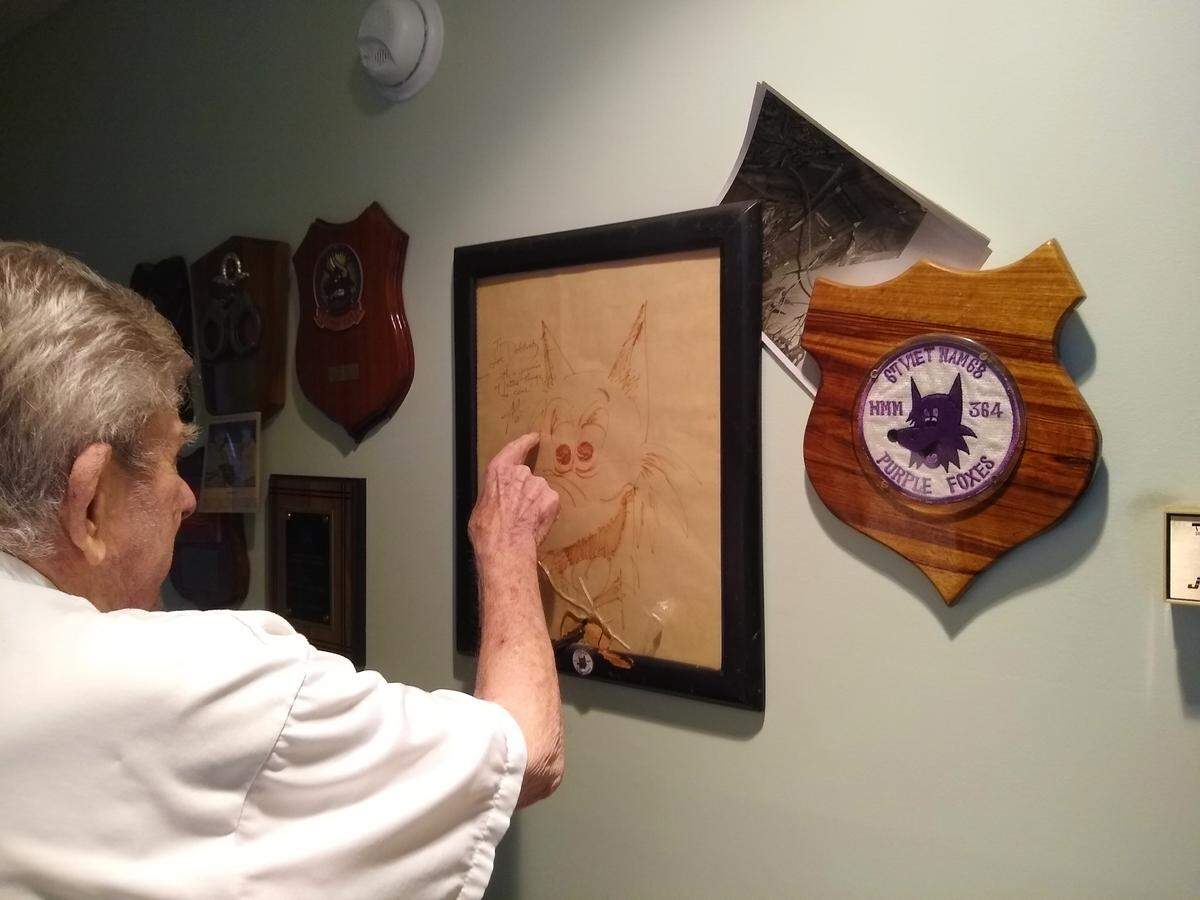
In 1968, he received orders to deploy in Vietnam, where he briefly commanded the Marine Medium Helicopter Squadron 364, known as the “Purple Foxes.”
Dobbratz flew “inserts,” dropping troops at different outposts.
“The whole area was a combat area. You never knew when you were going to get shot at. I took a few rounds, occasionally, but thank God I never ... I was just lucky,” he said.
Returning from Vietnam in the early 1970s, Dobbratz got a taste of the anti-war sentiment in full swing back home. Walking in his uniform in Boston, a crowd pelted him with eggs and rotten tomatoes.
“That’s the last time I ever wore my uniform in Boston,” he said.
His career continued, including a promotion to colonel, three years at the Pentagon and time as a commander at a Marine Corps air station in Iwakuni, Japan.
Finally, in 1981, the year he turned 54, he retired. Before long, Dobbratz returned to “the best place I’ve ever been,” he said. He and his wife Catherine, a Port Royal native, built a home on Lady’s Island and have now lived there for over 30 years.
Dobbratz has added model planes to his collection, including the commercial FedEx airliner his son, also a Marine, now flies for a living. On his wall is a framed photo of a CH-46 helicopter he flew in Vietnam. As it was retired decades later, his son flew the exact aircraft.
Just after his 93rd birthday, Dobbratz can still recite the emergency procedures for the first plane he ever flew.
He hopes Veteran’s Day will be a time of unity.
“I’d say that the thing we have to do in the country, in my opinion, is have a little peace with each other,” he said.
This story was originally published November 11, 2020 at 4:30 AM.