
New to the Lowcountry? The rare dolphin ritual you can watch from shore
If you’ve recently traded a suburban driveway for a view of the salt marsh, welcome. A Lowcountry wonder is unfolding in the creeks around you that most of the world never gets to witness — and once you know what to look for, you may spot it from your own dock.
It’s called strand feeding, and it may be the most extraordinary thing our bottlenose dolphins do.
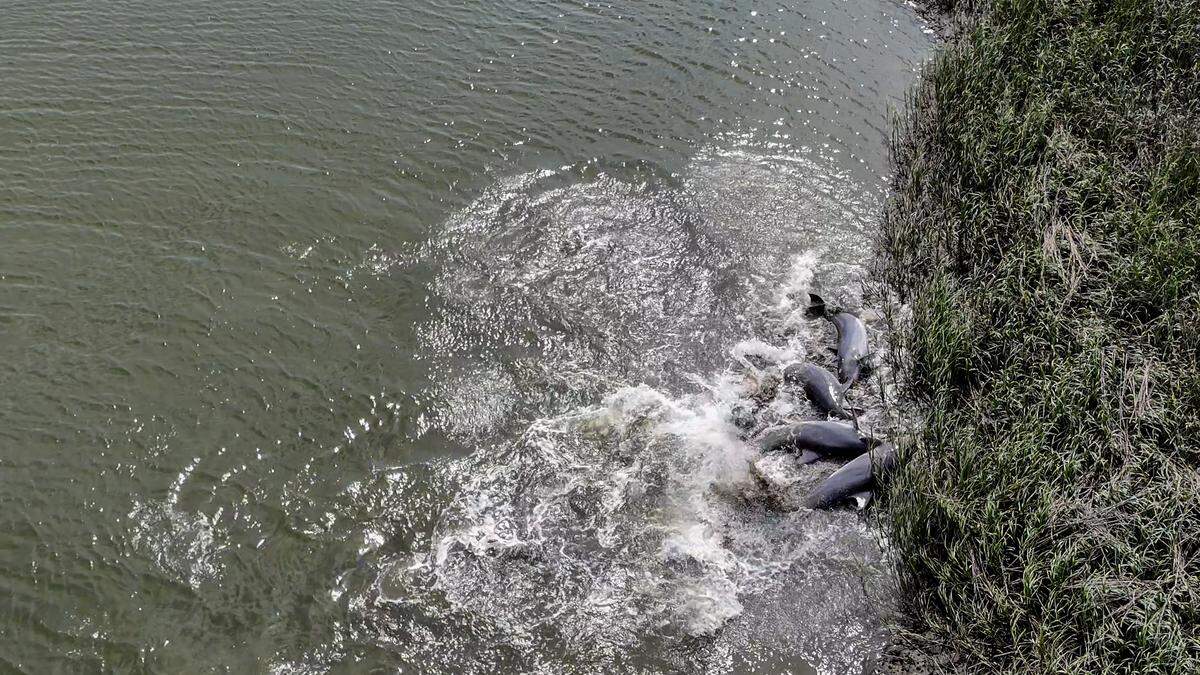
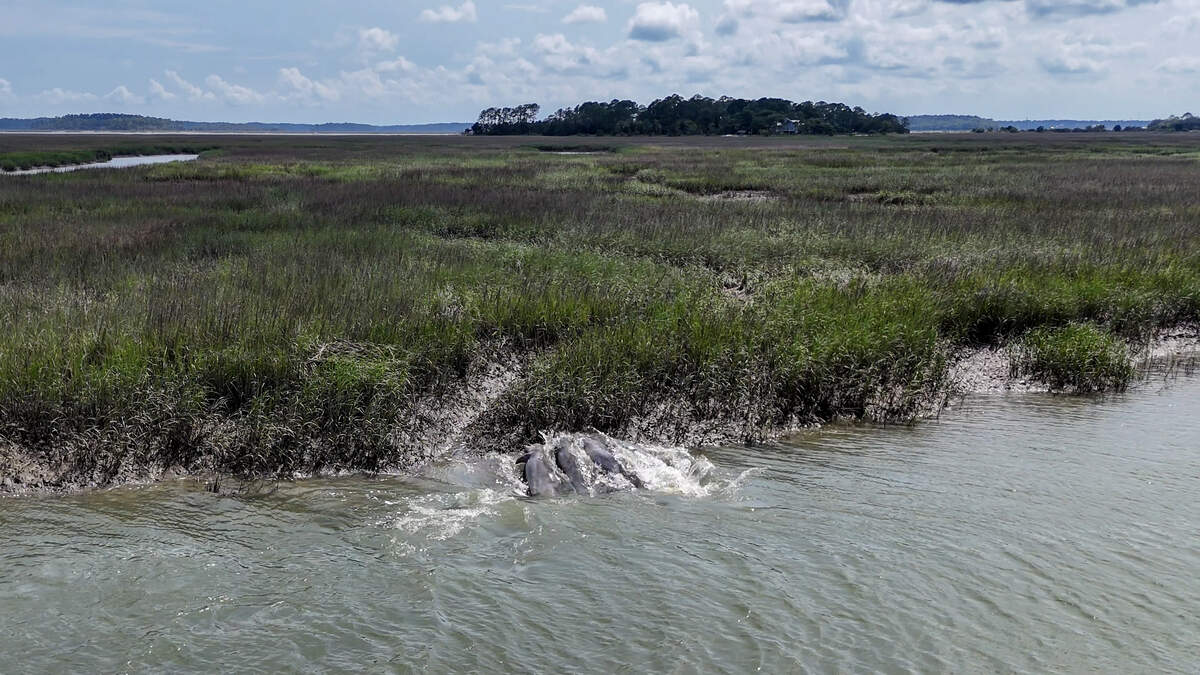
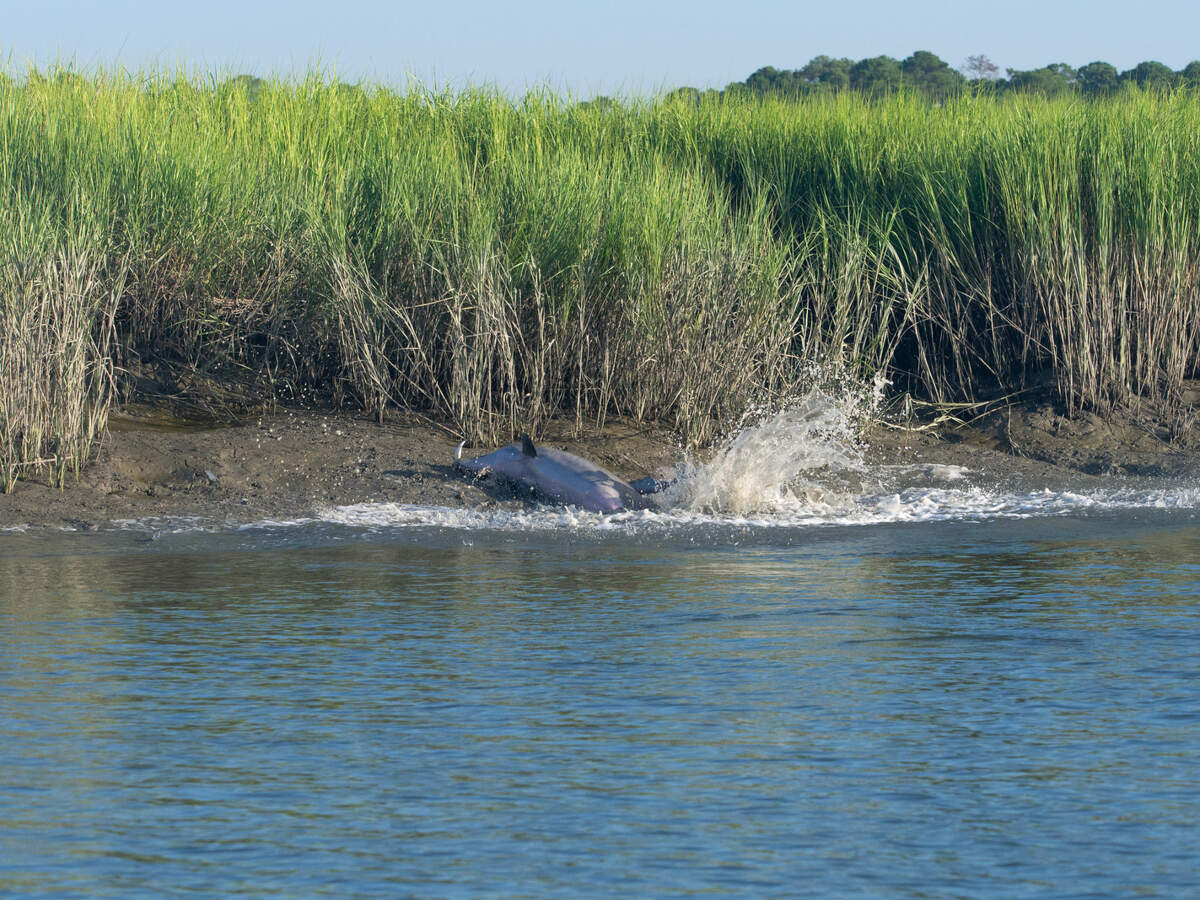
Picture four dolphins swimming shoulder to shoulder toward a muddy bank. In perfect unison, they surge forward, pushing a wave of water ahead of them. That wave carries a school of mullet up and over the shoreline. The dolphins then launch themselves halfway out of the water — always on their right sides — snatch the flopping fish and wriggle back into the creek. The whole event lasts about 30 seconds.
Bluffton drone pilot Jason All captured exactly that scene at 3:40 p.m. on a recent Friday near the mouth of the May River, not far from Old South Golf Links. Four dolphins teamed up to corral mullet onto a marsh bank, repeating the maneuver several times, according to Island Packet archives.
“I’ve never seen four of them doing it at once,” All said. “I thought, ‘This is beautiful.’”
A behavior found in only a few places on Earth
Here’s what makes strand feeding so remarkable: dolphins do it in only a handful of locations worldwide. A roughly 300-mile stretch of coastline from Little River in northern South Carolina down to northern Florida is one of them. The behavior has also been documented in Portugal, Ecuador, Australia and Mexico, along with orca whales in the remote Crozet Islands. That’s it.
South Carolina and Georgia are the only places along the entire U.S. Atlantic coast where scientists have documented dolphins hunting this way. Strand feeding was first identified in South Carolina salt marshes in 1971.
Wayne McFee, who heads the Coastal Marine Mammal Assessments Program for NOAA’s National Ocean Service in Charleston, has watched it play out countless times.
“I’ve seen them do it singly, by themselves. I’ve seen them do it in pairs. I’ve seen them do it in groups of three to six animals,” McFee said. “It’s a pretty impressive sight.”
Groups of three are the most common. Groups of four, like the ones All filmed, are not unusual. Six is the upper end.
Why the Lowcountry — and why these dolphins?
The answer comes down to geography, biology and mud.
The bottlenose dolphins you see gliding through the May, Beaufort and Colleton rivers are a different species from the dolphins living in deeper offshore waters. In 2022, researchers with NOAA and the University of Miami confirmed that the nearshore dolphins are Tamanend’s bottlenose dolphin — smaller than their offshore cousins, with spines built for weaving through the tight bends of tidal creeks and estuaries.
They are, in effect, custom-built for the Lowcountry.
Strand feeding requires a very specific kind of shoreline: sloped, soft and forgiving. It cannot happen on a flat surface, because the dolphins would beach themselves for good. That’s where pluff mud comes in — the dark, sulfur-scented mud that gives our marshes their signature aroma. To a newcomer, it’s the smell that takes some getting used to. To a 500-pound dolphin launching itself out of the water, it’s a landing pad.
Pluff mud provides a soft cushion for strand feeding dolphins, Amber Kuehn, owner of Spartina Marine Education Charters on Hilton Head, told The Island Packet. The mud also lets the animals slide back into the water afterward.
There’s another quirk: local dolphins always strand feed on their right sides. Lauren Rust, executive director of the Charleston-based Lowcountry Marine Mammal Network, explained the leading theory.
“The theory is they do it on the right side so they don’t put so much heavy weight on their heart when they strand feed,” Rust said. Researchers have noticed that the teeth on the right sides of these dolphins wear down faster from repeated scrapes against sand and oyster beds.
A skill passed from mother to calf
Not every dolphin in the Lowcountry strand feeds. The behavior is learned — mothers teach it to their calves — and it takes years to master. Rust said her network has watched calves 4 or 5 years old that still haven’t picked it up. A study is underway to determine how long it takes an individual dolphin to become proficient.
That transmission from one generation to the next is part of what makes strand feeding so precious. It’s culture, essentially — a specific skill passed through specific families of dolphins in a specific corner of the world.
When and where you might see it
Timing matters. Strand feeding happens on the receding or low tide, when fish are pushed out of the safety of the marsh grass. High tide won’t work — the little fish have too many hiding places. Twice a day, the tide sets the stage.
Look for a sloped mudbank along a creek or the edge of the marsh. Watch for congregating birds, mud skids on the bank and dolphins that seem to be lining up rather than swimming past. Capt. Rob Alexander of Beaufort Dolphin Adventures has learned to read one final tell: a dolphin with its eye tilted toward the beach.
“It’s one of the coolest things I think you can see in the Lowcountry,” Alexander said.
Your best chances as a newcomer? Small to mid-sized creeks winding through mudflats — not the wide-open front beaches. Locals with docks and small boats catch it most often. As Kuehn put it: “Sometimes locals see it because we have docks and we go out in our boats.”
Charter captains who know the tides and the resident dolphin families can dramatically improve your odds.
How to watch without doing harm
Dolphins are federally protected, and getting too close can chase them away from a meal. NOAA guidelines say boats must stay at least 50 yards away, drones must remain at least 1,000 feet away and viewers on shore should keep back at least 40 feet — with 150 feet a widely recommended cushion. Feeding or harassing a dolphin is illegal.
At Captain Sams Inlet, north of Beaufort County, more than 10,000 people visit each year hoping to see strand feeding. Reports of people walking up to feeding dolphins — even trying to swim with them — prompted a NOAA study now underway to answer a simple question McFee poses: “How close is close enough or too close?”
For newcomers, the answer is easy. Bring binoculars. Keep your distance. And when four dolphins line up and charge the bank in perfect union, do exactly what Jason All did on the May River that Friday afternoon.
Just watch.
The story above was compiled with the help of AI tools and edited by journalists. The full story in the link at top was reported, written and edited entirely by journalists.