Church v. state: Catholic group fights county over business license for St. Helena charity
St. Francis Center on St. Helena Island won’t have to get a Beaufort County business license to operate and put up a sign after all, after the County Council overruled its own staff following an appeal by the charity heard this week.
The case has drawn scrutiny because of the center’s popularity — it feeds 10,000 people a year — and raised questions about local regulations of charitable organizations.
St. Francis had argued the business requirement for the Catholic-run charity might be the end of the nonprofit’s work in the area. Besides that, the sisters and their supporters found the idea of classifying what the charity does as a business abhorrent. They also said it could set a precedent that could hurt other Catholic charities.
County licensing officials said the licensing requirement is not unusual and wouldn’t result in any fees or taxes. It’s also a way to get important contact information in the event of an emergency, they said.
Councilman York Glover made a motion to exempt St. Francis from having to get a business license – and to allow the nonprofit to put up a sign. It was approved unanimously.
When a government requires a religious group to submit to a licensing power, the government is placing itself between the faithful and works of faith, Councilman David Bartholomew argued.
The rationale from the county that the business license is just a way to collect contact information did not sit right with him, he said.
“We should be vigilant precisely because it seems so harmless,” Bartholomew said of the licensing requirement.
How the issue began
The dispute started earlier this year when St. Francis contacted the county about putting up some new directional signs along Sea Island Parkway that would point the way to the charity on Mattis Drive.
Putting up the signs required a zoning permit, which, in turn, required a business license number, according to Brandi Hussmann, Beaufort County’s business services administrator.
The clash between religion and the county’s rules governing nonprofits came Monday before a packed house of onlookers at a Beaufort County Council meeting, when an appeal by St. Francis of the business license requirement was on the agenda.
Many of the supporters of the well-known charity off of Sea Island Parkway were in the audience.
“It does a whole lot,” Will Smith, a member of the Beaufort County School Board and St. Helena resident, said of St. Francis’ work. “It puts meat and bread on peoples’ table.”
The Catholic charity is run by the Sisters of Saints Cyril and Methodius and dozens of local volunteers.
The sisters, their supporters and the Catholic Church insisted that St. Francis Center is no business.
“We’re doing it for the love of God,” Sister Pamela Smith said.
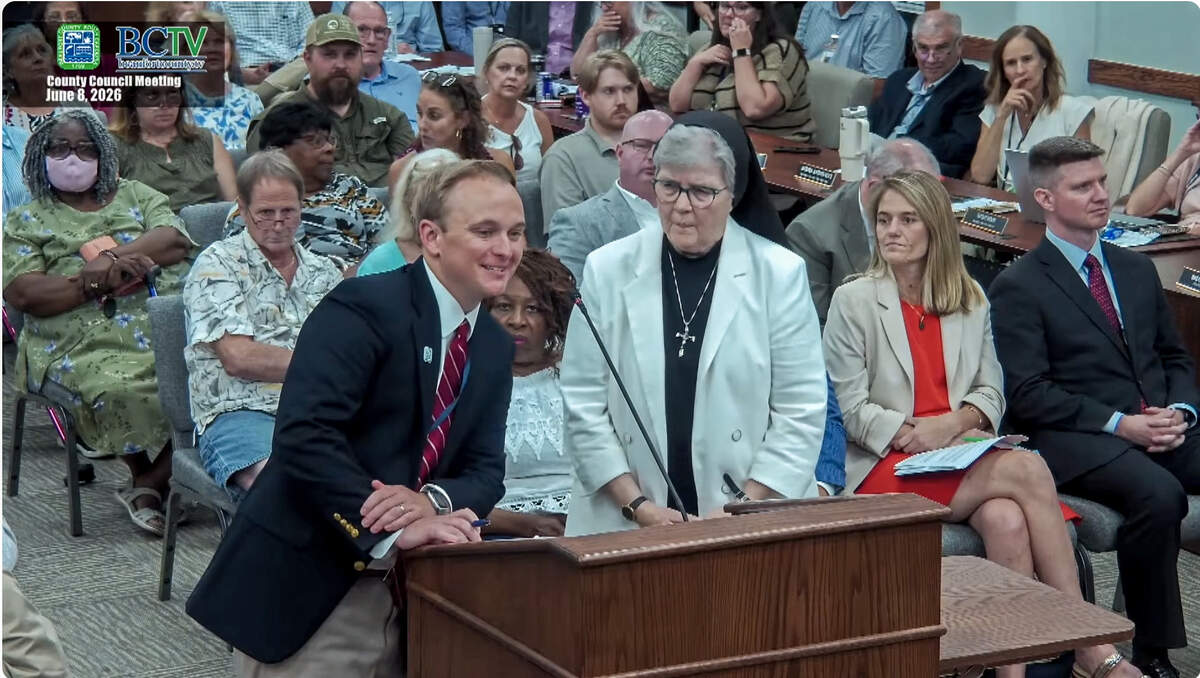
Smith, who is with the Roman Catholic Diocese of Charleston, represented the Sisters of Saints Cyril and Methodius.
The county’s position
Hussmann, the Business Services administrator, testified on behalf of the county under questioning by Dylan Kidd, interim assistant county administrator.
The pair seemed to be in the minority. Councilman Tom Reitz asked Kidd if he even wanted to make the case after Smith argued on behalf of St. Francis.
Kidd replied there is no dispute St. Francis is a charitable organization. The only dispute is “how we apply our ordinance to charitable organizations across the county.”
St. Francis is exempt from the business license tax, based on its gross revenue, the county told the group in a letter. But that exemption does not remove the obligation to apply for the license. Maintaining an active business license ensures that Beaufort County has accurate contact information in the event of a fire, emergency or other urgent matter requiring immediate communication, the county said.
Hussman checked with the Municipal Association of South Carolina, the city of Beaufort and the towns of Port Royal and Hilton Head to see how they treat charitable organizations. Nonprofits are required to apply for business licenses there as well, she said.
The bottom line, Kidd said, “We’re not asking them to pay tax on income or pay a fee to get the license, only to get the business license.”
St. Francis’ position
In a June 1 reply to the county’s Kidd, St. Francis volunteers Mike Hund, Bill Libert and Shelley Yuhas wrote that no part of St. Francis Center’s (SFC) operations constitutes the conduct of business and “SFC refuses to allow its charitable work to be characterized as such.”
Additionally, they wrote, the Catholic Church will not allow for the creation of a precedent that would hurt thousands of its charitable undertakings by having them recast as businesses.
“Unless this requirement is waived, the SFC will need to cease operations in Beaufort County,” they wrote.
Smith, who represented St. Francis at the meeting, talked about how the charity has a chapel in its building and how the Lord’s Prayer is said before volunteers give out food. How Sister Canice, who leads the charity, receives no salary. How a religious order governs the sisters. Its thrift shop is a source of revenue, but most of the food and services are free. Most of its money comes private donors, families and foundations.
“We’re not making money from the St. Francis Center,” said Smith, “we’re giving it away.”
Both the religious order and the Roman Catholic Diocese of Charleston Sisters of Saints Cyril and Methodius think “it’s ridiculous to get a business license” Smith said.
“It only came up because we wanted a sign,” Smith said.
What St. Francis does
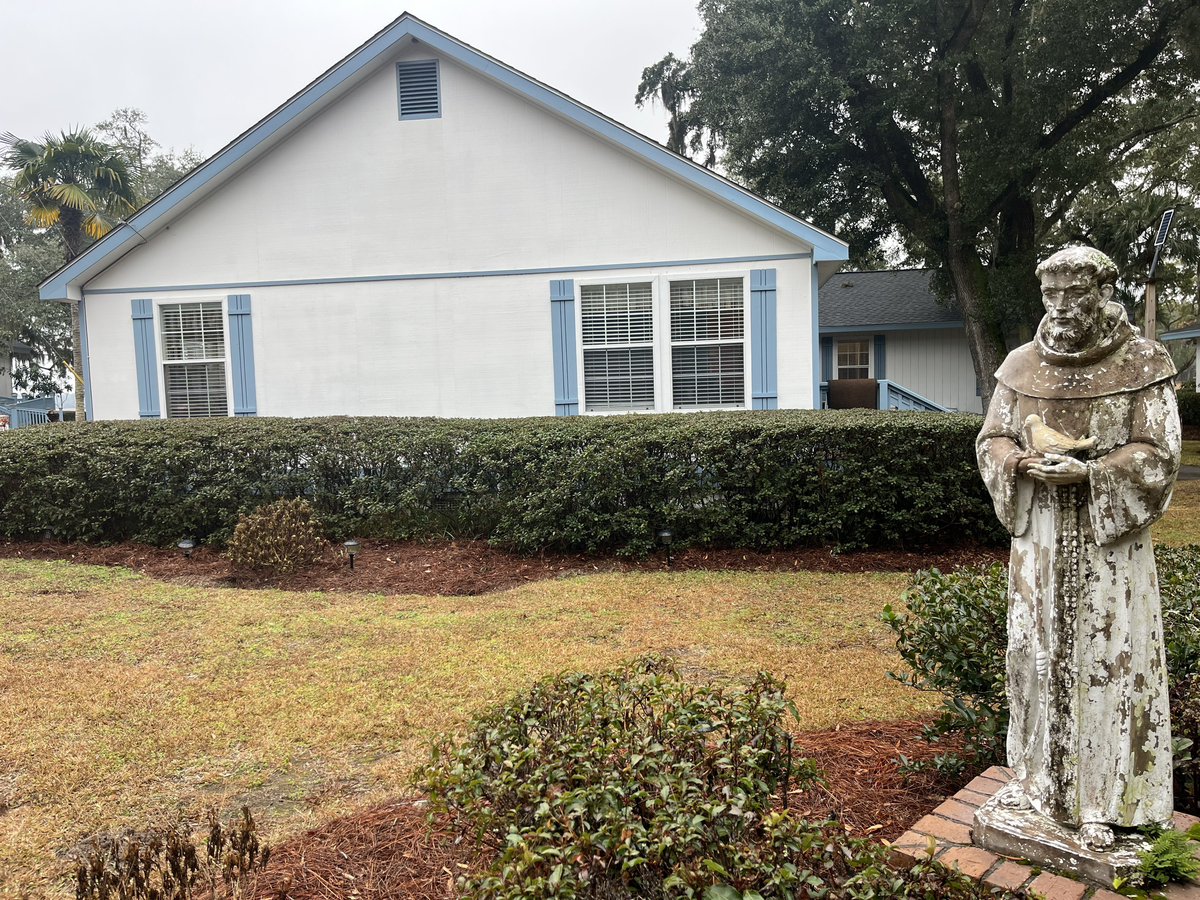
St. Francis spends some $500,000 a year on food and other necessities across the Lowcountry. Besides providing food and clothing, the charity provides housing assistance and builds ramps to homes to assist the elderly. It also supplies air conditioning units to residents without them.

Three sisters with the Sisters of Saints Cyril and Methodius are assisted by about 80 volunteers from all walks of life and denominations. It relies entirely on financial and food donations from individuals and area churches.
It also runs a small thrift shop where it sells used items at reduced prices. It helps offset its expenses.
Sign disappears
In January, St. Francis’ venerable sign along Sea Island Parkway, which had stood for 16 years, mysteriously disappeared. Calls flooded into the church about whether the popular out-of-the-way charity, located on the banks of a St. Helena salt marsh, was closing.
St. Francis wasn’t closing, but it did remove the sign over a dispute with the property owner where it was located.
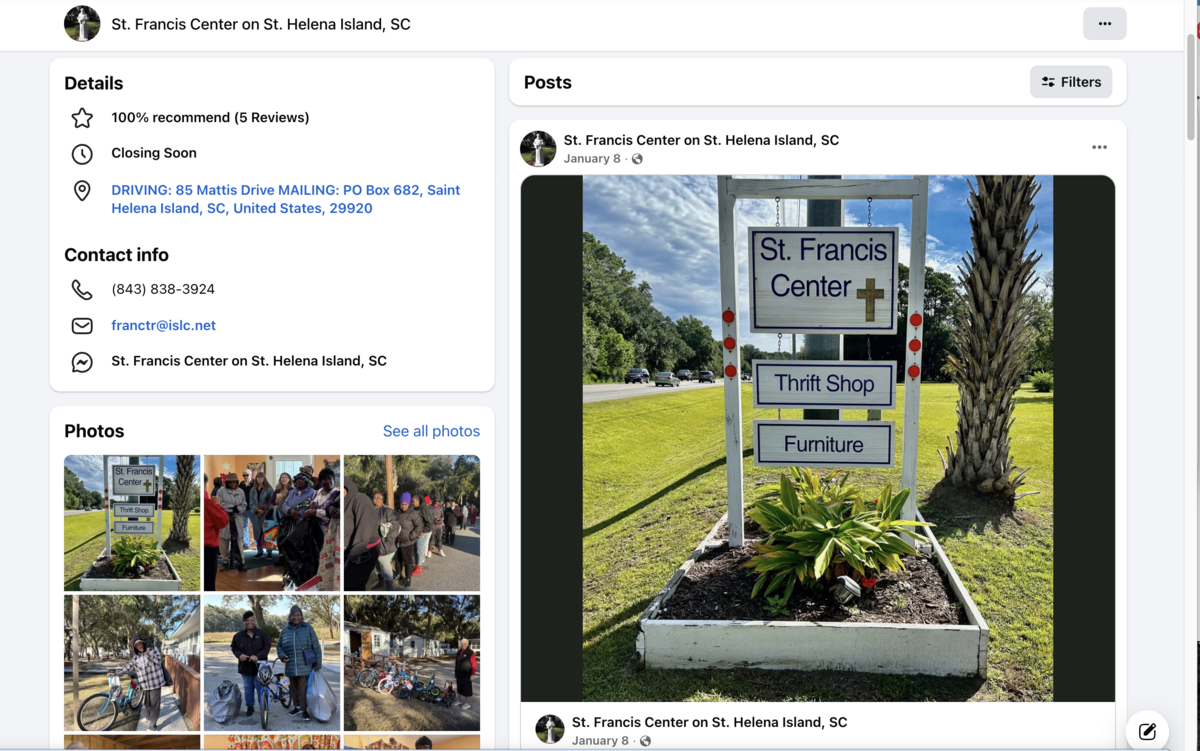
The estate of Lucinda Simmons said it planned to begin charging St. Francis $300 a month, or $3,600 yearly, to display the simple sign that had alerted the public to turn off of busy Sea Island Parkway onto Mattis Drive to reach the center since 2010. Before she died in 2021, Simmons had allowed St. Francis to display the sign on her land at 588 Sea Island Parkway rent-free.
St. Francis said it would not pay $3,600 a year for sign rent when that money would be better spent on helping people.
St. Francis decided to erect new signs on different property but was advised it would need a permit. That’s when the nonprofit reached out to Beaufort County.