Penn Center leader says the story of Port Royal’s experiment ‘should never be forgotten’
If Bernie L. Wright had a magic wand, he says he would immediately require that the Port Royal Experiment be taught in every school in America.
When Union forces captured the Sea Islands off the coast of South Carolina and the main harbor, Port Royal, in 1861, dozens of white-owned plantations were in operation, and 10,000 slaves toiled producing cotton, rice and indigo. White plantation owners fled. The slaves remained. The Port Royal Experiment was launched whereby former slaves farmed their own land and also went to school, demonstrating they could live free of white control.
“It should never be forgotten,” Wright says. He considers the history every bit as important as the “discovery” of America Christopher Columbus, but you rarely find it in the history books in the nation’s schools, he notes.
Penn Center on St. Helena Island, the site of the Port Royal experiment and one of the first schools for newly freed African Americans during the Civil War, continues to promote and preserve Gullah Geechee culture and history today.
Wright has been hired as the center’s interim executive director. He began work Sept. 20 and replaces Marion Burns, who died in August.
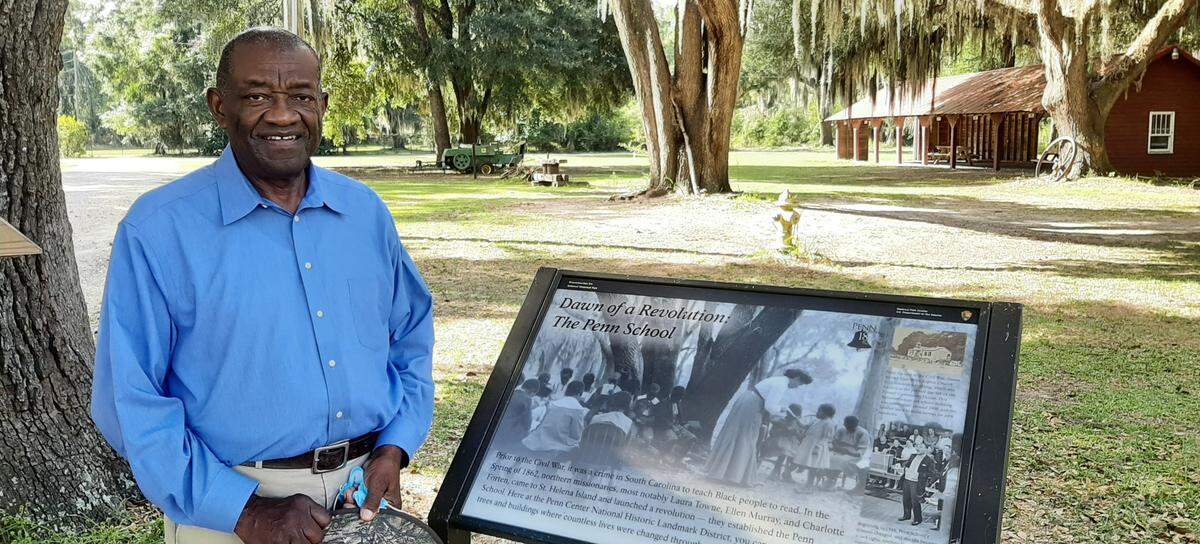
A national search will be conducted by the center’s board of directors for a permanent executive director, Wright said. Wright’s been hired to steady the ship in the meantime.
It isn’t Wright’s first stint with Penn Center. He served as executive director 2002-2007. Prior to joining Penn, he spent his entire working career with the Farmers Home Administration, a lending agency under the U.S. Department of Agriculture, including eight years as the state director for South Carolina. He also served on a Penn Center advisory board when he was the state director.
Wright, 74, of Orangeburg, was born and raised in St. Matthews in Calhoun County.
His focus at Penn Center, he says, will be working to renovate buildings and bringing programs up to speed, he said. The Penn Center History and Culture Program, for example, focuses on the heritage of the Sea Islands and the Gullah Geechee culture of Black Lowcountry residents.
“All these things are so richly interwoven with this place,” Wright says.
The center operates the 50-acre National Historic Landmark District and the York W. Bailey Museum. It also maintains and manages the on-site Penn School Collection, and oversees the Penn School Papers, which are archived within the Southern Historic Collection housed at the University of North Carolina-Chapel Hill’s Wilson Library.
Penn founded in 1862
Founded in 1862, Penn School was one of the first academic schools in the South established by northern missionaries to provide a formal education for formerly enslaved West Africans. After the school closed in 1948, Penn became the first African American site in South Carolina whose primary purpose was to safeguard the heritage of a Gullah Geechee community. During segregation in the 1960s, Penn Center also provided a sanctuary to Civil Rights leaders, including Dr. Martin L. King, Jr.
The public can learn about the history by touring the 23 buildings on the Penn Center campus, including Darrah Hall, which was dedicated as a Reconstruction Era Monument. The center is the only African American National Historic Landmark District in the state of South Carolina.
“People should always know about” the history, Wright says. The center “enlightens the citizens of this country.”