USC could lose barrier island to Georgia. McMaster promises he won’t let that happen
Gov. Henry McMaster says South Carolina won’t be giving up a Beaufort County barrier island to the University of Georgia.
The governor said in a voice message that the state will honor the commitments it made when Pritchards Island was donated to the University of South Carolina in the 1980s. The message was left with family representative Martha Rhodes, whose grandfather, Philip Rhodes, donated the island.
“South Carolina will live up to every single thing that is in the agreement, which is between the… university and your grandfather,” McMaster said in the Wednesday voicemail. He reiterated his backing during a later call.
The State and Island Packet reported last month that Rhodes and her family believed USC was not honoring its commitments. Under the agreement Philip Rhodes reached with USC, control of the island could transfer to the University of Georgia if USC didn’t follow the donor’s wishes to use it for scientific research and education.
The University of South Carolina Development Foundation, which currently owns the Pritchards property, also reached out to the Rhodes family Wednesday about USC’s future use of the island.
Martha Rhodes said Thursday the family was “so encouraged and impressed” with the steps taken by McMaster and the USC Development Foundation.
“We feel confident that the Rhodes family will be an integral part of ongoing discussions,” she said.
Upholding the deeds
The 1980s deeds, signed by Philip Rhodes and the then-Carolina Research and Development Foundation, required USC to keep Pritchards Island in a wilderness state and to use it for scientific, educational, charitable and general public purposes.
For several years, the university, especially USC-Beaufort, did just that.
Students and professors conducted research on tides, monitored microscopic organisms, researched shorebirds, barrier island dynamics and salt marsh ecology. The sea turtle program on Pritchards, spanning months, had participants staying out late in the evening tagging the turtles to follow their movements. Community members, environmentalists and even those from out of town joined in during day programs and some stayed overnight in a stilted research lab that Philip Rhodes paid to have constructed in the ‘90s.
The programs, staffing and day-to-day upkeep of Pritchards Island were paid for from private funding — including Rhodes and media mogul Ted Turner — community buy-in, and state and federal grants.
By 2009, funding sources had dried up and the research lab had become weather-worn and unusable because of erosion typical to barrier islands. Since then, a sea turtle program, under the purview of the South Carolina Department of Natural Resources and in agreement with USC, has continued. Otherwise, Pritchards Island has gone unused by the university.
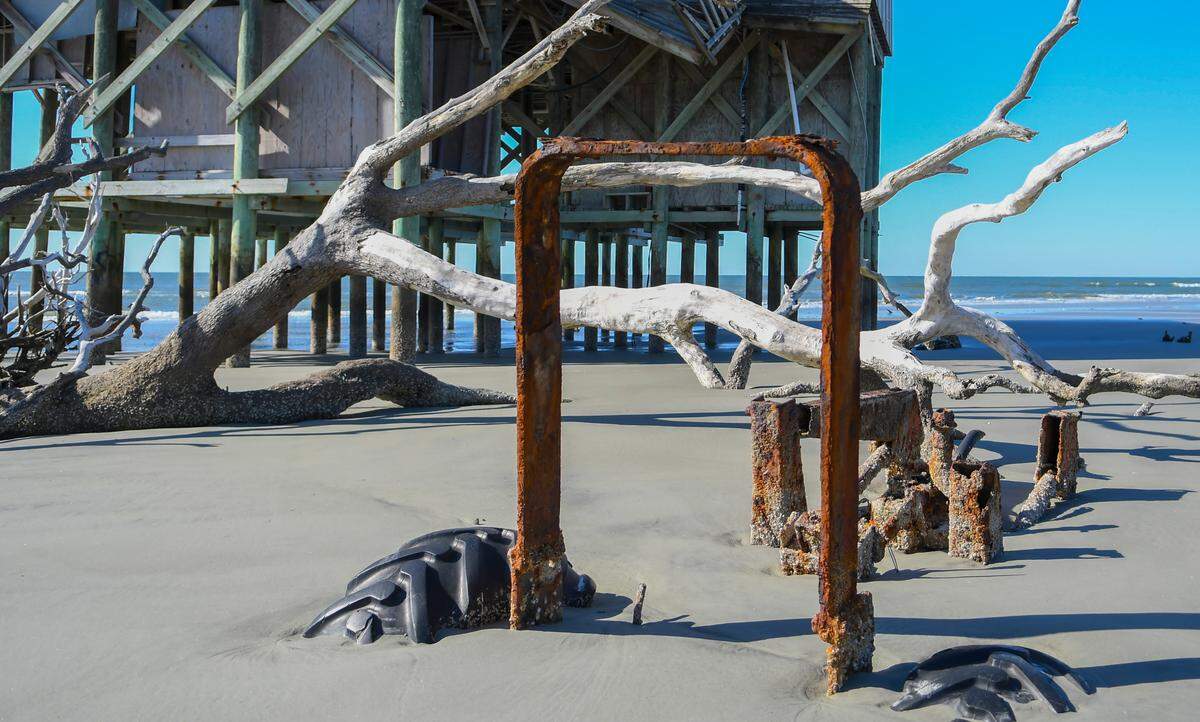
In 2010, trash had accumulated on the island, specifically around the vacant lab building, and the Rhodes family contacted USC with their concern. Emails between USC staff, the Rhodeses and others circulated, bringing up the deeds and the university’s stewardship.
“If USC is to be that steward, well and good,” a Rhodes family member wrote in a 2010 email. “If not, let’s move on.”
Moving on meant this: Under the deeds, if USC did not abide by the underlined rules, the island could go to the University of Georgia. If UGA was unwilling or unable to abide, Pritchards would go to The Nature Conservancy.
While trash, lab equipment and most machinery was removed from the island, the terms of the deed continued to go unmet for over the past decade.
Moving forward
Removing the lab building that, during high tide, sits in the water and has been badly battered by hurricanes is the only current definitive plan the university has laid out.
In September, Beaufort Construction of SC will remove the stilted building, bringing equipment in on a barge, placing debris on that barge and hauling it to trucks that will take the remains to a landfill, Jason Caskey, USC foundations’ president and CEO, wrote in a Wednesday email to Martha Rhodes.
“The Foundation and USCB value this property and believe there are opportunities for continued research even without the facility,” Caskey wrote.
Strategic planning for Pritchards Island will take place over the next few weeks with input from the Rhodes family, he said in a Thursday email to The State Media Co.
While there have been no new monies set aside for the work on Pritchards Island, Caskey noted that the foundation hopes to identify potential funding sources as part of the planning process for programs on the Island.
“The Foundation appreciates Governor McMaster’s support for Pritchards Island and we plan to keep the Governor and his staff updated on our planning efforts,” Caskey said in his email to The State newspaper. “We also plan to seek input from his staff on additional resources that the State may be able to provide as we explore future plans for the Island.“
On Thursday afternoon, Brian Symmes, McMaster’s spokesman, said it is too soon to identify available funding sources that could restart programs and university research on the island. However, Symmes said the governor is actively engaged with the Rhodes family and USC regarding Pritchards Island.
“(McMaster) is very interested in finding a way for the university to satisfy the original desires of the Rhodes family so that Pritchards Island remains in the custody of the university and the state of South Carolina,” Symmes said.
This story was originally published July 7, 2022 at 3:20 PM.