No more cancellations? DHEC says new vaccine plan will help Beaufort Co. hospitals
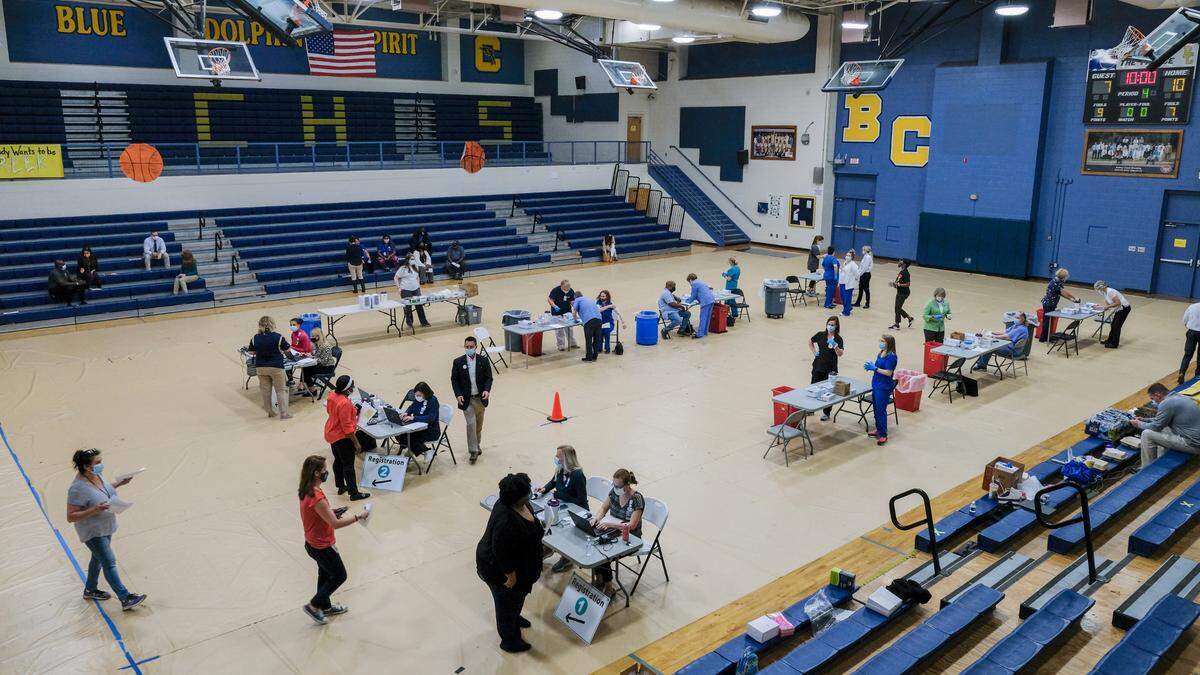
A new distribution model for coronavirus vaccines in South Carolina will help Lowcountry hospitals better predict how many residents they can inoculate week to week, reducing the chance that local health care providers must cancel hundreds of shots whenever the area’s demand for doses significantly outstrips the available supply, health officials say.
The S.C. Department of Health and Environmental Control is now allocating a weekly “baseline” of first doses to the state’s Pfizer-BioNTech providers, which means medical centers like Beaufort Memorial Hospital are guaranteed a set vaccine shipment each week, barring a major production shortfall or some other “tragedy,” said Nick Davidson, DHEC’s senior deputy for public health.
Earlier this year, the Lowcountry’s vaccine supply shifted dramatically from week to week, forcing local hospitals to cancel hundreds, even thousands of appointments — leading to widespread confusion and frustration among residents.
“We want to ensure that we’re more predictable,” Davidson said in an interview. “That will make everybody’s lives easier, and we would anticipate fewer cancellations ... because facilities know what they’re going to get, and therefore how many appointments they can make.”
The new Pfizer baselines went into effect this week, Davidson said, and DHEC plans to set similar baselines later this month for the state’s Moderna providers.
Beaufort Memorial Hospital, the area’s largest vaccinator, will receive at least 2,340 first Pfizer doses per week. Hilton Head Hospital will get at least 1,002 first doses. Coastal Carolina Hospital now has a baseline of 1,866 first Pfizer doses. (Second-dose deliveries will be based on first-dose shipments.)
Here’s how the new distribution system works:
A regional approach
The Pfizer baselines are “complementary” to DHEC’s new allocation formula for in-state vaccine deliveries, Davidson said.
Vaccine providers place weekly orders for more doses, and the federal government uses an algorithm to allocate a certain amount to South Carolina each week based on the state’s adult population. DHEC later decides how to divvy up those doses.
When previously making its allocation choices, DHEC factored in the state’s vaccine supply, provider utilization rates and order requests from providers, Davidson said.
DHEC didn’t use a “statistical equation” to make its decisions, he said.
The agency, though, changed its approach this week after Gov. Henry McMaster signed a bill in late February requiring DHEC to allocate doses to each of the state’s four public health regions based on a variety of factors.
(The Lowcountry region includes 11 counties stretching between Calhoun and Charleston counties. Beaufort and Jasper counties are in the region.)
DHEC now uses a “fairly complex” Z-score calculation, Davidson said, to allocate doses to the regions.
How does it work?
DHEC calculates the percentage of South Carolina’s population living in each of the four regions. The Lowcountry, for example, accounts for 23.4% of the state’s population, according to Davidson.
(If DHEC used a per capita-only allocation model, the agency would send doses to each region based exclusively on population levels.)
But the state’s new algorithm isn’t that simple. Under the bill signed by McMaster, DHEC had to add variables into its regional, per capita calculations. State legislators wanted to make sure the vaccine rollout was equitable and tailored to those at a high risk of coronavirus complications, among other things.
DHEC included seven variables in its model, with different weights:
The percentage of people per region over 55 years old (a weight of 5%)
The percentage of people per region who identify as Black, white Hispanic or “other,” according to U.S. Census Bureau data (a weight of 5%)
The percentage of people per region who live in poverty (a weight of 5%)
The “prevalence” of diabetes per region (a weight of 5%)
The “prevalence” of hypertension per region (a weight of 5%)
The two-week coronavirus incidence rate per region (a weight of 25%)
The percentage of people per region who are unvaccinated (a weight of 50%)
Those final two variables have greater weights, Davidson said, because they’re more likely to change rapidly.
“If there’s an outbreak of COVID in a community, we quickly need to try to react,” he said, “by putting as much vaccine in that area as we can.”
With the seven variables included in DHEC’s equation, the Lowcountry will receive 27.1% of the state’s first-dose allotment that’s arriving this week, even though the region accounts for only 23.4% of the S.C. population. The Lowcountry will get 29,733 first doses.
DHEC, for its part, also modified its formula to ensure that a region’s weekly allocation will never be more than 5% above or less than 5% below its percentage of the state’s population.
In other words, if a region hypothetically accounted for 25% of the population, DHEC wouldn’t allow its weekly allocation to fall lower than 20% or go higher than 30%.
A predictable amount
Here’s where the facility-level baselines come into play:
When combined, all of the baselines in one region will likely add up to a number just below that region’s weekly share of first doses (or will equal that share exactly).
DHEC’s being slightly conservative with its baselines, Davidson said.
(The baselines — for the most part — were created when DHEC averaged together each facilities’ Pfizer shipments sent for the weeks of March 1 and March 8.)
If South Carolina received extra doses at any point, DHEC could distribute those to vaccine providers that have higher utilization rates, Davidson explained.
For example, if Hilton Head Hospital administered 100% of its weekly first doses by Thursday, and DHEC had additional doses it could send to providers in the Lowcountry region, the agency might allocate some of those to the local medical center.
DHEC’s baselines will gradually increase, Davidson added, as the nation’s vaccine production ramps up. DHEC will also include Johnson & Johnson’s deliveries in its allocation formula once those shipments become regular.
“Maybe after several weeks or a month we’ll say, ‘Hey, you’re new baseline is this, and we’ll guarantee at least this month,’” Davidson said.
Dr. Edward Simmer, DHEC’s director, during an agency board meeting last Thursday predicted that the new strategy will help bolster hospitals’ vaccination efforts.
“This problem we’ve seen with canceling appointments should hopefully, largely go away,” Simmer said.