SC likely to exceed coronavirus projections by Saturday. Here’s why
If current trends continue, South Carolina will surpass state health officials’ projections for new coronavirus infections by about 500 cases on Saturday and top 3,000.
The S.C. Department of Health and Environmental Control anticipated 2,657 cases by April 11, according to its March projection. But as of Wednesday afternoon, 2,552 S.C. cases had been confirmed. State epidemiologist Linda Bell recently noted “an accelerated rate of new infections” — an average of 187 documented cases per day last week.
DHEC said its public models account for delays in lab reporting. But it’s unlikely the projection could account for the varying testing backlogs at public and private labs, with some residents waiting over a week for results and others getting a diagnosis within a day.
The size of the backlog is a big unknown for any projection. Most of the state’s large hospital systems and one of the nation’s largest private labs would not say how many COVID-19 tests are currently pending.
Additionally, DHEC’s modelling is old. The state health agency hasn’t updated its projections for over two weeks. After a reporter asked about discrepancies between reported case trends and the model, DHEC removed it from its website on Tuesday evening and replaced it with University of Washington modeling that doesn’t project statewide cases, archived versions of the page show.
A spokesperson said Wednesday the agency is working on updated forecasting.
“No model will tell you exactly what’s going to happen 100% of the time,” said Stella Self, a statistician at University of South Carolina’s Arnold School of Public Health who builds infectious disease models. “That’s not statistics, that’s fortune telling,” she said.
“We don’t really know, in a lot of areas, how many people are sick at the moment,” she said. In South Carolina and in many places across the U.S., only the sickest patients are getting tested for the virus.
Public health experts have long said the actual number of infected people far exceeds the number of confirmed cases. On Monday, South Carolina backed this up with data, releasing county-by-county estimates of actual cases that reveal a much more dire outbreak than previously known.
According to those figures, about 85% of states COVID-19 cases are undiagnosed.
“These testing issues are really limiting the predictive capabilities of the models,” Self said.
Actual number of cases much higher than those reported
For the first time on Tuesday, state health officials released estimates for the actual number of coronavirus cases in the state. For every one confirmed case, there are nine infected people who haven’t been tested, officials said.
A week ago, the director of the U.S. Centers for Disease Control and Prevention said as many as 25% of people infected by the coronavirus don’t display any symptoms, meaning they wouldn’t be eligible for testing under South Carolina’s guidelines.
DHEC’s newest estimates mean while there are currently just under 2,500 people who have tested positive, over 16,000 people have potentially contracted the virus.
That number tracks with warnings from University of South Carolina scientist Jim Morris, who specializes in mathematical modeling of future events. In a letter to McMaster on March 23, Morris wrote, “the number of cases will explode in early April, all at once.”
Morris urged McMaster to seriously consider instituting a stay-at-home order then. The governor waited two weeks to take that step, making South Carolina one of the last states in the country to do so on Monday.
In Richland County, 84% of total COVID-19 cases are undiagnosed and in Lexington County this figure is 83%, according to DHEC’s new estimates. Beaufort County has one of the lowest percentages of untested cases in the state with about 82.2% of total cases, or about 751, reported The State.
In rural parts of the state, like Dillon County, which has one hospital, an estimated 98% of cases have not been identified. DHEC officials have said the small number of confirmed cases in rural counties is likely due to a lack of access to testing.
Self said some epidemiologists are using infection data from other countries, like South Korea, that have tested a greater portion of their citizens, but regional differences in interpersonal contact, access to health care and other population dynamics make the outbreak look different from country to country.
The models have high stakes, mainly in predicting the effects of the outbreak on the health care system.
Self is working with Prisma Health to determine when its hospitals might see a surge of patients. “The timing of the peak demand is going to vary a good bit from from state to state and even within a state,” she said. This has implications for where resources — ventilators, protective equipment and bed space — are prioritized.
How many tests are pending?
State health officials’ models for the coronavirus spread in South Carolina, before the were removed from the web, said they took into account “delays in lab reporting.”
“It is important to note that projected data is estimated and may change significantly due to various factors,” read a notice above the projections.
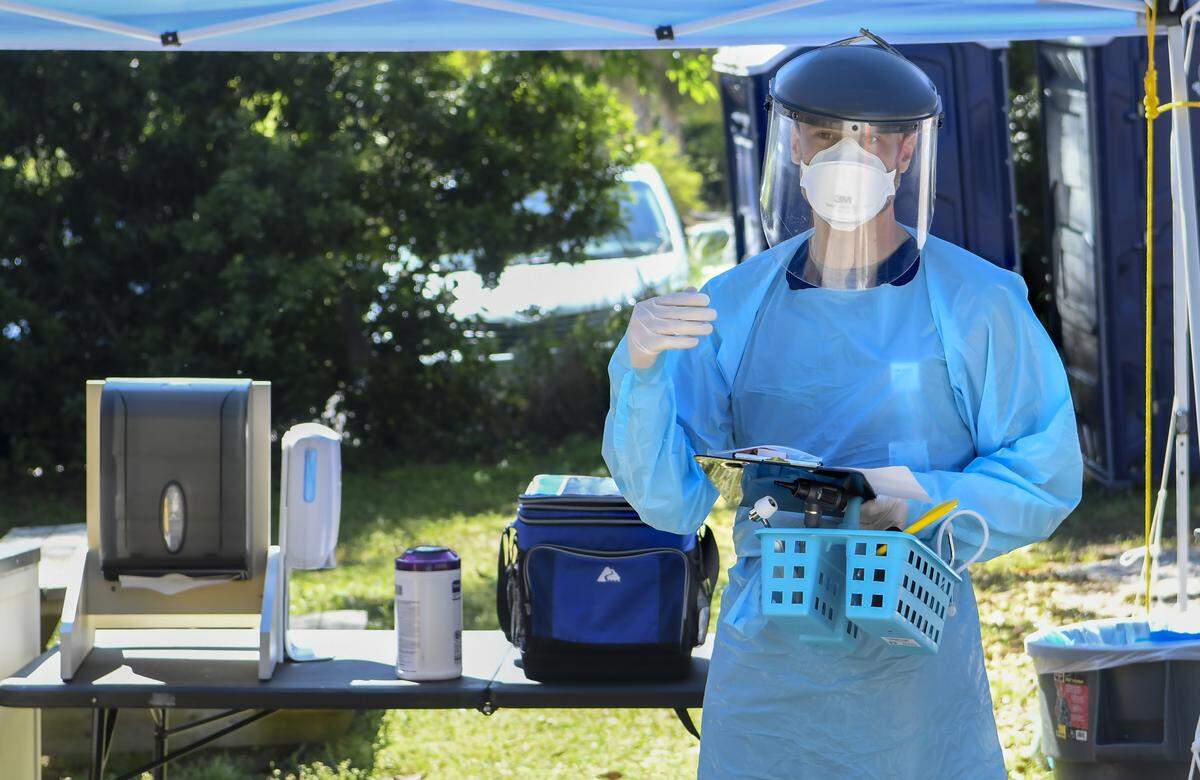
Reporters at The Island Packet and The State attempted to estimate the number of total outstanding coronavirus tests by asking the largest hospital groups in South Carolina how many of their COVID-19 tests were currently pending. Many declined to say, but others reported large numbers of people waiting on results over the past week.
Prisma Health, the state’s largest nonprofit health system, had 2,150 pending tests a week ago, Dr. Eric Ossmann told Midlands lawmakers. At Monday’s press briefing, Ossmann said the system was caught up on the “vast majority” of testing.
Prisma did not respond to a request for updated numbers on Tuesday.
The Medical University of South Carolina (MUSC) is seeing 600 people daily at its drive-thru specimen collection sites in West Ashley, Florence and Lancaster, according to news release issued on April 2.
Since March 23, MUSC has moved toward conducting coronavirus testing mostly in-house, said spokesperson Heather Woolwine in an email. The hospital system said in a Monday news release that it was no longer sending samples to private labs or DHEC.
Asked last week how many tests were pending, Woolwine said the number “changes hourly,” and the health system is averaging 24 to 30 hours between the collection of a sample and delivering results, with slight variations depending on where the sample is collected and if the patient has been admitted to the hospital.
Spokespeople for McLeod Health, Lexington Medical Center and Providence Health would not share numbers of pending or completed COVID-19 tests. All reported using private labs for at least a portion of their testing.
“Our employees and patients are not numbers. They are lives to be valued and protected,” said McLeod spokesperson Tracy Stanton in an email, adding that testing delays are determined by the “independent lab” processing the tests.
Quest Diagnostics, a private company testing coronavirus samples at 12 labs across the country, said in a statement on Monday that it had a backlog of about 80,000 tests, resulting in a two-day to three-day turnaround for results on tests not marked as priority.
This backlog had been cut in half from the week prior, the statement said.
A Quest spokesperson declined to provide numbers specific to South Carolina.
What can COVID-19 models tell us?
Self, the USC statistician, cautioned the public against looking to infectious disease models for definitive numbers.
“What the models are telling you is not so much one number but a range of possible scenarios that could happen,” she said, pointing to the upper and lower estimates on many predictions. DHEC’s coronavirus projections included date ranges for the forecasted number of cases, for example.
Researchers at Harvard University’s Global Health Institute projected demand placed on the country’s hospitals using nine scenarios, with various percentages of the population being infected over different time periods.
“This is not something that as a society we’ve really done before,” said Self, pointing to the 1918 Spanish flu, which infected nearly a third of the world’s population, as the last severe pandemic humanity experienced.
The data being collected will allow epidemiologists to assess the effect of social distancing and exactly how much is needed in different areas to prevent an explosion of cases. There are major questions around whether the U.S. will continue to experience major outbreaks when restrictions are relaxed, she said.
“Predicting what we’re going to see tomorrow is so much easier than predicting what we’re going to see three months from now,” Self said.
Isabella Cueto with The State contributed reporting.
BEHIND THE STORY
MOREBehind our coverage
The Island Packet and Beaufort Gazette’s reporters and editors are working from home to maintain social distancing while continuing to provide important and timely updates about coronavirus in Beaufort and Jasper counties. Click the drop-down icon on this card for more information about our coverage and how to reach us.
How to contact us
For general news tips, send an email to newsroom@islandpacket.com. If you’d like to reach out to us anonymously, you can use this form or look at the other options in this story.
Reporters’ email addresses are linked at the top of each story. Just click on the reporter’s name. Phone numbers are in the bio at the bottom of each story if you’d rather leave a message.
Support our work
As businesses shut down or reduce hours because of the coronavirus, The Island Packet and Beaufort Gazette are seeing dramatically less advertising. Subscriptions are critical to our ability to sustain local news coverage. Find out more information about subscriptions at islandpacket.com/subscribe.
This story was originally published April 8, 2020 at 2:59 PM.