
Renovations on Beaufort's 'Big Chill' home reveal secrets from its 165-year-old past
While many people know Beaufort's Tidalholm mansion from the movies "The Big Chill" and "The Great Santini," renovations currently underway at the house are peeling away a past that existed long before the cameras rolled.
Last year, Country Living magazine named Tidalholm the most famous historic house in South Carolina.
The New York Times also once featured the 7,400-square-foot home in a story about production companies turning their focus to Beaufort County for filming.
It has a lesser known past as a guest inn that inspired writers and, earlier in its 165-year history, as a Union hospital during the Civil War.
But a deeper history is revealing itself as a renovation uncovers the bones of the home.
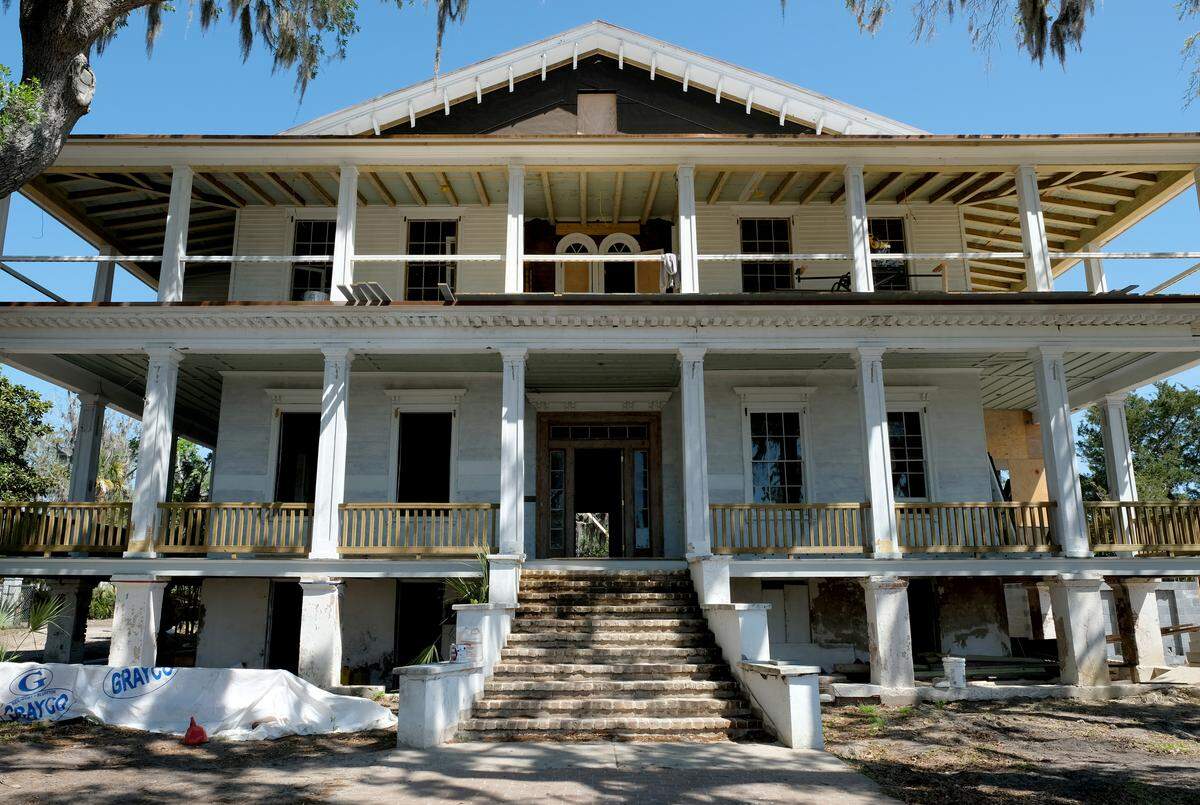
John C. Tashjian, a New York City developer, purchased the property for $1.76 million last year. Tidalholm had sat empty for years. That neglect, along with generations of renovations — some of them completed in questionable ways — left the home nearly irreparable, its new owner says.
"It needed someone to come in and, literally, save it," Tashjian said. "We have done that, and we are proud of it."
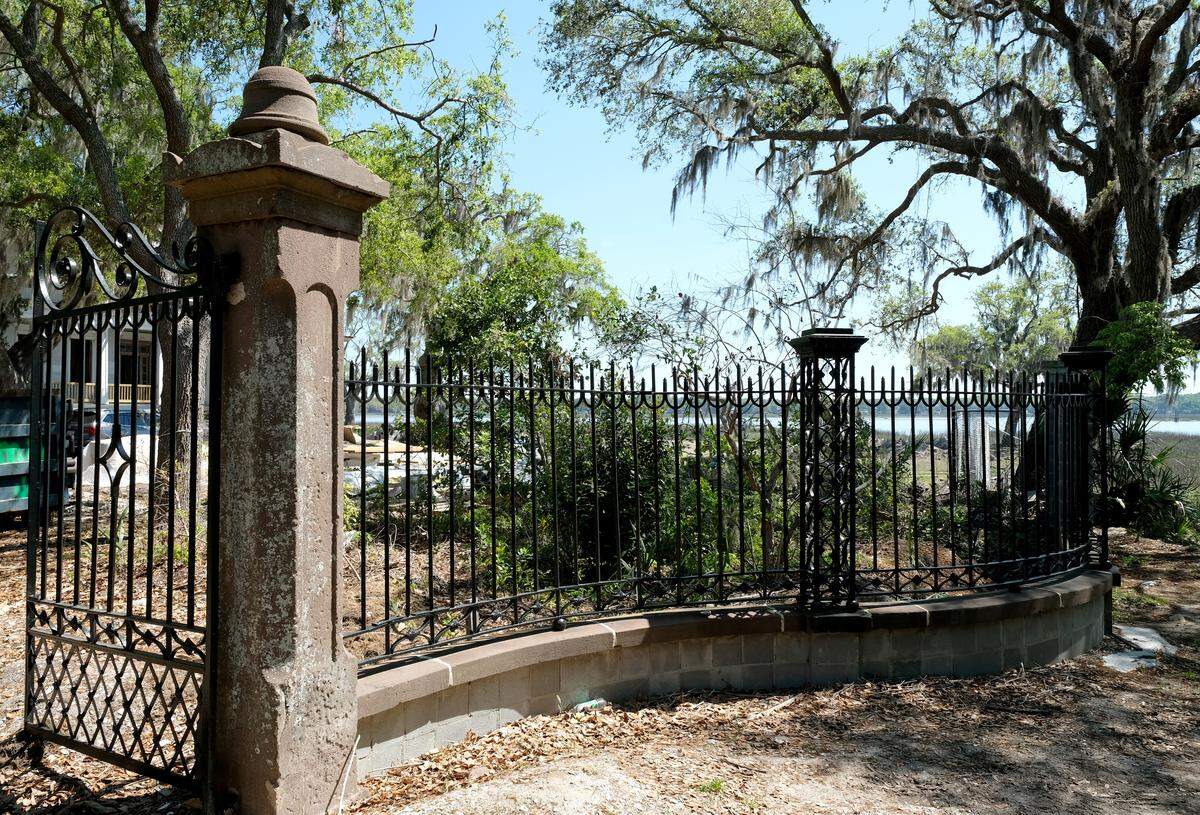
On Thursday, a steady stream of tourists stood outside the property's gates peering at the white columned mansion as hammers pounded and drills churned.
The tourists looked past nicks in the gates. The dents are rumored to be from Union soldiers using the posts for target practice, said Arthur Aquilato, a representative for Tashjian overseeing the renovation.
But from outside the gates, tourists are unable to see the original wood floors installed when the home was built in 1853.
They don't see the workers moving over the wood planks that once felt the weight of film legends such as Robert Duvall, Kevin Kline, Jeff Goldblum, Tom Berenger and Glenn Close.
From inside the home, you can't see the tourists, You can see views of marsh from three sides of the home. It makes it easy to understand why Edgar Fripp picked the peninsula on the Beaufort River to build his summer getaway.
The home was built as a Victorian mansion by Fripp but evolved into a colonial home, Tashjian said.
"The house is an organic house," he said. "It grew based on the needs of the inhabitants and modern technology. Not all the design choices in the past have been good ones."
At times it appears hatchets were used for demolition, and those who remodeled didn't always consider engineering concepts.
"We have gone through, sometimes, scratching our heads and thinking how is this area (a staircase) even being held up," Tashjian said.
As problematic as some of the renovations are, they do tell the story of the house.
"You can tell when people had money and when people didn't have money," Aquilato said of the long line of remodels.
The evolution of time can also be seen through items found behind the walls.
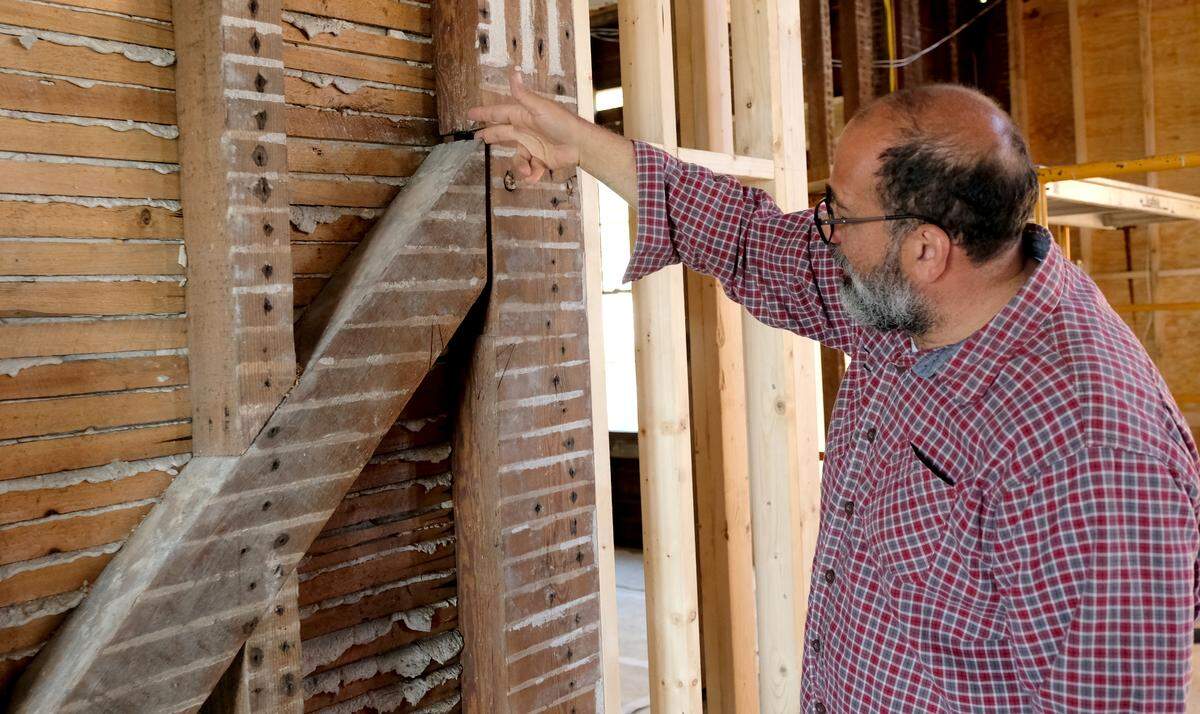
Multiple types of electrical wiring hang from rafters. Some wiring on the ground floor is outdated but much more modern than the early 1900s "knob and tube" style found on the upstairs floor. That method uses porcelain tubes to protect the home as the electricity ran through wood joints.
Early building methods such as a peg and joist style also can be found. It uses wooden pegs to fit boards together rather than nails.
It's that sort of work that intrigues Tashjian.
"I want to celebrate these pieces of history," he said. "Whether that is to uncover it and leave it exposed or remove it and showcase it somewhere else in the house."
The home tells other stories of the Lowcountry inhabitants before Tashjian — the 11th owner of the property.
At times, the clues lead to a past of superstition.
A pair of shoes was found in the floorboards during the renovation. Artist Jayne Parker, Aquilato's wife, found herself so inspired by the shoes that she started researching the practice that put the shoes there.
"It was a Victorian custom to put shoes, often children's shoes, under the floorboards to scare away ghosts," Parker said.
Parker ultimately decided to include a picture she took of the shoes in a photography series titled "A Year in the Lowcountry" to premier May 12 at the Habersham.
The reasoning behind other found oddities is anyone's guess. They include a small burlap bag hanging from the rafters on the second floor.
Aquilato said theories range from a way to scare off mice or bats to some sort of voodoo practice.
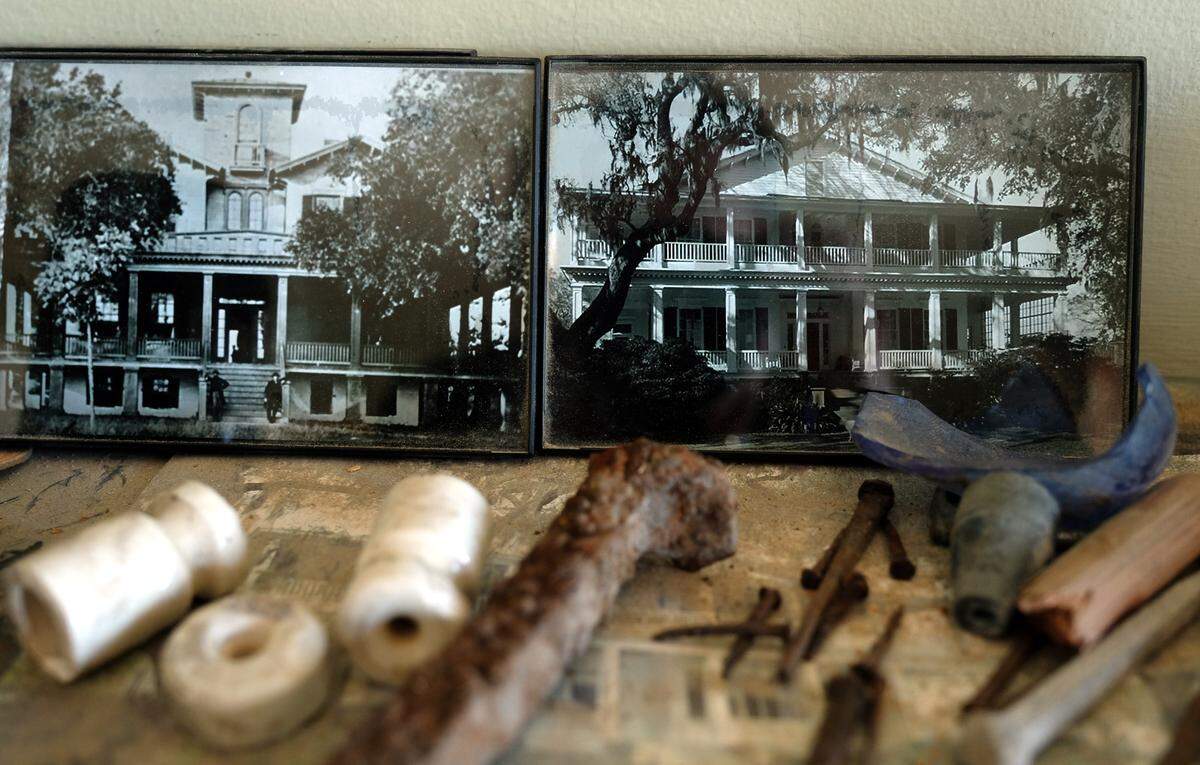
Workers also stumbled on a tiny medicine jar in the yard. After digging out the dirt that time had packed inside, they found a fully intact adult tooth.
Aquilato has been driving around with the jar and tooth in his vehicle since.
Various ways to rid the house of rodents have been discovered, including old rat traps, poison and formaldehyde bombs, Aquilato said.
Handmade nails and a railroad spike are scattered across one of the mantels.
While the home's history makes it a treasure, preserving it doesn't come without struggles.
"The challenge is to restore an old home and figure out how it can be enjoyed by a modern family without changing the design intention and character of the home," Tashjian said.
Additions that came post-Civil War have already been removed, and new additions are being built on the back of the home. Some of the home's history will have to be lost to ensure safety, Tashjian said. He said when items are lost, craftsman are being brought in to reproduce the styles used in the home.
"We understand you own a house for a period of time and then it is handed to someone else," Tashjian said. "So your ownership is really a period of stewardship. For our role, we wanted our period of stewardship to be one where we took the house from what it was to one people will enjoy for future generations to come."
While he acts as Tidalhom's steward, Tashjian is writing his own history into the home — one the future could look back on as a love story.
Tashjian purchased the house partly because of its location in Beaufort, where his fiancee, Katie Cunningham, was raised.
The two have announced a November wedding at the property — setting a hard deadline for completing the renovation.
Just as the home originally was a summer one for Fripp, it will remain a second home for Tashjian and Cunningham.
Tashjian also hopes it will remain a historic reminder for the community it sits in.
This story was originally published April 13, 2018 at 3:52 PM with the headline "Renovations on Beaufort's 'Big Chill' home reveal secrets from its 165-year-old past."