
Lauderdale: It's a Norman Rockwell moment for Bluffton's abstract illustrator
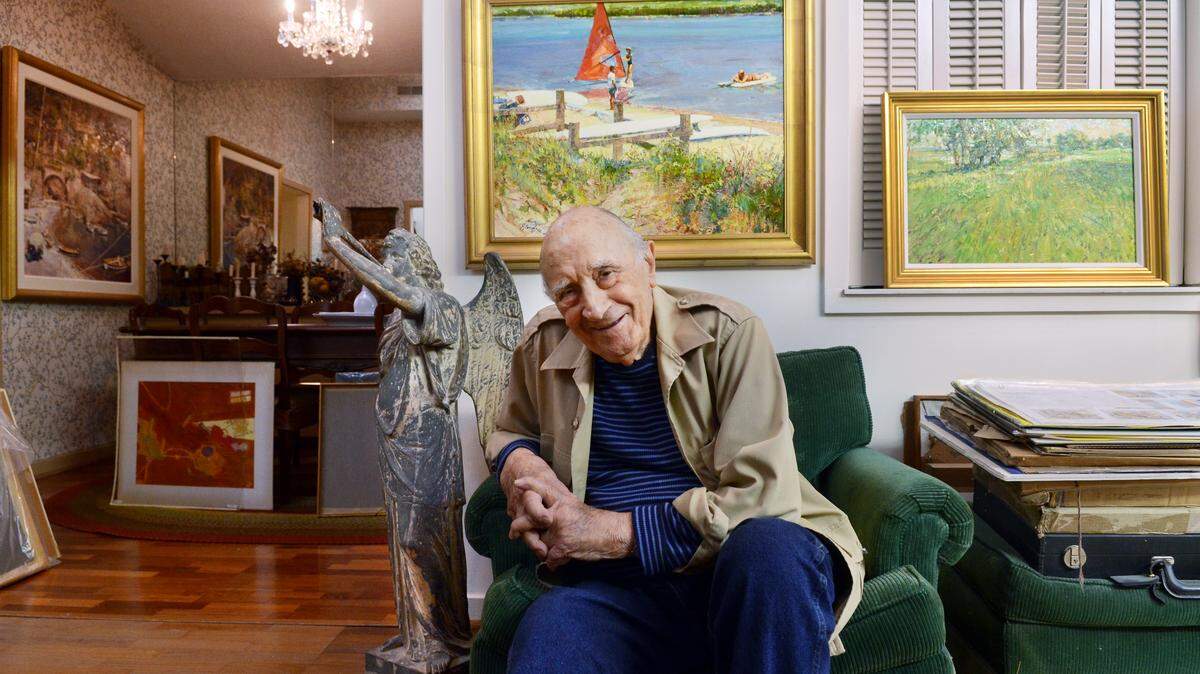
Bernard D'Andrea of Moss Creek will be inducted into the Society of Illustrators Hall of Fame Friday in New York City, where he painted a beautiful face of America emerging from world war.
"We were on 16 million coffee tables every week, and that was just the Saturday Evening Post," D'Andrea says of the golden age of illustrators. Their work graced the pages of McCall's, Good Housekeeping, Cosmopolitan, Seventeen and stacks of magazines when print was king and no art came from computers.
"Norman Rockwell was doing the covers and we were what I'd call the store windows," D'Andrea said. "We were the tempters, in a sense. People saw our illustrations and were drawn into stories by famous writers, and that would lead them to page 36 for the double-spread ad with GM selling cars."
D'Andrea will join the likes of Norman Rockwell and Frederic Remington in the hall, along with three others who left the rat race to make Hilton Head Island their home, his friends Joe Bowler and the late Coby Whitmore and Joe DeMers.
On Hilton Head, they found arts patrons and a lively community of artists with their famous Thursday morning roundtable discussions.
D'Andrea, now 91, remains active in his home studio, but will not be attending the induction ceremonies in Manhattan. He may communicate with them by Skype.
That's a long shot for the kid from Buffalo, N.Y., who built his own drawing table and worshiped Vincent van Gogh, not Babe Ruth. He earned a scholarship to Pratt Institute in Brooklyn by winning a national art contest in Scholastic Magazine.
Uncle Sam wanted him to illustrate war posters and Army manuals during World War II. Then he joined the Charles E. Cooper Studio in New York, where the illustrators were rock stars and one of the models was Grace Kelly.
"After the war, people had to be entertained," D'Andrea said. "They wanted illustrations that were positive, not negative. We were dealing with very pretty people."
The abstract
D'Andrea finished his last magazine illustration in 1994.
That was the year it snowed 17 times in western New Jersey, and the year he moved to Moss Creek with his wife, Jean Stark, an internationally known goldsmith, instructor and author.
But long before the move, D'Andrea as living in two worlds.
While still doing the illustrations, he veered into abstract expressionism.
"I was doing wild paintings," he said. "They were social commentary on American culture at the time."
The smiling world of Betty Crocker had morphed into the street clashes and assassinations of the 1960s. D'Andrea's large canvases reflected the time, and the teachings of landscape abstract impressionist Reuben Tam.
"Abstract expressionism was very wild and progressive and rather difficult to comprehend," D'Andrea said.
While visiting his illustrator friends on Hilton Head, D'Andrea discovered a place that merged his two worlds: the beach.
"Instinctively, I wanted to paint it," he said. "I was interested in the structure of the beach, what sand and water do when they collided and met. I was interested in its moods and weather. I even painted it under an umbrella in the rain."
Some days he felt like Norman Rockwell, sketching human studies on the beach of children and families.
He began pouring the ocean's energy into paintings, with his own peculiar twist.
People loved it, and he wanted more.
New light
Artist Louanne LaRoche of Bluffton asked D'Andrea to paint a show for the Red Piano Gallery on Hilton Head back in the early 1980s.
He did it in two weeks. He was noticed by art patron Frank Fowler, and D'Andrea quickly followed Whitmore, DeMers and Bowler in commercial and critical art success in the Lowcountry.
Retrospectives of his work at the Telfair Museums in Savannah and the Arts Center of Coastal Carolina were well received.
And artist Betsy Chaffin invited him to paint and exhibit at Spring Island.
"I felt like Vincent van Gogh, leaving each day to paint in the fields," D'Andrea said. "This was all very new to me -- the landscape of the Lowcountry, with the new light I was working with and the new tropical shapes."
He stroked the Lowcountry with thick pots of paint.
"That's what I was always trying to do," he said. "Combine energy with what I was doing."
Today, he joins a hall of fame with his idols. His first wife, Lorraine Fox, who died at the height of her career, is also in the hall.
The post-World War II illustrators of the ideal America were not seen as fine-art painters. But they were, D'Andrea said. They contributed to the entertainment, the culture and the aesthetic of a great nation.
"Each of us tried to excel, not only as illustrators but to raise our art to a better echelon, to a better level," he said.
He has seen that when art gets so abstract it has nowhere else to go, it comes back to imagery.
"Illustrators are now accepted as artists," he said.
This story was originally published April 30, 2015 at 5:27 PM.