
Hilton Head church silver are signs and wonders on this special Christmas Eve
Christmas Eve delivered the rarest of gifts to the Lowcountry 50 years ago today.
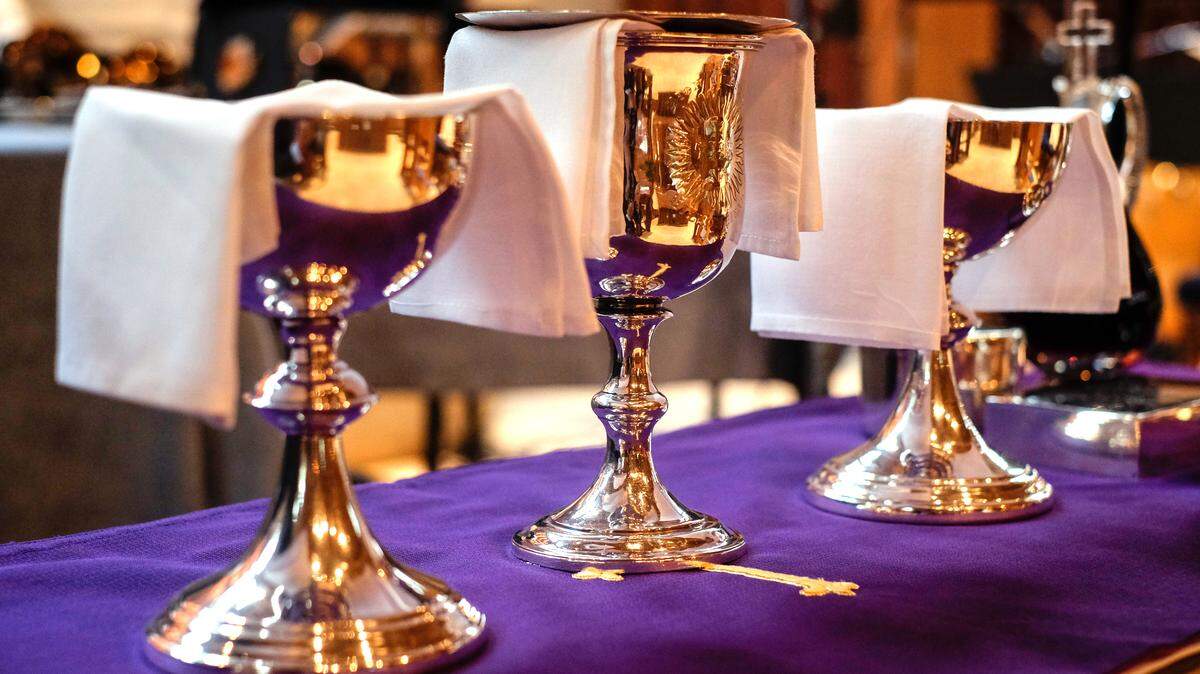
Bright colors of the season danced off the gift: two glowing silver chalices. They were a special present for an even more special occasion on Hilton Head Island.
The stemmed goblets had been crafted a century earlier by the finest silversmiths in London to reflect God's gift to mankind. On this day, they reflected the gift of redemption.
Their story begins in 1834, when the chalices were placed into service for Holy Communion in a small, wood-frame chapel on what was then a very lonely Hilton Head.
Quiet sips at the altar would have seemed light years away from the American Civil War, which came early to the island. In a single day in November 1861, the era of Sea Island cotton plantations was uprooted. The landowners who worshiped at the Episcopal Zion Chapel of Ease vanished. Slavery ended.
And the island was teeming with tens of thousands of Union troops.
The chapel itself vanished in the maelstrom, its wood and nails believed to have been recycled into housing for islanders.
Tombstones and a mausoleum became the only signs that a house of worship stood at what is today the intersection of Mathews Drive and William Hilton Parkway at Folly Field.
Also missing were the silver chalices. Eventually, they would seem to be as dead and gone as the Kirks, Stoneys and Baynards who entered eternal rest by the Zion Chapel of Ease of the St. Luke's Parish.
But the chalices were not dead, and they were not gone.
Margaret Greer wrote in "Short & Tall Tales of Hilton Head Island": "In 1920, the family of a young bride in Philadelphia was searching for old silver goblets to adorn the bride's first home."
They found two, tarnished black and dusty, and bought them from an antiques dealer.
With the first rubs of polish, they were astonished at what they discovered.
Etched into the silver was "Zion Chapel, Hilton Head, 1834."
They instantly knew this silver would never belong to the bride-to-be.
The Philadelphia family found that Hilton Head had no Episcopal church. The chalices were entrusted to the Parish Church of St. Helena in Beaufort with the stipulation that they would return to Hilton Head if it ever had an Episcopal church.
When St. Luke's Episcopal Church held the first service in its first building on Pope Avenue on Christmas Eve 1964, the chalices came back home.
Charter member Nelle Smith recalls that the fledgling congregation barely had enough members to put on a decent Nativity scene. A little boy pressed into duty was found eating a Wise Man's "gold," Nelle said.
Over the years, that original building has expanded in all directions on the 5 acres donated by the Fraser family, who developed Sea Pines nearby. And today what is known simply as St. Luke's Church is on the verge of a campaign to enlarge and bring new life to its Parish Hall.
One constant over the past half century of rapid change has been the silver chalices. They are used every Sunday.
On this Christmas Eve, they will be used during services at 4:30, 8 and 11 p.m.
They also could be used as signs and wonders.
The Rev. Greg Kronz of St. Luke's said that at the end of the baby Jesus' earthly life, he spoke directly about drinking from the cup in remembrance of him.
So the silver chalices transcend time, linking people of all eras. In that way, they are a sign of what the pastor calls "a heavenly banquet."
But on this Christmas Eve, the once stolen, lost and tarnished chalices are themselves a wonder.
"When you talk about the bread and the wine, it's all about a redemptive moment," Kronz said.
"It is a moment of thanksgiving and remembrance of what Christ has done for us. And that's redemption."
And that's why the world celebrates Christmas.
Follow columnist David Lauderdale at twitter.com/ThatsLauderdale.
Related content:
This story was originally published December 23, 2014 at 6:47 PM with the headline "Hilton Head church silver are signs and wonders on this special Christmas Eve."