
Election preview: Sen. Clementa Pinckney's replacement must tackle disparity issues
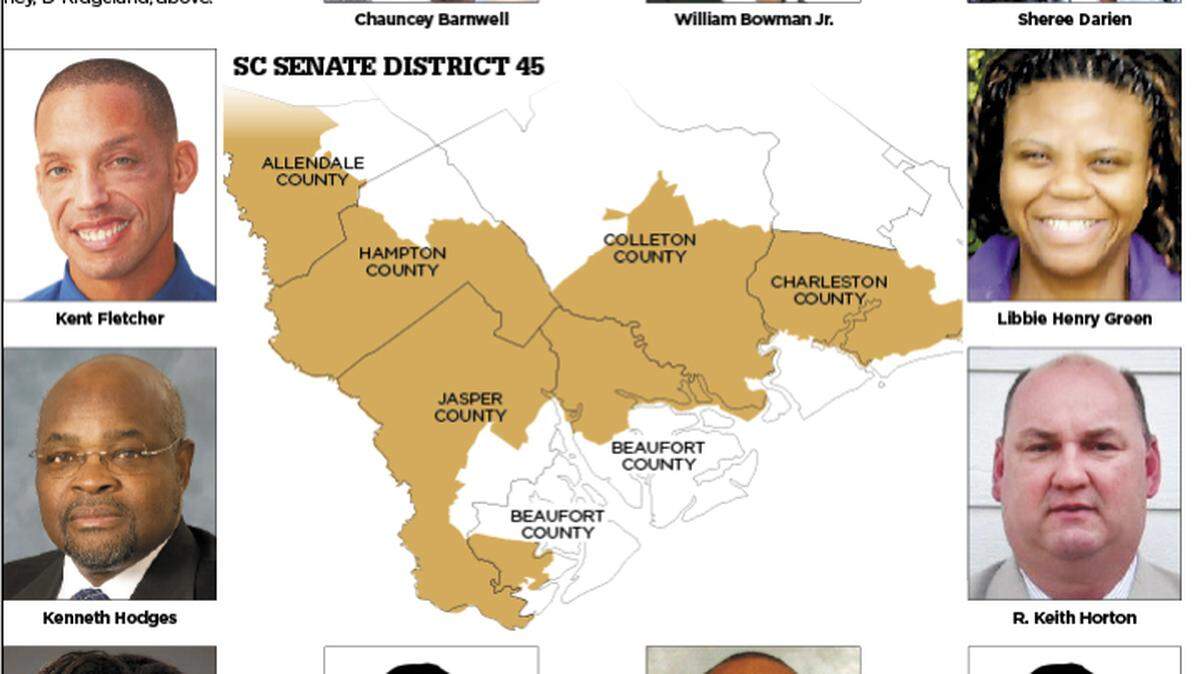
The candidate who wins the state Senate seat of the late Sen. Clementa Pinckney's District must tackle a long list of challenges, say Lowcountry leaders.
The district that stretches from Allendale through Jasper and Beaufort counties up to Charleston is one of the poorest, most neglected areas in South Carolina, they add.
Its counties have some of the highest rates of uninsured adults in the state, their school districts consistently post some of the lowest standardized test scores and the area's network of roads have long been neglected and are in need of repairs and expansions.
These needs made for a mighty workload for Pinckney, D-Ridgeland, who chipped away at them during his 15 years representing the district, leaders said.
And it's a set of core issues the next senator will have to learn in a flash, said Arthur Murphy, president of the Jasper County Democratic Party.
Pinckney "had a lot on his plate, and I think our next senator will have to hit the ground running and have to be proactive, like he was proactive," Murphy said. "They have a lot that they have to do."
HEALTH CARE FOR THE WORKING POOR
Access to affordable health care has dogged the predominantly rural district for years.
With the exception of Beaufort and Charleston -- which the district partially includes -- the counties in District 45 rank in the bottom third of counties for clinical care, according to this year's County Health Rankings study by the Robert Wood Johnson Foundation and the University of Wisconsin Population Health Institute.
Jasper County ranked last for clinical care in that study of all of the state's 46 counties.
The same collection of counties also ranked in the bottom half of the state in their rate of uninsured residents, according to a study last year by the S.C. Institute of Medicine and Public Health.
In that study, Jasper County again ranked worst in the state, with more than one third of adults ages 18 to 64 living without health insurance.
While the Affordable Care Act has provided coverage for many residents, many more do not qualify for the law's federal subsidies that help pay for medical coverage. They're also ineligible for Medicaid because they earn too much money.
Pinckney and other S.C. Democrats have championed Medicaid expansion in South Carolina as a way to close this so-called coverage gap and guarantee access to health care for the working poor and their families.
Pinckney's colleagues have pledged to push again next year for the expansion.
"There's a misperception out there that when (the Affordable Care Act) was passed, everyone received health insurance," said Brad Talbert, CEO of Coastal Carolina Hospital in Jasper County. "We've seen significant growth in our uninsured (patients), and that's going to continue as we see pressures on physicians as reimbursement rates are going down ... It's a snowball effect."
The election's winner must find new ways of helping health care groups and hospitals partner to better serve the poor, Talbert said.
"It's going to be critical that (the next senator) work closely with all those constituents and all those stakeholders so that we can have some success," he said.
BETTER ROADS NEEDED TO BRING BUSINESSES, JOBS
Throughout most of the six-county district, more than 28 percent of residents live in poverty and the median $32,705 income is 45 percent less than the national median, according to federal data.
Those dismal statistics have earned about half the district the bittersweet designation of being a federal "Promise Zones," putting it in league with the most poverty-stricken areas in the nation but also qualifying it for federal aid.
The ultimate antidote to that poverty is more jobs, district leaders unanimously agree.
"Whoever wins the election can quite possibly be overwhelmed immediately by the responsibility of that position and the role they'll have to play in supporting the district, especially Jasper County," said Marty Sauls IV, a Jasper County councilman and president of the Jasper County Chamber of Commerce.
"There are so many worthy causes and needy people, but economic development is going to be the key to bring in jobs, better quality of life and health care benefits from new employers," he continued.
Allendale, Colleton, Hampton and Jasper counties within District 45 are already a part of the Southern Carolina Alliance Economic Development Coalition. The alliance uses tax incentives and grants to build industrial infrastructure to lure new businesses to the counties and alliance leaders team up to share possible prospects, Sauls said.
New tech parks have been built or are planned for each of the counties, but more still needs to be done, said Sauls and Allendale Mayor Ronnie Jackson.
The neglected roads criss-crossing the district from the Georgia state line to Charleston desperately need updating for new businesses to access the areas, Jackson said. In Jasper County, officials already are eyeing the rail and highway improvements needed to support the planned Jasper Ocean Terminal and the long-anticipated expansion of U.S. 17, county administrator Andy Fulghum said.
"The biggest issue facing us all (in this district) is employment," Jackson said. "To do that, whoever wins this election, he or she is going to have to do infrastructure."
The next senator must also play a role in the leadership of the new Promise Zone designation, handed down by the U.S. Department of Housing and Urban Development in April, said Murphy, of the Jasper County Democratic Party.
The designation, more than half of which is in District 45, will give the area unprecedented access to federal aid and grants, and it will create a network of public and private partner organizations to help expand the district's economic base, Murphy said.
PREPARING A WORKFORCE
One of the Promise Zone's other goals is to improve low-performing public schools that are struggling to train a capable workforce.
Low standardized test scores continue to dog the area's public schools, particularly in Jasper County, where scores consistently rank at the bottom of the state's school districts.
The unemployment in the Promise Zone, the most rural part of the district, is more than double the state rate of 14.7 percent, according to Promise Zone documents.
"We have unemployment issues due to workforce development and training for a qualified workforce," Sauls said. "We need assistance from technical schools."
Welding, for example, is a high-paying technical skill in high demand at TICO Manufacturing and the Savannah River Site, Sauls said. But area schools are not pumping out enough qualified welders to fill the open positions, he said.
"We know we have opportunities in that area," said Talbert. "We've made great strides across the board ... We need to do more. You've got education (as issue) 1A ... It all works hand in hand."
The federal Promise Zone should help bolster the educational system, but it will take a strong leader in the District 45 seat to keep those efforts focused, Murphy and Sauls said.
"There are a lot of things that need to be addressed in an expeditious manner," Sauls said. "Whoever assumes that position after the election, they're going to be faced with a lot of challenges."
Follow reporter Zach Murdock on Twitter at twitter.com/IPBG_Zach and on Facebook at facebook.com/IPBGZach.
Related content:
- Special election: Hodges leans on experience while Walterboro candidates stand out in first debate among Democrats vying for Pinckney's seat , Aug. 19, 2015
- 13 candidates to vie for slain Sen. Clementa Pinckney's state Senate seat , July 13, 2015
- 2 more candidates emerge for Clementa Pinckney's state Senate seat , July 7, 2015
- Former Marine Kent Fletcher joins race for Clementa Pinckney's state Senate seat , July 6, 2015
This story was originally published August 30, 2015 at 8:08 PM with the headline "Election preview: Sen. Clementa Pinckney's replacement must tackle disparity issues."