
National effort to highlight Reconstruction begins in Beaufort
A national effort to recognize the historical significance of Reconstruction began with a trip to the city of Beaufort last month.
A National Park Service specialist and two historians traveled to the Sea Islands to tour St. Helena Island's Penn Center -- the oldest American school for freed slaves -- along with several other historic sites to acclimate themselves to one of the first areas to embrace freedmen's schools, churches and rights.
Due to Beaufort's early occupation by Union forces, the activities that led up to and followed Emancipation became known as a "dress rehearsal for Reconstruction," said Michael Allen, a community partnership specialist with the National Parks Service in Charleston.
The service will continue traveling throughout the state and country to create a listing of historical places connected to the era, and support organizations that are already working to preserve those sites.
Allen said the service has not decided what area to visit next, though Hilton Head Island and Charleston are on the list.
"It's an opportunity to bring an awareness to a point in our American experience that has not always been championed or highlighted the way it should be," Allen said. "It's something we as a country should be able to embrace, can relate to, can connect with, but also talk about openly."
Two of the local areas of interest -- Penn Center and Robert Smalls' home -- are already designated as National Historic Landmarks, the service's highest level of recognition:
Penn Center
Known as one of the most significant African-American institutions in the country, the center remains the oldest hub of Gullah culture studies on the East Coast.
Established in June 1862 in a back room of the Oaks Plantation House, Penn School was staffed by white abolitionists who educated the children of freedmen. The school soon relocated to Brick Baptist Church, then got a building of its own.
In 1901, the school began teaching an industrial arts curriculum and adopted a new name, the Penn Normal, Agricultural and Industrial School.
Though it closed in 1948, it continued to play a critical role in local and national black history. In the 1950s and '60s, the center became a meeting place for the Gullah community, as well as Dr. Martin Luther King Jr. and members of the Southern Christian Leadership Conference, who stayed at the center as they planned the March on Washington in 1963.
Robert Smalls' home
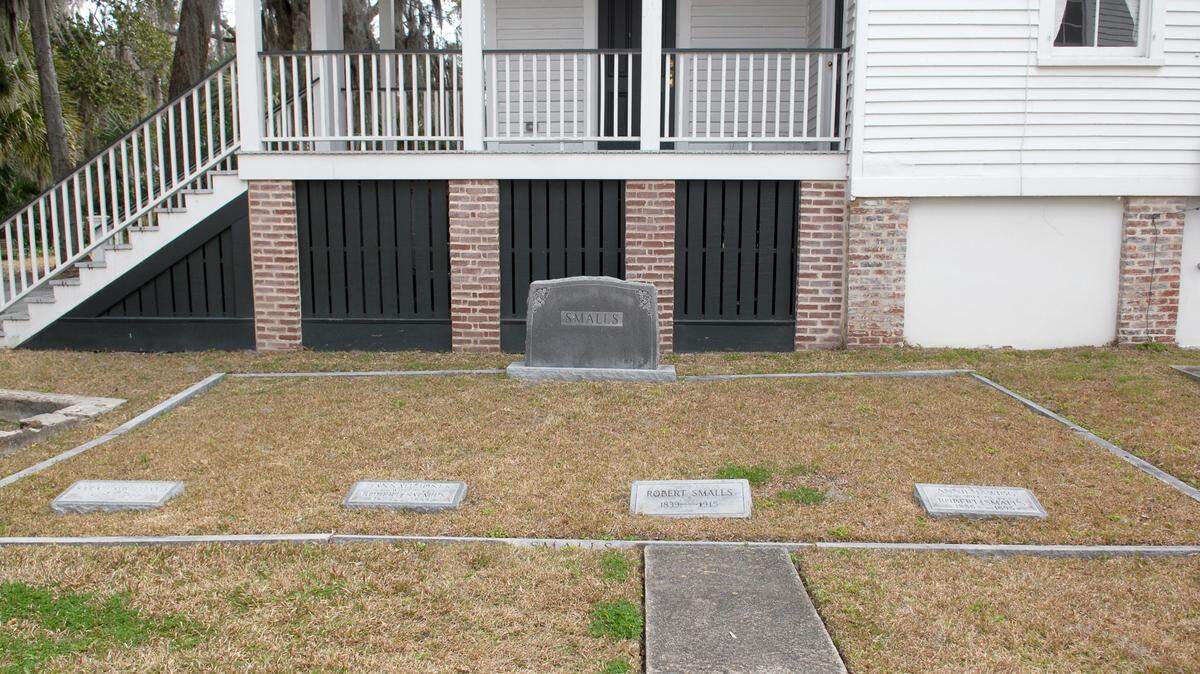
This large, two-story frame house on Beaufort's Prince Street was home to Union hero Robert Smalls when he was a slave in the 1840s and '50s.
Years after Smalls commandeered a Confederate ship during the Civil War, he became a state lawmaker, a U.S. congressman, and then in 1863, owner of the Prince Street home where he was born.
Smalls, who died 100 years ago this February, bought the property at a tax sale. He and his family lived there for about 90 years, at one point also caring for the family of Small's former master in the home.
The service also visited several other sites in northern Beaufort County, including:
Beaufort Arsenal Museum
Located on Craven Street in downtown Beaufort, the brick and tabby museum once was a headquarters of secession activity in Beaufort before the Civil War.
The Revolutionary-era arsenal was seized by Union soldiers in 1861, nine years after it had been rebuilt.
Emancipation Oak
Sea Island folklore says this centuries-old tree in Port Royal was the site of one of the first local recitations of the Emancipation Proclamation.
The spot where the tree stands is now on the campus of Naval Hospital Beaufort.
On Jan. 1, 1863, though, the land was called Camp Saxton, and was occupied by the 1st South Carolina Volunteers, the U.S. Army's first black regiment of the Civil War.
Records show newly freed slaves, along with free citizens, gathered there for an Emancipation Day celebration that included barrels of molasses, hundreds of loaves of bread and about a dozen roasted oxen.
Harriet Tubman Bridge
While abolitionist Harriet Tubman was best known for her work rescuing escaped slaves on the Underground Railroad, she also played a pivotal role in a local Union victory.
Tubman took part in a raid on Confederate troops at the Combahee River on June 2, 1863, helping Union forces free more than 750 slaves at several nearby plantations destroyed in the battle.
The bridge that now crosses the Combahee on U.S. 17 was renamed for Tubman in 2008.
Follow reporter Rebecca Lurye on Twitter at twitter.com/IPBG_Rebecca.
Related content:
- Robert Smalls: From Slave to Congressman, Feb. 22, 2015
This story was originally published June 7, 2015 at 5:02 PM with the headline "National effort to highlight Reconstruction begins in Beaufort."