
As gravestone's mystery revealed, former Beaufort slave's descendants connect through history
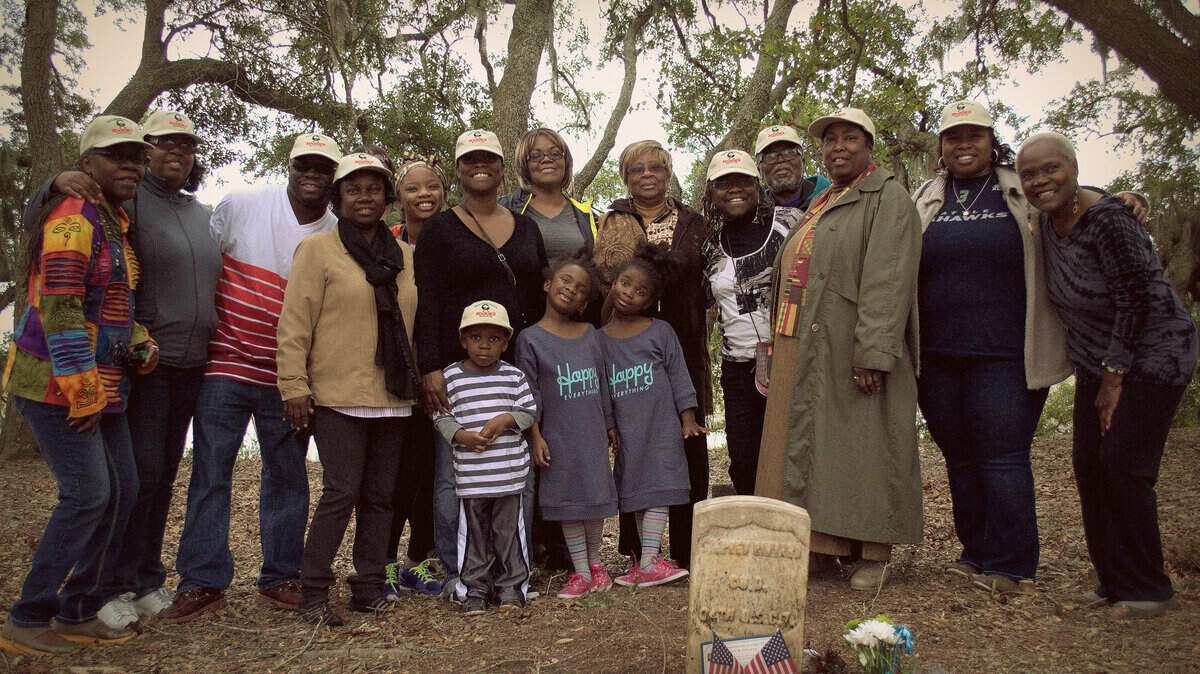
On a December morning in 1882, Stephen Binyard was at work at Duncan Wilson's lumber mill in Beaufort, loading timber planks onto boats bound for Bluffton, Savannah and Charleston.
Binyard was tall and slender and hardworking, earning fairly good wages at the mill, allowing him to support his wife and eight children at home. He was a former slave, but as a free man he had become a respected property owner in the area.
He toiled alone on the banks of the Beaufort River that morning, so when he fell overboard, no one saw.
Colleagues arrived at the mill that afternoon, and Binyard was nowhere to be found.
The next morning, his body washed up on the riverbank.
More than a century later, in 2004, Kimberly Morgan visited her boyfriend at the officer's barracks on Marine Corps Air Station Beaufort.
As usual, she parked on the back side of the building next to a dumpster, passing a heavily wooded area before knocking on his door.
As usual, she got a funny feeling while walking past the woods, as though someone was watching.
As usual, he told her she was crazy.
To prove that her suspicions were all in her head, he persuaded Morgan to traipse into the woods with him. They hacked through tangled vines and thick foliage that tugged at their ankles and clothing. Several hundred yards in, they came across a small tombstone.
Morgan recognized the simple, upright marble stone as military-issued. The white marble was dingy and yellow from neglect.
It had a two-line inscription: "Stephen Binyard, USCT."
"It was kind of sad," Morgan recalled.
"Why is he back here?" she thought. "Where is his family? What happened to him?"
"I immediately had to figure out why," she said.
AN UNLIKELY CONNECTION
Last Saturday, Morgan flitted nervously among a crowd at the St. Helena Public Library. She wore a red blazer over a colorful dress, her long blonde hair straight.
As attendees took their seats, she greeted and hugged as many as possible, then went to make sure the projector at the front of the room was ready for her Power Point presentation. She took her place behind the lectern, her hands shaking slightly.
Morgan had reason to be anxious. She was about to report her findings on Stephen Binyard to nearly 40 of his living descendants, many of whom had traveled long distances and were hearing their family history for the first time.
Ten years of research, hours upon hours in the library poring over microfilm and old books, and countless minutes digging through online records and newspaper articles had led Morgan to this day.
At her side was Akosua Moore, a school teacher from Atlanta and Stephen Binyard's great-great-great-grandniece. A shared interest in the Binyard history and an unlikely connection on Ancestry.com had brought them together.
The two women are not related, but Moore calls Morgan her sister. Before their presentation, they shared excited, knowing smiles.
Stephen Binyard was about to come back to life.
AN UNTIMELY DEATH
Stephen Binyard was born in 1840. His parents were James Binyard and Hannah Kelson, both slaves on Edgerly Plantation, where the air station is today.
Stephen Binyard grew up as a house servant, catering to the needs of Mary Givens, the plantation owner's wife.
After the Union Army occupied Beaufort in 1861 and President Lincoln's Emancipation Proclamation freed slaves in 1863, Binyard joined the United States Colored Troops as a free man. That's why his grave says "USCT."
He returned to Beaufort three years later and married his childhood sweetheart, Jane Henry.
Jane had lived on an adjoining plantation owned by the Talbird family. Binyard bought land on Edgerly, the plantation he had worked as a slave. He and Jane began their family.
After Binyard died about a week before Christmas in 1882, he was buried on his brother's nearby farm overlooking Brickyard Creek.
Jane was left with eight children to care for. She couldn't afford to buy them meat or bread. The man she had known since childhood and married at 18 was dead.
She was entitled to his military back pay and pension, but could not read or write to apply for it.
She found help in Thomas Talbird, the son of her former master. He was a lawyer and wrote up the paperwork and affidavits Jane needed, free of charge. She received about $500 and later moved to Augusta, Ga., where she died in 1922.
'SO I DID SOME MORE GOOGLING'
The amount of documentation that Morgan was able to dig up is unusual, especially because it involved a family of former slaves, who had less access to record-keeping than whites. But with curiosity, tenacity and help from Beaufort County librarian Grace Cordial, Morgan amassed a thick binder full of information, from property records to enlistment papers to obituaries.
When telling the Binyard story, Morgan speaks quickly, the facts tumbling out of her faster than she can flip through her binder for the matching document.
She describes the step-by-step process of finding information with phrases like, "So I did some more Googling ..." or "So I dug into more property records ..." or "I was on Ancestry.com, like I always am ..."
Binyard's story was one she couldn't let go of.
"Who doesn't love a good mystery?" she said. "The more you pick at it, the more it unravels."
There was a reason she got that feeling of being watched, she said. There was a reason she went into the woods with her boyfriend at the time (they later broke up) to find out what it was.
Another person might have come across the gravestone and thought it was interesting, even spooky, but not given it much more thought.
Not Morgan.
A Beaufort native, Morgan is the daughter of a police investigator, who took her and her brothers to Civil War battle sites as kids. She used to give buggy tours of historic Beaufort. She lived in Japan for several years, teaching English to Japanese senior citizens in Hiroshima.
While there, she threw herself into researching World War II history. She briefly became immersed in a story about a Japanese woman who had fallen in love with an American colonel.
When Morgan moved back to Beaufort in 2013, she resumed her research of Binyard. On the side she works part-time at the Port Royal Veterinary Hospital. And she fosters dogs. She'll tell you stories of the strays she has found homes for -- one begins, "I had this golden retriever whose owner was dying of cancer ..."
The helpful, mothering enthusiasm is the same in each tale. An unlikely love story. A lost dog. A lone grave.
WORKING PARALLEL
At the same time Morgan was hunting down documents, so was Akosua Moore, Binyard's great-great-great-grandniece.
Moore grew up hearing stories of the Lowcountry and her slave ancestors from her grandmother Rosalie, but had been unable to find many documents corroborating the information. That is, until one day in 2013, when Morgan found Moore on Ancestry.com.
Moore had posted on the site's message board, asking for any information about the Binyard family. Morgan saw it and wrote back explaining that, although she had no connection to the family, she had been researching the Binyards for years.
Moore cried from shock and happiness.
"I couldn't believe someone else was doing the same thing and wasn't even part of the family," she said. "We were working parallel for so long. I'm a math teacher, and I always say parallel lines don't intersect. But they did."
Moore quickly arranged a trip to Beaufort to meet Morgan. She stayed at Morgan's house and got a tour of Beaufort and pieces of her family's story that she never would have gotten otherwise. They visited Binyard's grave, which the Air Station had cleaned up, thanks to Morgan's cajoling and the work of MCAS Cultural Affairs Officer Gary Herndon. Crews had cleared the thick undergrowth and built a fence around the area. A sign commemorating the spot is also being made.
During the visit, Morgan showed Moore her binder full of documents. Moore pulled out her own binder full of information on the Finleys, from Stephen Binyard's sister's side of the family. The two women talked late into the night.
The stories Grandma Rosalie had told were true.
DESCENDANTS COME TOGETHER
At the St. Helena library, descendants of the Binyards and the Finleys sat next to descendants of the Talbirds.
Progeny of former slaves and masters gathered in the same room.
The atmosphere was charged with a sense of reunion and discovery. During the presentation, guests listened intently to Morgan and Moore, clapping whenever a family connection was made.
Afterward, people talked, hugged and exchanged contact information, intermingling with such exuberance that it was hard to hear.
Moore's mother walked around with a Ziploc bag full of tissues.
"Hey cousin!" one man shouted to a woman he had just met.
They both smiled.
Morgan was smiling, too.
The gathering of the families, she said, "made all of this work worth it."
Below the timeline: See the family tree that connects Stephen Binyard to Akosua Moore
Binyard family tree

Drew Martin/Staff graphic
This story was originally published February 27, 2015 at 12:29 PM with the headline "As gravestone's mystery revealed, former Beaufort slave's descendants connect through history."