
Special Olympics Invitational at Port Royal Golf Club features 7 from Lowcountry
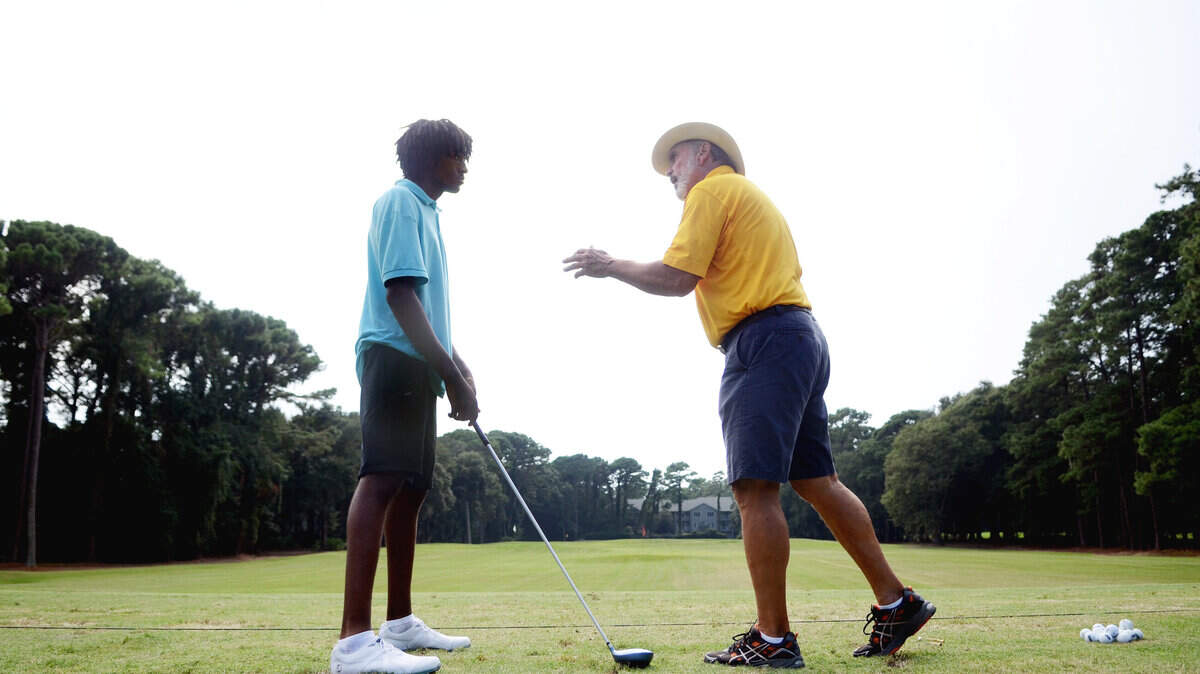
Meghan Witherly topped her iron shot, sending the ball skittering across Port Royal Golf Club's sixth fairway. From about 30 yards back, Doug Weaver's booming voice had a few words of reminder.
"When I look up ... " began Weaver, Palmetto Dunes' longtime teaching pro.
Witherly sighed. "The ball goes down," she said.
Locating her ball in the rough, she set up again with the same club and struck a low-arching shot that came to rest just off the edge of the green. She broke out a big grin.
So did Weaver. "They know it," he said. "Now it's up to them to do it."
Witherly is one of seven Lowcountry entrants at this weekend's Special Olympics North America Golf Invitational, where Port Royal is hosting more than 220 golfers drawn from Special Olympics programs across the U.S. and Canada. Now in its 15th year, the event is making its first visit to this golf hotspot.
If all goes well, it could be a recurring thing.
"That's our goal: to do a great job, so they'll want to keep doing it with us," said Kathy Cramer, Hilton Head Island's SOAR program director.
Competition is spread over three days, offering five levels of ability. Level I simply tests individual skills such as driving, chipping and putting, without actually venturing out on the golf course. Others feature an alternate-shot format with a "unified" partner of regular ability, all the way up to standard 18-hole stroke play.
Two months ago, South Carolina's Scott Rohrer (Clover) set a Special Olympics record with a 66 during the World Games in Los Angeles. He'll also be competing at Port Royal. So will Hilton Head's Chris McPherson, who won a silver medal five years ago when the invitational was held in Nebraska.
"Hopefully he gets something this year," said Weaver, who has worked with McPherson since welcoming some of Cramer's students to his youth clinics seven years ago.
"Christopher wouldn't look at you" at first, Weaver said. "No confidence, felt totally out of place. Not a mean bone in his body; he'd just probably never been exposed much to the (outside) world. Now it's amazing the person he is. ... It's a great example of a tree blossoming. Not that he's a great golfer, but what it's done. He can now hold a job; he can interact with customers. It's really exciting."
As it is for the adult volunteers who assist the Special Olympians on a one-on-one basis.
"They've got a great attitude about life," said Dave McDonald, a retired jet engineer who works part time at Palmetto Dunes. "Nothing really bothers them too long. If they hit a bad shot, it's no big deal. If they hit a great shot, it's a big deal because I'm cheering."
As with anyone who's on his lesson tee, Weaver builds his instruction on establishing routine, with only slight variations to help make the process easy to remember.
"They can pretty much sing three different songs," he said.
Or perhaps three verses of the same song, all broken into three steps. For putting: Aim your club, aim your feet, tick-tock -- representing the motion of taking the putter back and striking the ball.
"That gives them instruction, rhythm and focus," Weaver said.
Chipping isn't much different: Aim your club, aim your feet, "potato chip" -- suggesting a longer takeaway. A full swing can have different endings based on the student -- "squash the bug" or "kiss your knees" to get the right knee to pivot toward the left. Or simply "turn-turn."
Into all this, Weaver mixes other golf aphorisms. When you look up, the ball goes down. Putt with your shoulders, not your arms. Slow (i.e. backswing) is fast.
"They all know it," Weaver said. "Now they're human, and sometimes they want to go back to what's easy. You've got to tell them, 'Hey, do the routine.' 'OK, coach.' It's process-oriented thinking."
In that sense, it's not much different than what Jason Day does before crushing a 330-yard drive. Or RBC Heritage champion Jim Furyk lining up a putt.
Weaver actually developed his methods years ago with his own now-grown daughter. "She would hit the ball and chase it like a hockey player," he recalled.
"I'm telling her stop -- 'No, Dad, I don't want to stop. I want to hit the ball. Let's go to the next hole.' So I had to build a program that would make her -- and my son and other juniors over the years -- get into the golf rhythm."
It doesn't hurt that these Special Olympians are proficient in other sports. McPherson and Rashawn Young were part of a kayak team that won the overall title at last month's state championships. Young and Robert Seignicious have competed at the World Games in equestrian. Kayanna Simmons, Steve Cole, Wallace Gamble and others have competed in tennis.
Witherly, in fact, came away with two tennis medals at the World Games at UCLA -- a gold in doubles and bronze in singles. "My brother even said (I should) get a sponsor," she said.
Though she took up golf only about six months ago, she quickly found a co-favorite.
"Her first time on the course, she was excited," said her mother, Karen Johnson. "I think she likes them equally now. She's just real excited to have this opportunity."
WANT TO HELP?
http://bit.do/sonagolfvolunteer
Follow golf writer Jeff Shain at twitter.com/JeffShain.
This story was originally published September 9, 2015 at 8:08 PM with the headline "Special Olympics Invitational at Port Royal Golf Club features 7 from Lowcountry."