
McMillan: Lowcountry dragonflies feel the need for speed
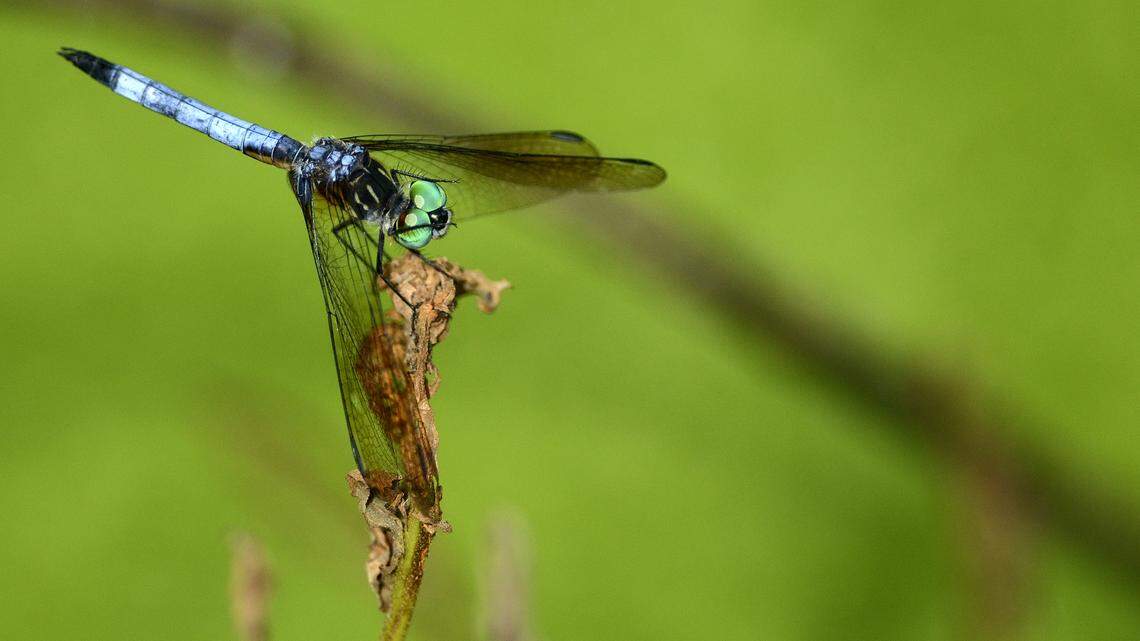
Summer may be drawing to an end, but dragonflies and damselflies are still going full steam.
They're easy to spot at our lagoons -- perching, gliding, chasing one another at top speed, and hovering like miniature helicopters.
Dragonflies and damselflies belong to the ancient insect group Odonata, which comprises over 5,000 species worldwide. About 150 kinds are found in South Carolina.
Contrary to myth, none have stingers and none will bite you - unless, like a mosquito, you're small enough to eat.
Damselflies look like flying pipe-cleaners with delicate bodies and boxlike, rectangular heads. Dragonflies tend to be larger and more robust.
Another difference is that most damselflies perch with their wings folded over their backs, whereas dragonflies hold their wings outstretched.
In the air, both are unparalleled flying machines, able to move up, down, forward, backwards, even sideways. Some dragonflies have been clocked at speeds over 35 mph.
Both dragonflies and damselflies hatch from eggs laid in freshwater or in aquatic plants. For several weeks or longer, they live as wingless larvae that crawl or scuttle across bottom sediments, seizing tiny prey with a hooked, hinged lower lip. Larger species can catch tadpoles and fish.
Once fully grown, the larvae climb out of the water, shed their hard outer "skins," and morph into winged adults. Until their wet, soft wings dry and harden, they're vulnerable to birds and other predators. After a week or so of feeding away from water, they become sexually mature and return to ponds, lagoons, and streams, where their focus is not food but reproduction.
In some species, males stake out individual breeding territories along the shoreline, patrolling the borders and chasing off rivals. In others, males patrol tirelessly back and forth over large areas, looking for mates.
Females make only brief appearances -- just long enough to mate and lay their eggs.
Adults usually live just a few weeks. Late-summer dragonflies eventually die off once temperatures fall, while their offspring overwinter as developing eggs or larvae. They'll emerge the following spring.
Adults of few dragonfly species, though, migrate southward from the Lowcountry in the fall, sometimes in swarms. Their descendents -- perhaps several generations removed -- will appear here in the spring. The behavior of these dragonfly migrants is still poorly understood.
Vicky McMillan, a retired biologist formerly at Colgate University, lives on Hilton Head Island.
This story was originally published September 5, 2015 at 12:55 PM with the headline "McMillan: Lowcountry dragonflies feel the need for speed."