What Hornets owner Michael Jordan misses from simpler days at North Carolina
Michael Jordan sounded Thursday like he misses a simpler time back in Chapel Hill, when he was asking his mother to send stamps to keep down a college student’s phone bill.
Jordan, a five-time NBA most valuable player and Charlotte Hornets owner, doesn’t do a lot of interviews. Thursday, he appeared on ABC’s Good Morning America to promote “The Last Dance,” ESPN”s multi-part documentary on the Chicago Bulls that begins Sunday.
GMA host Robin Roberts didn’t ask Jordan during the eight-minute interview about the NBA discontinuing its season, due to the pandemic, or his decade owning an NBA team.
He did speak sentimentally about his brother, Larry, now the Hornets’ director of player personnel, being crucial to Michael making it to the NBA and his time at North Carolina in the early 1980s being so less technology-driven.
“I had a phone bill that was probably $60 or a little less, and I only had $20 in my account,” said Jordan, now a billionaire. “My kids laugh about it when they see it, but we used postage stamps back in those days (to communicate). I had to ask my mom to send me postage stamps.
“Life was this way: We didn’t have Instagram, we didn’t have Twitter. You had to live life as it came. Each day you preciously protected it and you learned. Spending time with friends and family. It wasn’t via the phone. It was actually in (their) presence. And you wrote letters.”
Jordan said his mom kept all those letters from college, and while reading them can be embarrassing, it’s also refreshing as he lives in Florida, one of 30 primary owners of NBA franchises.
Jordan says during the ESPN documentary that the buzzer-beater he made in 1982 to win the national championship turned him from “Mike” Jordan — known only in college basketball circles — to a national figure.
“Up until that point, no one knew who I was,” Jordan said. “When I hit that shot, my whole name became ‘Michael Jordan.’ It resonated with a lot of people outside UNC.”
Family influences
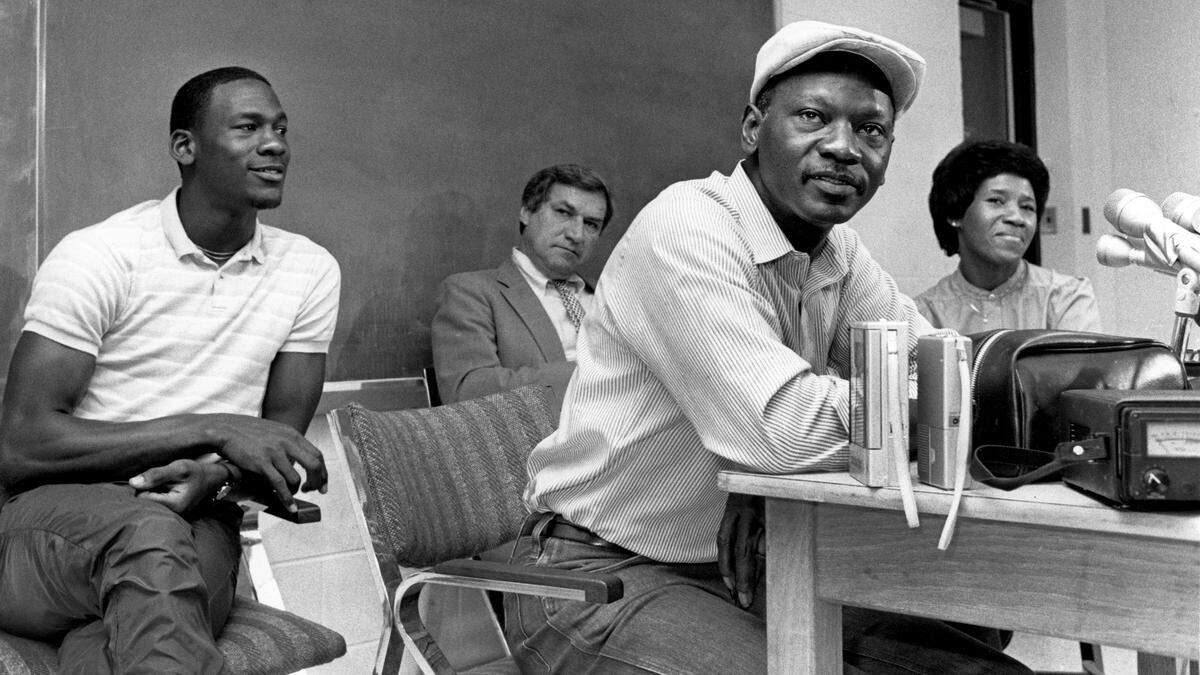
Jordan talked about the perseverance and problem-solving skills he learned from his mother, Deloris, and father, James, as they both worked various jobs to raise a family of five children in Wilmington. He particularly appreciates what he got from older brother Larry for pushing him so hard growing up.
“I wouldn’t be here if it wasn’t for my brother, Larry. Larry pushed me. We used to fight after every game,” Jordan said. “Through that fight, it emerged someone like me. He supports me. He works for me and the team. And I would have never gotten this far without him.”
Risk/Reward
The 10-part “Last Dance” documentary focuses on the 1997-98 Chicago Bulls, the final title run for a team built around Jordan and Scottie Pippen. Coach Phil Jackson had been informed before the season by Bulls general manager Jerry Krause that he wouldn’t be retained regardless of that season’s outcome.
Jordan said he wouldn’t stay with the Bulls without Jackson.
“I married myself to him. If he isn’t coach, I wasn’t coming back,” Jordan said in the GMA interview.
Jordan is well known for being a risk-taker. He was asked about an anecdote in “The Last Dance” when he injured himself in his second NBA season, playing just 18 seasons, and a debate he had with Bulls owner Jerry Reinsdorf about his determination to come back that season.
Jordan broke his left foot early that season. Doctors advised that will there was only 10 percent chance of re-injury if Jordan came back that year, but such a re-injury could be career-ending.
In arguing for him not to play, Reinsdorf made a headache analogy: If Jordan was given 10 pills for a splitting headache, and nine would end the headache, but one could kill him, would he take a pill?
“It depends how (expletive) bad the headache is,” Jordan replied with a laugh.
This story was originally published April 16, 2020 at 9:01 AM with the headline "What Hornets owner Michael Jordan misses from simpler days at North Carolina."